The Death of Carloman and the Rise of Pepin the Short
747 · Vienne, Frankish Kingdom
The death of Carloman, the Frankish mayor of the palace of Austrasia, occurs, leading to the consolidation of power by his brother Pepin the Short.
December 16, 0714
Pepin of Herstal, the Frankish mayor of the palace of Austrasia, dies. His death leads to a power struggle in the Frankish kingdom.
Jupille-sur-Meuse, Frankish Kingdom | Frankish Kingdom
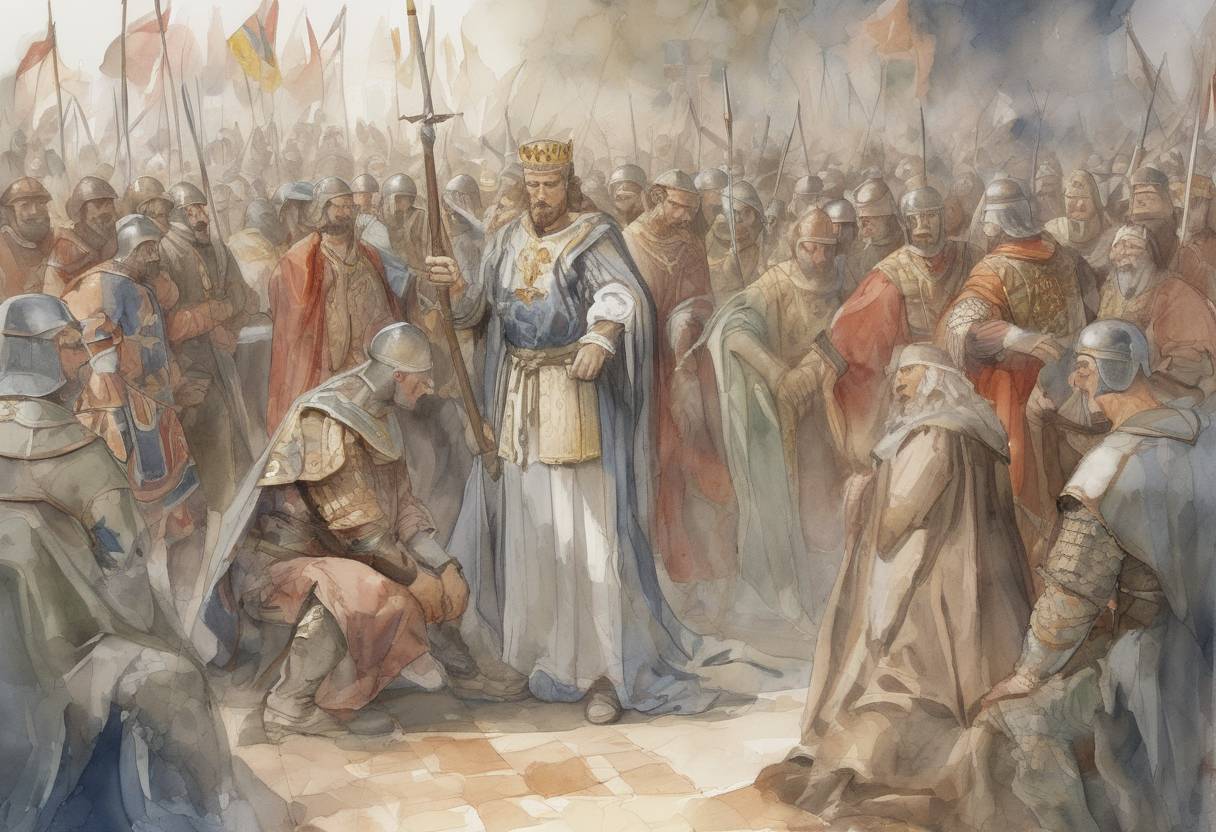
On December 16, 714, Pepin of Herstal, the Frankish Mayor of the Palace of Austrasia, passed away. His death marked a significant turning point in the history of the Frankish kingdoms, leading to a period of instability and power struggles that would eventually pave the way for the rise of the Carolingian dynasty.
Pepin of Herstal, also known as Pepin II, was a prominent figure in the late Merovingian period. Born around 635, he was a member of the powerful Arnulfing family, which later became known as the Carolingians. As the Mayor of the Palace, Pepin effectively held the real power behind the throne, as the Merovingian kings had become largely ceremonial figures by this time.
Pepin’s tenure as Mayor of the Palace began in 680, and he successfully consolidated power over the Frankish territories. He achieved this through a combination of military prowess, strategic marriages, and alliances. His victory at the Battle of Tertry in 687 was particularly significant, as it allowed him to extend his influence over Neustria and Burgundy, unifying much of the Frankish realm under his control.
Pepin’s death in 714 left a power vacuum that led to a struggle for control over the Frankish territories. At the time of his death, Pepin’s legitimate heirs were not in a strong position to succeed him. His eldest son, Drogo, had died in 708, and his other son, Grimoald, was assassinated in 714, just before Pepin’s death.
This left Pepin’s grandson, Theudoald, as his designated heir. However, Theudoald was only a child, and his position was contested by other members of the Frankish nobility. Pepin’s widow, Plectrude, attempted to secure Theudoald’s position, but her efforts were met with resistance.
The power struggle that ensued following Pepin’s death eventually led to the rise of Charles Martel, an illegitimate son of Pepin. Charles, who had been imprisoned by Plectrude, escaped and began to rally support among the Frankish nobility and military.
By 718, Charles had defeated his rivals and established himself as the de facto ruler of the Frankish kingdoms. His leadership was marked by a series of military campaigns that expanded and secured Frankish territories. Charles Martel’s victory at the Battle of Tours in 732 was particularly significant, as it halted the advance of Muslim forces into Western Europe.
The death of Pepin of Herstal and the subsequent power struggle were crucial in shaping the future of the Frankish kingdoms. The rise of Charles Martel laid the groundwork for the establishment of the Carolingian dynasty, which would reach its zenith under his grandson, Charlemagne. The Carolingians would go on to play a pivotal role in the formation of medieval Europe, influencing the political and cultural landscape for centuries to come.
Source: en.wikipedia.org