United States Forces Land in Cuba - June 22, 1898
1898 · Daiquirí, Cuba
During the Spanish-American War, the United States forces land in Cuba.
July 25, 1898
During the Spanish-American War, U.S. forces, led by General Nelson A. Miles, invaded Puerto Rico, beginning the island's transition from Spanish to American control.
Guánica, Puerto Rico | United States Army
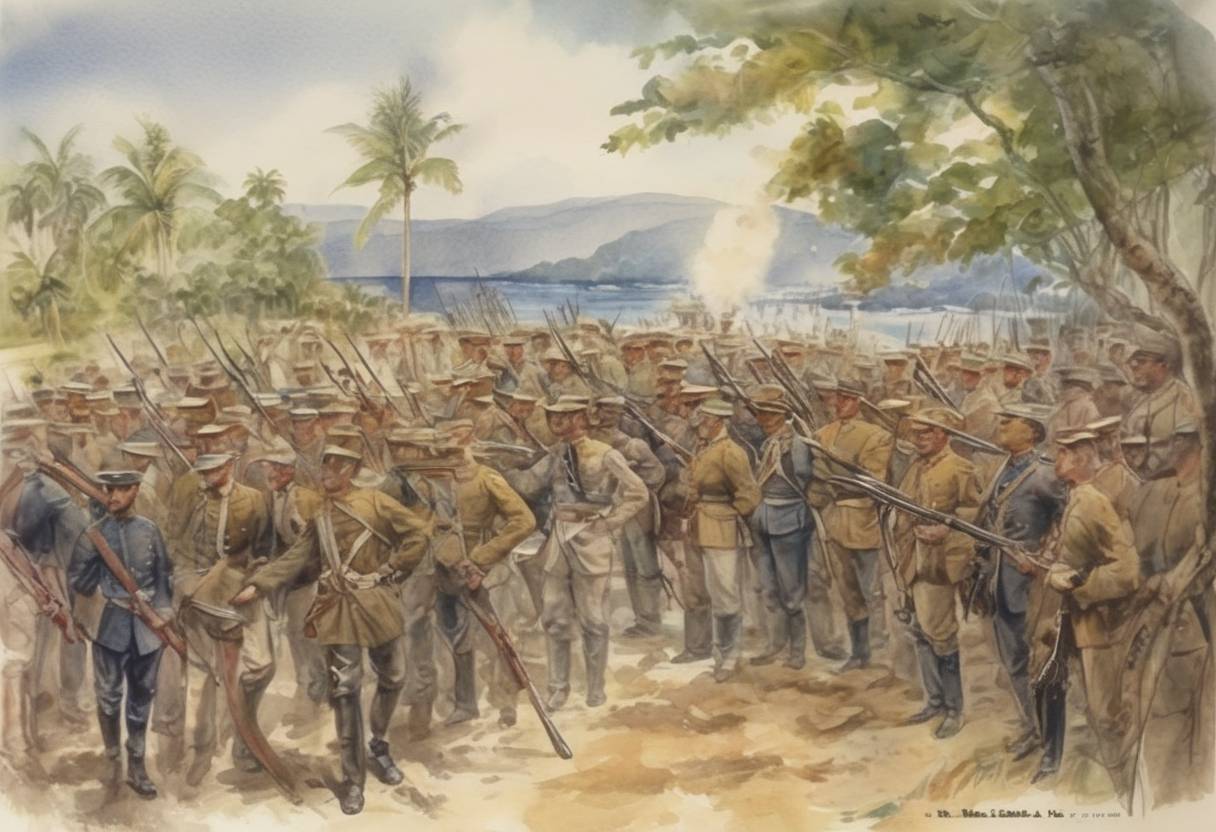
On July 25, 1898, during the Spanish-American War, U.S. forces led by General Nelson A. Miles landed at Guánica, Puerto Rico, marking the beginning of the island’s transition from Spanish to American control. This event was a significant moment in the brief but impactful conflict between the United States and Spain, which ultimately reshaped the geopolitical landscape of the Caribbean and the Pacific.
The Spanish-American War was primarily triggered by the Cuban struggle for independence from Spain, which garnered significant sympathy in the United States. The explosion of the USS Maine in Havana Harbor on February 15, 1898, further inflamed public opinion and led to the U.S. declaring war on Spain in April 1898.
Puerto Rico, like Cuba, was one of Spain’s last remaining colonies in the Americas. The U.S. saw strategic value in capturing Puerto Rico, both as a means to weaken Spanish influence in the region and to establish a stronger American presence in the Caribbean.
General Nelson A. Miles, a seasoned military leader, was tasked with leading the invasion of Puerto Rico. On July 25, 1898, his forces landed at the southern port of Guánica, encountering minimal resistance from Spanish troops. The choice of Guánica was strategic, as it allowed the U.S. forces to avoid the heavily fortified northern coast and the capital, San Juan.
The U.S. troops quickly advanced inland, capturing several key towns and cities, including Ponce, with relative ease. The local population, weary of Spanish colonial rule, largely welcomed the American forces, which facilitated the rapid U.S. advance across the island.
The invasion of Puerto Rico was part of a broader American military campaign that saw the U.S. achieve decisive victories in both the Caribbean and the Pacific. The war officially ended with the signing of the Treaty of Paris on December 10, 1898, which resulted in Spain ceding Puerto Rico, Guam, and the Philippines to the United States.
The transition of Puerto Rico from Spanish to American control marked the beginning of a new chapter in the island’s history. Under U.S. rule, Puerto Rico underwent significant political, economic, and social changes. In 1917, Puerto Ricans were granted U.S. citizenship, and in 1952, the island became a U.S. Commonwealth, a status it retains to this day.
The invasion of Puerto Rico and the subsequent Treaty of Paris signaled the emergence of the United States as a global power with overseas territories. This expansionist policy, often referred to as “American imperialism,” had lasting implications for U.S. foreign policy and its role on the world stage.
The events of July 25, 1898, are a pivotal moment in Puerto Rican history, shaping the island’s identity and its complex relationship with the United States. The legacy of this period continues to influence discussions about Puerto Rico’s political status and its future.
Source: en.wikipedia.org