Founding of The Royal Astronomical Society
1820 · London, United Kingdom
The Royal Astronomical Society was founded in London.
June 14, 1822
Charles Babbage proposes a difference engine in a paper to the Royal Astronomical Society.
London, United Kingdom | Royal Astronomical Society
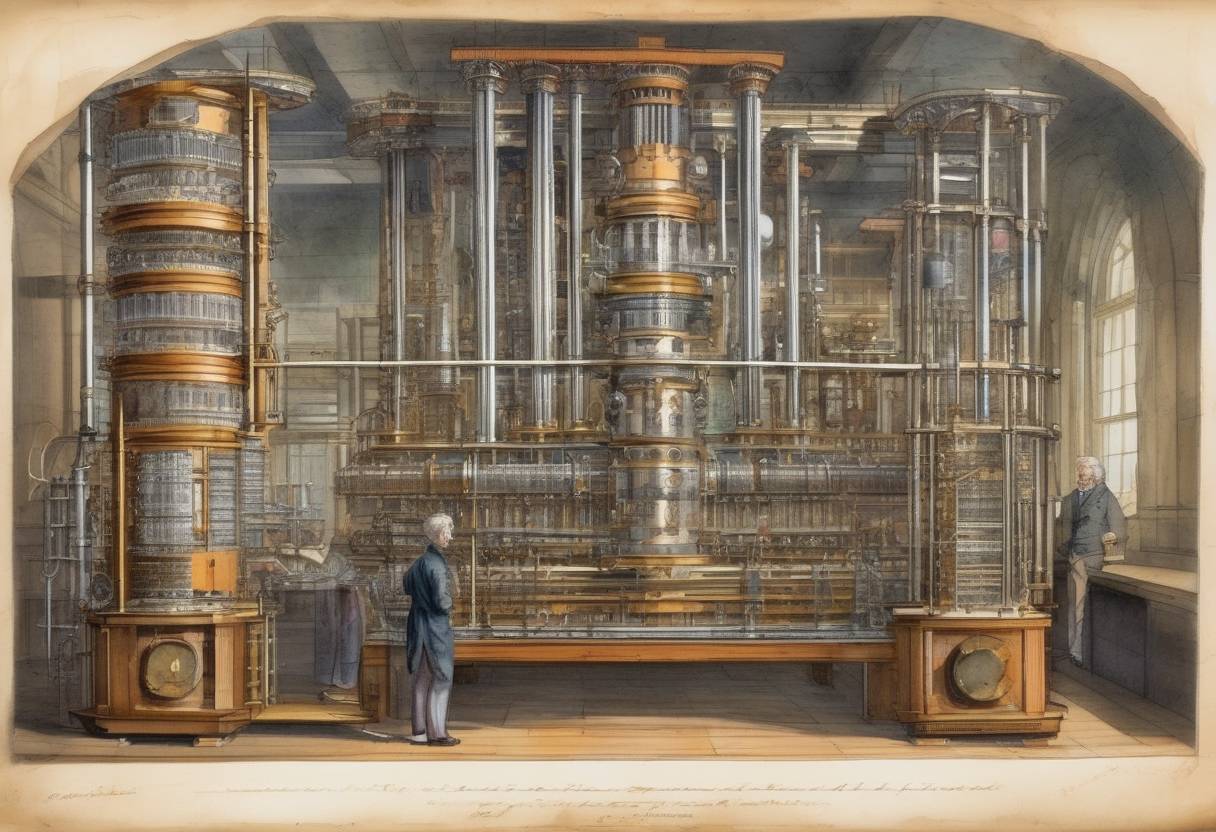
On June 14, 1822, Charles Babbage presented a groundbreaking paper to the Royal Astronomical Society titled “Note on the application of machinery to the computation of astronomical and mathematical tables.” In this paper, Babbage proposed the concept of the Difference Engine, a mechanical device designed to automate the process of calculating polynomial functions, which was a significant advancement in computational technology.
During the early 19th century, the production of mathematical tables was a labor-intensive process prone to human error. These tables were essential for navigation, engineering, and astronomy. Babbage, a mathematician and inventor, recognized the potential for machinery to improve the accuracy and efficiency of these calculations.
Babbage’s Difference Engine was designed to compute values of polynomial functions using the method of finite differences, which eliminates the need for multiplication and division. The engine was to be powered by a hand crank and consisted of a series of gears and levers that could perform calculations automatically.
Babbage’s proposal marked a significant milestone in the history of computing. Although the Difference Engine was never completed during his lifetime due to technical and financial challenges, the concept laid the groundwork for future developments in computational machinery.
Despite the challenges in constructing the Difference Engine, Babbage continued to refine his ideas, eventually conceptualizing the more advanced Analytical Engine. This later design included features such as a control unit and memory, which are fundamental components of modern computers.
In summary, Charles Babbage’s proposal of the Difference Engine on June 14, 1822, was a pivotal moment in the evolution of computing technology. It showcased the potential of machines to perform complex calculations and set the stage for the development of future computational devices.
Source: en.wikipedia.org