Assassination of Didius Julianus: June 1, 193
193 · Rome, Roman Empire
Didius Julianus, Roman Emperor, is assassinated in Rome by order of the Senate.
March 22, 0238
Gordian I and his son Gordian II are proclaimed Roman Emperors by the Senate, marking the beginning of the Year of the Six Emperors.
Rome, Roman Empire | Roman Senate
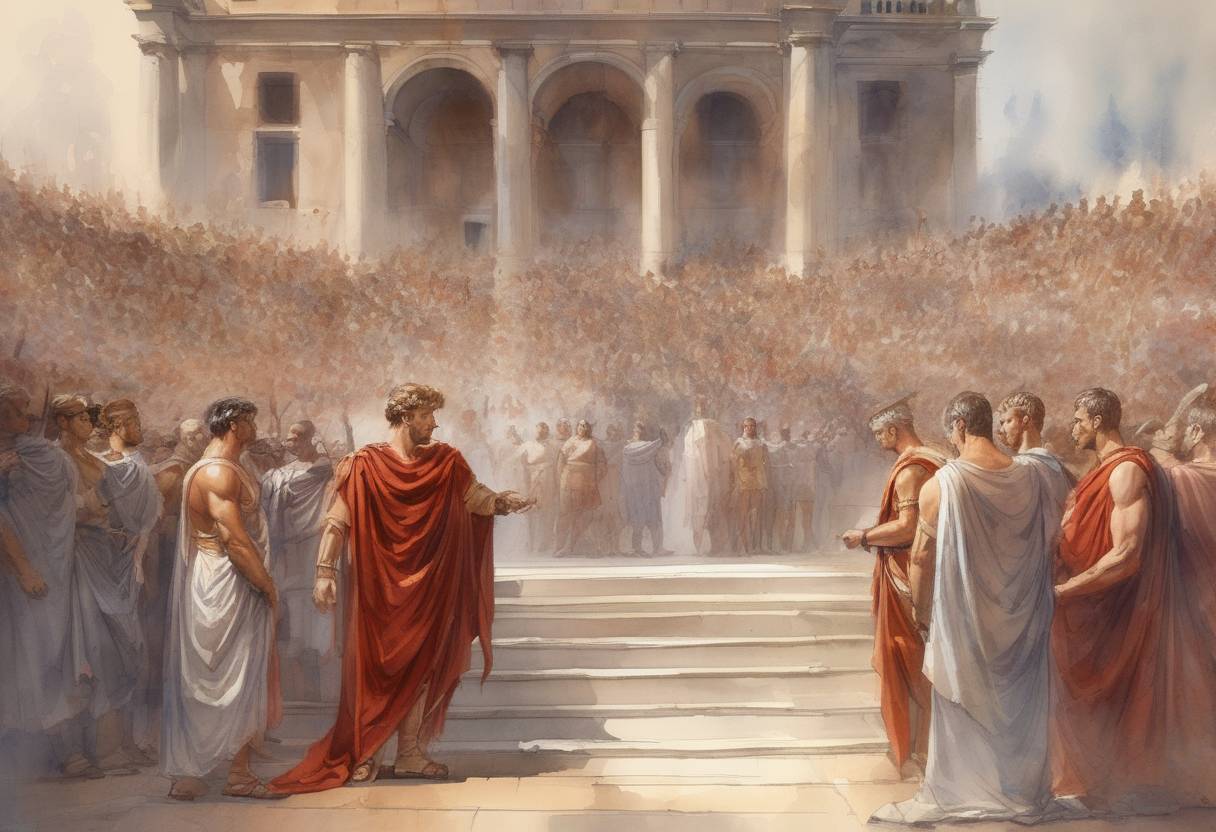
On March 22, 238 CE, a significant event unfolded in the Roman Empire that marked the beginning of a tumultuous period known as the “Year of the Six Emperors.” On this day, Gordian I and his son Gordian II were proclaimed Roman Emperors by the Senate, setting off a chain of events that would lead to a rapid succession of rulers within the same year.
The Roman Empire in the early 3rd century was characterized by political instability and economic difficulties. The reign of Emperor Maximinus Thrax, who had ascended to power in 235 CE, was particularly unpopular among the Roman Senate and the aristocracy. Maximinus was a soldier-emperor who had risen through the ranks of the military, and his rule was marked by heavy taxation and military campaigns that strained the empire’s resources.
Gordian I, whose full name was Marcus Antonius Gordianus Sempronianus Romanus Africanus, was a respected senator and a proconsul of Africa. He was well-regarded for his administrative skills and his lineage, which connected him to the Roman aristocracy. His son, Gordian II, shared his father’s political ambitions and was also a prominent figure in Roman society.
The catalyst for their rise to power was a revolt in the province of Africa. The local landowners, burdened by Maximinus’ oppressive policies, supported Gordian I as a more favorable alternative. The revolt quickly gained momentum, and the Senate, eager to replace Maximinus, endorsed Gordian I and Gordian II as co-emperors.
Despite the initial support, the reign of Gordian I and Gordian II was short-lived. Their rule lasted only 22 days. The decisive moment came when Capelianus, the governor of Numidia and a loyalist to Maximinus, marched against them with a well-trained army. The forces of Gordian II were defeated in the Battle of Carthage, where he was killed. Upon hearing of his son’s death and the defeat, Gordian I took his own life.
The deaths of Gordian I and II did not resolve the crisis. Instead, it led to further instability, as the Senate quickly moved to appoint new emperors, Balbinus and Pupienus, to continue the opposition against Maximinus. This period of rapid succession and civil strife continued until the eventual rise of Gordian III, the grandson of Gordian I, who would bring a measure of stability to the empire.
The proclamation of Gordian I and Gordian II as emperors is a notable example of the political volatility of the Roman Empire during the 3rd century. It highlights the power struggles between the Senate, the military, and provincial authorities. The Year of the Six Emperors underscores the challenges of maintaining a vast empire with diverse interests and the constant threat of usurpation and rebellion.
This period also illustrates the Senate’s attempts to reassert its influence over the imperial succession, a struggle that would continue to shape the dynamics of Roman politics in the years to come.
Source: en.wikipedia.org