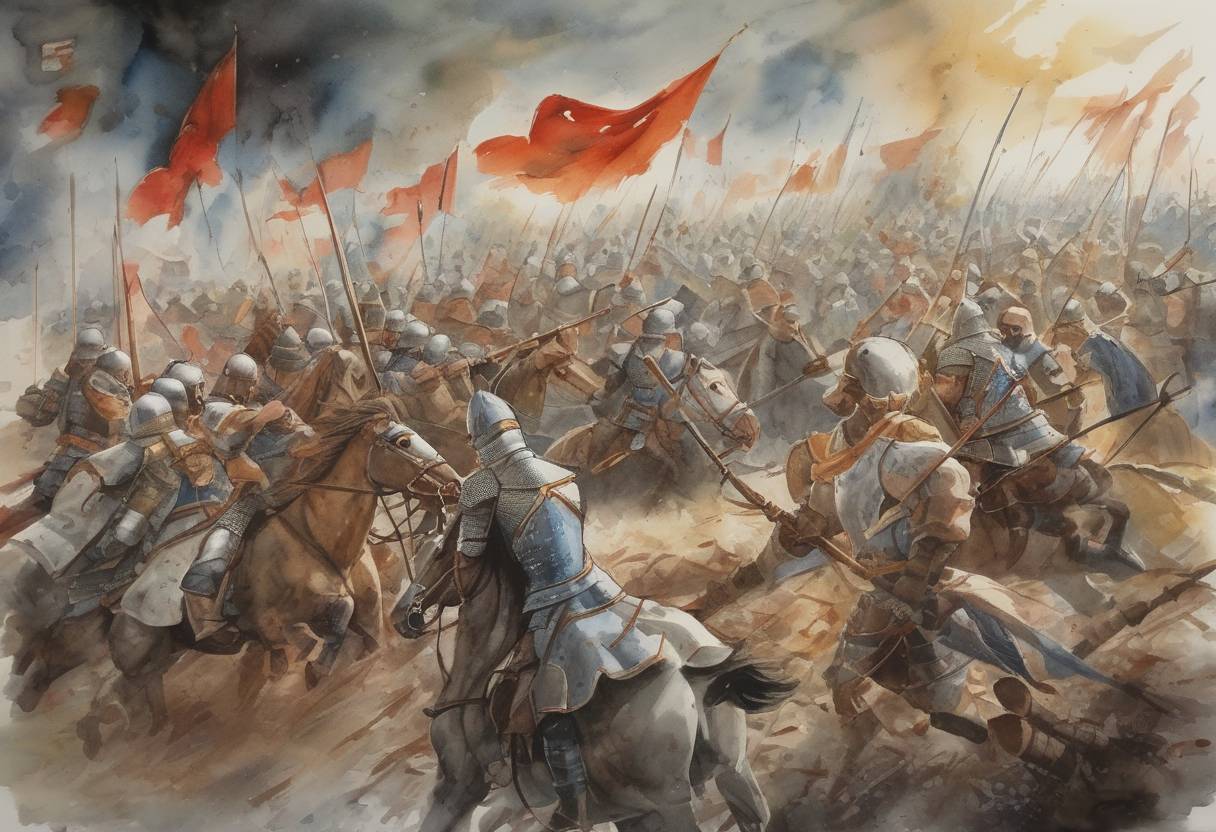
The Battle of Liegnitz: April 9, 1241
The Battle of Liegnitz, also known as the Battle of Legnica, was a significant military engagement that took place on April 9, 1241. It was part of the Mongol invasions of Europe, a series of campaigns initiated by the Mongol Empire to expand its territories into the European continent. This battle saw the Mongol forces, led by Baidar, Kadan, and Orda Khan, decisively defeat a coalition of European knights.
Context and Prelude
The Mongol Empire, under the leadership of Genghis Khan and his successors, had rapidly expanded across Asia and into Eastern Europe. By the early 13th century, the Mongols had already conquered vast territories, including parts of Russia. The invasion of Europe was part of a broader strategy to secure the western frontiers of the Mongol Empire.
In 1241, the Mongols launched a two-pronged invasion into Europe. One force moved into Hungary, while another, led by Baidar, Kadan, and Orda Khan, advanced into Poland. The aim was to prevent European forces from uniting against the Mongols and to create a diversion for the main Mongol army attacking Hungary.
The Battle
The European coalition at Liegnitz was composed of Polish, Moravian, and German troops, led by Henry II the Pious, Duke of Silesia. The European forces were a mix of knights and infantry, hastily assembled to counter the Mongol threat. Despite their efforts, the European forces were outmatched by the Mongols’ superior tactics and mobility.
The battle took place near the town of Liegnitz (modern-day Legnica in Poland). The Mongols employed their typical strategies of feigned retreats and encirclement, which confused and disorganized the European forces. The Mongol cavalry, renowned for its speed and archery skills, proved devastating against the heavily armored European knights.
Aftermath and Consequences
The defeat at Liegnitz was a significant blow to the European defenders. Duke Henry II was killed in the battle, and the Mongols reportedly collected nine sacks of ears from the fallen European soldiers as a grim tally of their victory. However, the Mongols did not press further into Central Europe immediately after the battle. Instead, they turned south to join the main Mongol army in Hungary.
The Battle of Liegnitz demonstrated the effectiveness of Mongol military tactics and highlighted the vulnerability of European armies to these strategies. It also served as a wake-up call for European leaders, who realized the need for better coordination and defense against the Mongol threat.
Despite their victory, the Mongols did not establish a lasting presence in Central Europe. The sudden death of the Great Khan Ögedei in December 1241 prompted the Mongol leaders to return to Mongolia to participate in the election of a new Khan, effectively halting their European campaign.
Broader Historical Significance
The Battle of Liegnitz is remembered as a pivotal moment in the Mongol invasions of Europe. It underscored the reach and power of the Mongol Empire at its height and the challenges faced by European powers in defending against such a formidable adversary. The battle also contributed to the mythos of Mongol invincibility, which persisted in European consciousness for years to come.