The Union of Lublin: Formation of the Polish-Lithuanian Commonwealth
1569 · Lublin, Poland
The Union of Lublin is signed, merging the Kingdom of Poland and the Grand Duchy of Lithuania into the Polish-Lithuanian Commonwealth.
July 15, 1410
The Battle of Grunwald (also known as the Battle of Tannenberg) takes place, where the Polish-Lithuanian alliance decisively defeats the Teutonic Knights, marking a turning point in the power dynamics of Eastern Europe.
Grunwald, Kingdom of Poland (modern-day Poland) | Polish-Lithuanian alliance
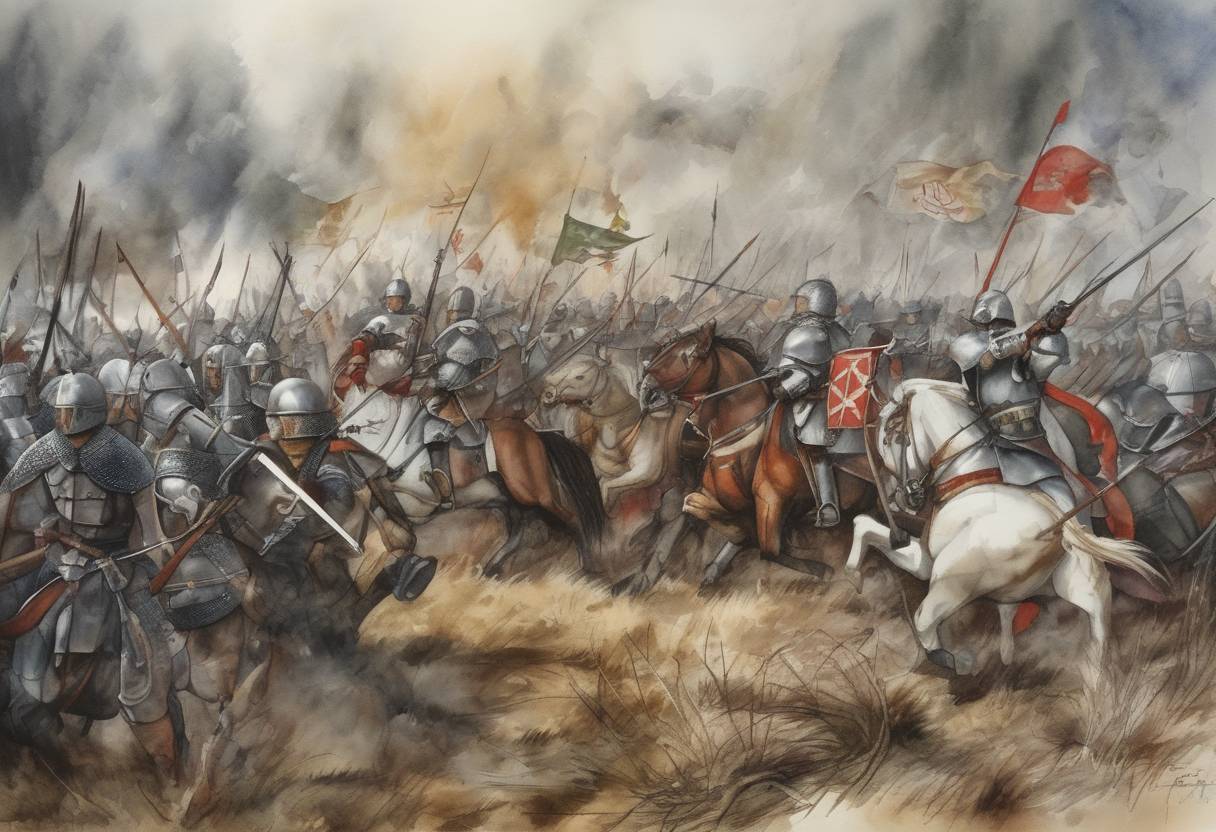
The Battle of Grunwald, also known as the Battle of Tannenberg, was a pivotal conflict that occurred on July 15, 1410. This battle marked a significant turning point in the power dynamics of Eastern Europe, involving a decisive victory for the Polish-Lithuanian alliance over the Teutonic Knights.
The conflict was rooted in territorial disputes and the expansionist policies of the Teutonic Knights, a powerful military order that had established a monastic state in the Baltic region. The Knights sought to expand their influence, often clashing with neighboring states, including the Kingdom of Poland and the Grand Duchy of Lithuania.
Polish-Lithuanian Union: The alliance between Poland and Lithuania was formalized through the Union of Krewo in 1385, which was further solidified by the marriage of Polish Queen Jadwiga and Lithuanian Grand Duke Jogaila (who became King Władysław II Jagiełło of Poland). This union was crucial in presenting a united front against the Teutonic Knights.
Rising Tensions: The Knights’ aggressive campaigns and territorial ambitions led to increased tensions with their neighbors. The Polish-Lithuanian alliance sought to curb the Knights’ power and reclaim lands lost to them.
The battle took place near the villages of Grunwald, Tannenberg, and Ludwigsdorf in present-day Poland. It was one of the largest battles in medieval Europe, involving tens of thousands of troops.
Forces Involved: The Polish-Lithuanian alliance, commanded by King Władysław II Jagiełło and Grand Duke Vytautas, fielded a diverse army composed of Polish, Lithuanian, Ruthenian, Czech, and Tatar forces. The Teutonic Knights, led by Grand Master Ulrich von Jungingen, were supported by knights from across Europe.
Battle Tactics: The battle began with a series of skirmishes, but the Polish-Lithuanian forces eventually gained the upper hand through superior tactics and coordination. The Knights’ heavily armored cavalry was effectively countered by the more mobile and diverse allied forces.
Outcome: The battle ended in a decisive victory for the Polish-Lithuanian alliance. Grand Master Ulrich von Jungingen and many of the Teutonic Knights’ leaders were killed, leading to a significant loss of manpower and morale for the order.
The victory at Grunwald had far-reaching consequences for the region:
Decline of the Teutonic Order: The defeat marked the beginning of the decline of the Teutonic Knights as a dominant military and political power in Eastern Europe. They were forced to cede territory and pay reparations in subsequent treaties, notably the Peace of Thorn in 1411.
Strengthening of the Polish-Lithuanian Union: The battle solidified the Polish-Lithuanian alliance, enhancing its political and military influence in the region. It paved the way for the eventual formation of the Polish-Lithuanian Commonwealth in the 16th century.
Cultural Impact: The victory at Grunwald became a symbol of national pride and resistance against foreign domination for both Poles and Lithuanians. It is celebrated in literature, art, and folklore.
In conclusion, the Battle of Grunwald was a landmark event that reshaped the political landscape of Eastern Europe, weakening the Teutonic Knights and strengthening the Polish-Lithuanian alliance, with lasting historical and cultural significance.
Source: en.wikipedia.org