The Battle of Aratus: June 7, 555
555 · Aratus, Italy
The Battle of Aratus took place, where Byzantine forces under General Narses defeated the Ostrogoths, contributing to the Byzantine reconquest of Italy.
July 1, 0552
The Battle of Taginae occurs, where Byzantine forces under Narses defeat the Ostrogoths, leading to the fall of their kingdom in Italy.
Taginae, Italy | Byzantine Empire
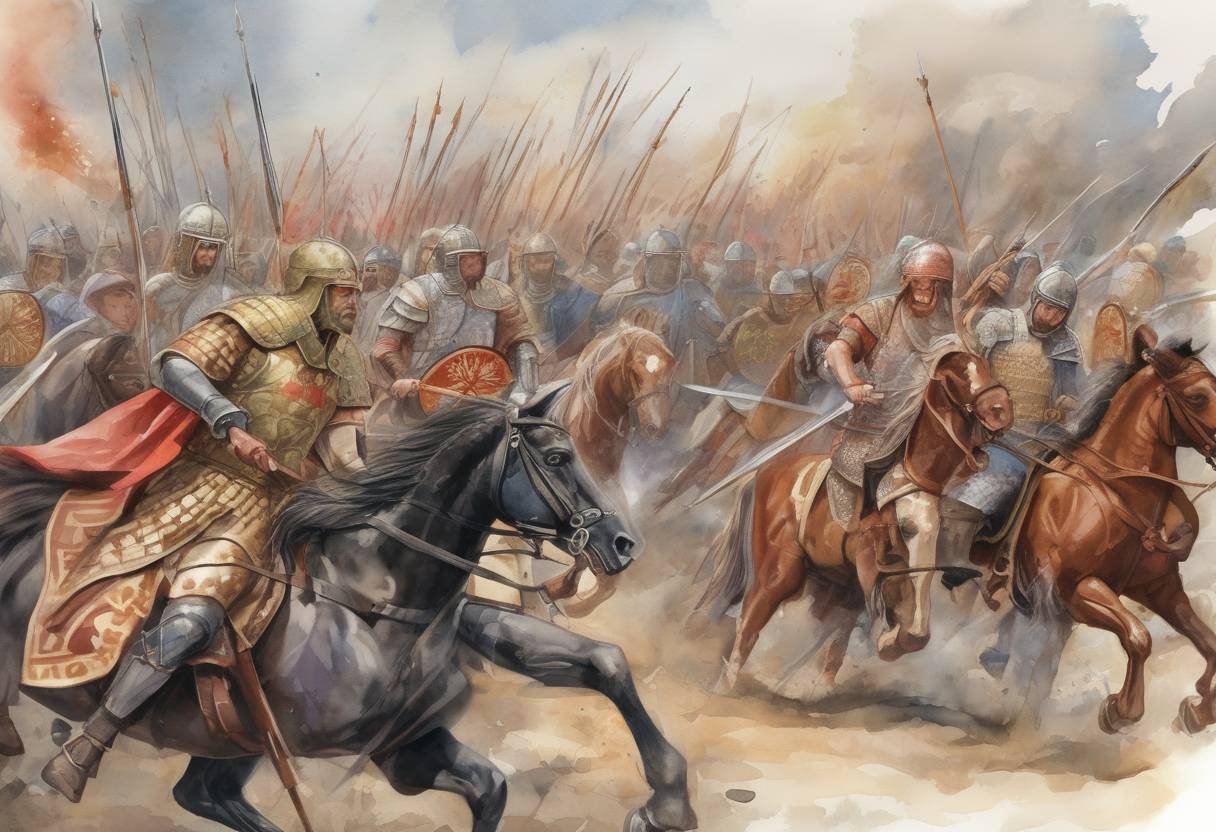
The Battle of Taginae, also known as the Battle of Busta Gallorum, took place on July 1, 552, during the Gothic War (535–554), a protracted conflict between the Byzantine Empire and the Ostrogothic Kingdom in Italy. This war was part of Emperor Justinian I’s ambitious campaign to reconquer former Roman territories in the West, aiming to restore the Roman Empire’s past glory.
The confrontation at Taginae occurred near the town of Gualdo Tadino in central Italy. Narses, commanding a diverse army of Byzantines, Lombards, Heruli, and other mercenaries, faced Totila’s Ostrogothic forces. Despite being outnumbered, Narses employed a clever tactical formation, arranging his troops in a crescent shape to envelop the enemy.
The battle commenced with a series of skirmishes, but the decisive moment came when Narses’ cavalry executed a well-timed charge against the Ostrogothic flanks. This maneuver, combined with the disciplined archery of the Byzantine forces, led to the disintegration of Totila’s army. Totila himself was mortally wounded during the battle, which significantly demoralized the Ostrogothic troops.
The defeat at Taginae was catastrophic for the Ostrogoths. With Totila’s death, their resistance crumbled, and the Byzantine forces swiftly moved to consolidate their control over Italy. The fall of the Ostrogothic Kingdom marked a significant victory for Justinian’s reconquest efforts.
In the broader historical context, the battle significantly weakened the Ostrogothic presence in Italy, paving the way for the eventual Byzantine reconquest of the region. However, the prolonged conflict and subsequent Byzantine rule left Italy economically devastated and politically fragmented, setting the stage for future invasions and the eventual rise of the Lombards.
The Battle of Taginae is a pivotal moment in the Gothic War, showcasing the military prowess of Narses and the strategic importance of Italy in Justinian’s imperial ambitions. It underscores the challenges of maintaining a vast empire and the enduring impact of warfare on the political landscape of Europe during the early medieval period.
Source: en.wikipedia.org