The Completion of the Salt March: April 5, 1930
1930 · Dandi, India
Mahatma Gandhi completed the Salt March, a 240-mile protest against the British salt tax in India, which became a significant event in the Indian independence movement.
March 18, 1922
Mahatma Gandhi was sentenced to six years in prison for civil disobedience after leading the non-cooperation movement against British rule in India. His imprisonment was a pivotal moment in the Indian independence movement.
Ahmedabad, India | British Colonial Government
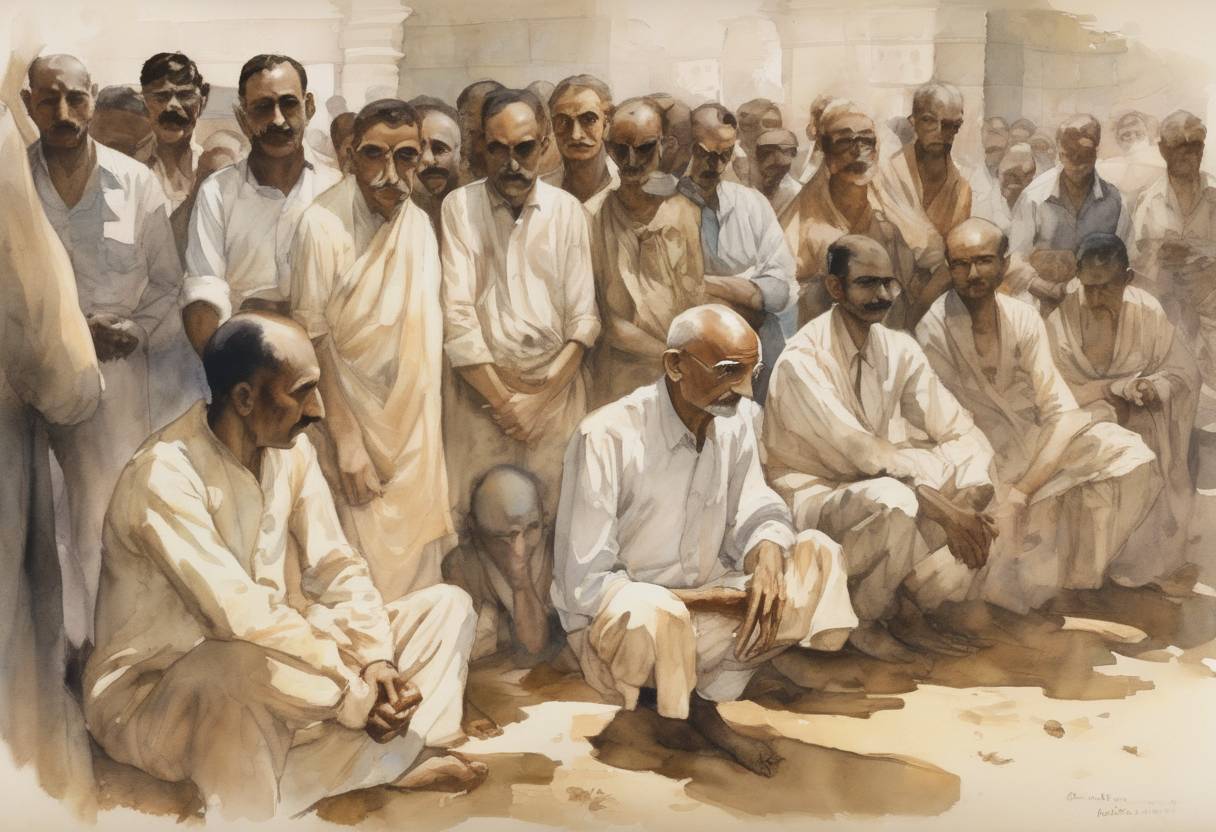
On March 18, 1922, Mohandas Karamchand Gandhi, widely known as Mahatma Gandhi, was sentenced to six years in prison by the British colonial authorities in India. This event was a significant moment in the Indian independence movement, marking a critical juncture in the struggle against British rule.
The early 1920s were a period of intense political activity in India, characterized by widespread dissatisfaction with British colonial rule. The catalyst for Gandhi’s imprisonment was the Non-Cooperation Movement, which he launched in 1920. This movement was a mass protest against the British government, advocating for nonviolent resistance and non-cooperation with the colonial authorities. It aimed to achieve self-governance and full independence for India.
The Non-Cooperation Movement gained momentum following the Jallianwala Bagh massacre in 1919, where British troops killed hundreds of unarmed Indian civilians. This atrocity galvanized Indian public opinion against British rule and increased support for Gandhi’s approach of nonviolent resistance.
Gandhi’s leadership in the Non-Cooperation Movement involved organizing nationwide strikes, boycotts of British goods, and the refusal to pay taxes. The movement drew millions of Indians from diverse backgrounds, uniting them in a common cause. However, the movement faced challenges, including outbreaks of violence, which Gandhi strongly condemned.
The turning point came with the Chauri Chaura incident on February 4, 1922, when a violent clash between protesters and police resulted in the deaths of 22 policemen. Gandhi, a staunch advocate of nonviolence, was deeply disturbed by this incident and called off the Non-Cooperation Movement, believing that the Indian populace was not yet ready for a nonviolent struggle.
Gandhi was arrested on March 10, 1922, and charged with sedition for his writings in “Young India,” a weekly journal he edited. During his trial, Gandhi used the courtroom as a platform to express his views on British rule and the moral imperative of nonviolent resistance. He famously stated:
“I am here, therefore, to invite and submit cheerfully to the highest penalty that can be inflicted upon me for what in law is a deliberate crime and what appears to me to be the highest duty of a citizen.”
On March 18, 1922, Gandhi was sentenced to six years in prison. His imprisonment was intended to suppress the growing independence movement, but it instead amplified his status as a symbol of resistance and inspired further activism across India.
Gandhi served two years of his sentence before being released in 1924 due to ill health. During his imprisonment, the Indian National Congress continued to push for reforms and independence, albeit with less momentum. Gandhi’s incarceration highlighted the repressive nature of British rule and further united Indians in their quest for freedom.
The imprisonment of Gandhi marked a pivotal moment in the Indian independence movement, underscoring the power of nonviolent resistance and the moral authority Gandhi wielded. It set the stage for future campaigns and ultimately contributed to India’s independence in 1947.
Gandhi’s legacy as a leader of nonviolent resistance continues to inspire movements for justice and civil rights worldwide, demonstrating the enduring impact of his philosophy and actions.
Source: en.wikipedia.org