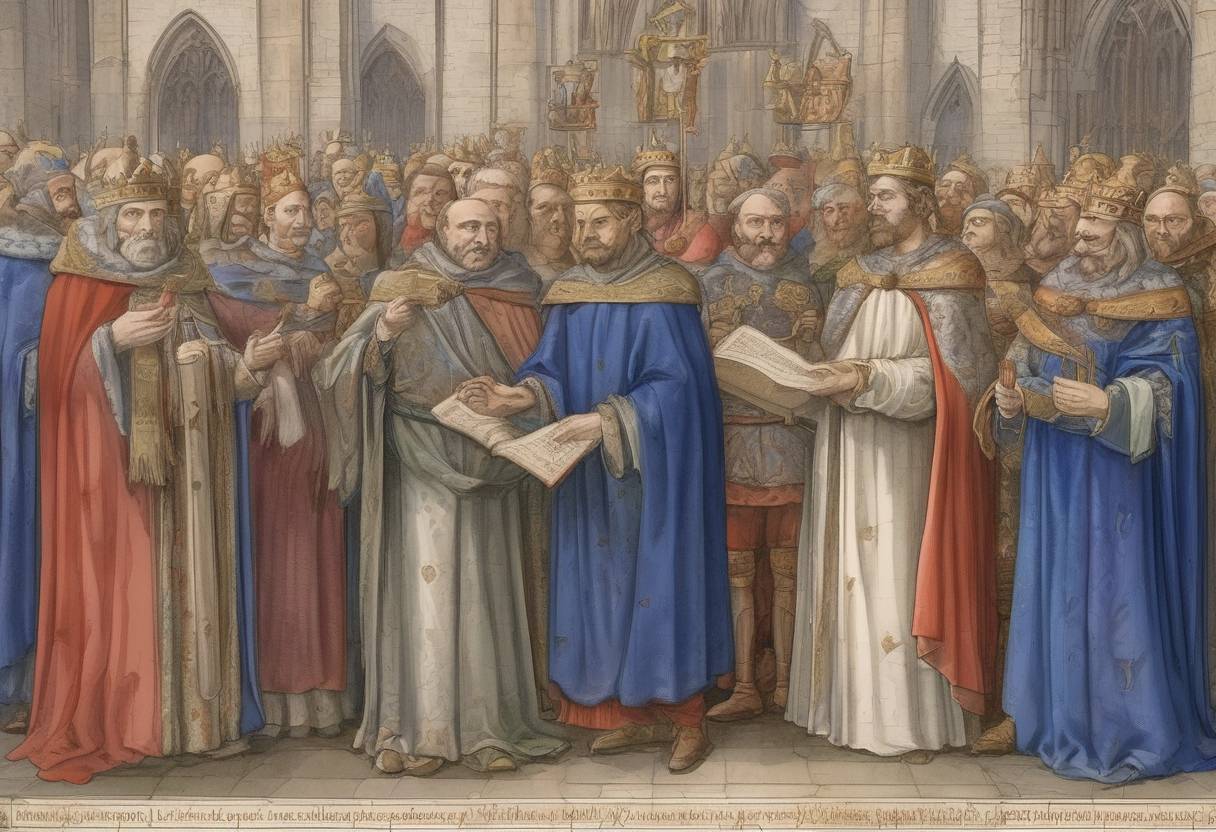
The Oaths of Strasbourg: February 14, 842
The Oaths of Strasbourg, sworn on February 14, 842, represent a pivotal moment in the history of the Carolingian Empire. This event involved two grandsons of Charlemagne, Louis the German and Charles the Bald, who pledged mutual allegiance against their elder brother, Lothair I. The oaths are historically significant not only for their political implications but also for their linguistic importance.
Historical Context
Following the death of Charlemagne in 814, the Carolingian Empire faced internal strife as his successors struggled to maintain control over the vast territories. Charlemagne’s son, Louis the Pious, attempted to keep the empire united, but his death in 840 led to a power struggle among his sons: Lothair I, Louis the German, and Charles the Bald.
Lothair I, as the eldest, sought to assert his dominance over the entire empire, leading to tensions and conflicts with his brothers. The division of the empire was formalized in the Treaty of Verdun in 843, but the events leading up to this treaty were marked by significant military and political maneuvering.
The Oaths
The Oaths of Strasbourg were sworn in the context of this familial conflict. Louis the German and Charles the Bald allied against Lothair I to strengthen their positions. The oaths were a declaration of mutual support and loyalty, effectively forming a coalition against their brother.
Linguistic Significance
The oaths are particularly notable for being one of the earliest examples of a document written in a Romance language. The text was recorded in both Old High German and a Romance language, which would later evolve into Old French. This bilingual documentation highlights the linguistic diversity of the Carolingian Empire and marks an early stage in the development of modern European languages.
Aftermath and Significance
The alliance between Louis and Charles was instrumental in their eventual victory over Lothair, leading to the Treaty of Verdun in 843. This treaty divided the Carolingian Empire into three distinct kingdoms, laying the groundwork for the future political landscape of Europe.
The Oaths of Strasbourg are a testament to the complex interplay of power, language, and culture in medieval Europe. They underscore the fragmentation of the Carolingian Empire and the emergence of distinct linguistic and cultural identities that would shape the continent’s history.
In summary, the Oaths of Strasbourg were a crucial step in the disintegration of Charlemagne’s empire and a milestone in the evolution of European languages, reflecting the shifting dynamics of power and identity in the early medieval period.