The Siege of Constantinople: April 2, 1453
1453 · Constantinople, Byzantine Empire
Mehmed II, the Ottoman Sultan, began the siege of Constantinople, which would eventually lead to the fall of the Byzantine Empire.
August 15, 0718
The Second Arab Siege of Constantinople ends as the Arab forces withdraw after failing to capture the city, marking a significant Byzantine victory and halting Arab expansion into Europe.
Constantinople, Byzantine Empire | Byzantine Empire
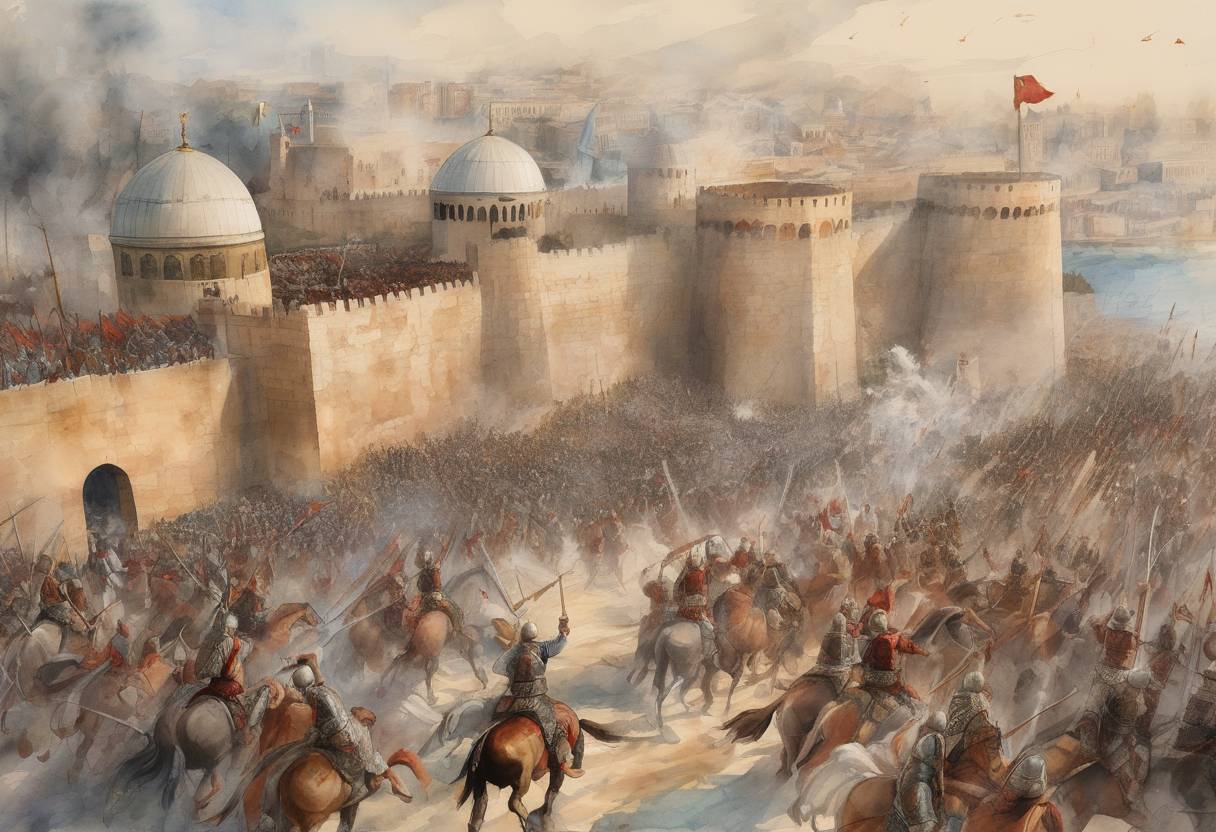
The conclusion of the Second Arab Siege of Constantinople on August 15, 718, marked a pivotal moment in Byzantine history and had significant implications for the future of Europe. This event was a critical turning point in the Byzantine-Arab conflicts and played a crucial role in halting the expansion of the Umayyad Caliphate into Europe.
The siege was part of the larger Arab-Byzantine Wars, which were a series of conflicts between the Byzantine Empire and the expanding Umayyad Caliphate. The Umayyads, having established a vast empire that stretched from the Iberian Peninsula to the Indus River, sought to capture Constantinople, the capital of the Byzantine Empire, to further consolidate their power and influence.
The first Arab siege of Constantinople had occurred earlier, from 674 to 678, but ended unsuccessfully for the Arab forces. Learning from their previous attempt, the Umayyads launched a second, more formidable siege in 717 under the leadership of Caliph Sulayman ibn Abd al-Malik, and later his successor, Caliph Umar II.
The siege began in August 717, with Arab forces led by Maslama ibn Abd al-Malik, the brother of Caliph Sulayman. The Arab army, reportedly numbering around 80,000, was supported by a large fleet intended to blockade the city from the sea. The Byzantine Empire, under Emperor Leo III, was well-prepared for the attack, having fortified the city’s defenses and stockpiled provisions.
A key factor in the Byzantine defense was the use of “Greek fire,” a highly effective incendiary weapon that could burn even on water. This technological advantage allowed the Byzantines to repel the Arab naval forces and maintain control over the Bosporus Strait.
The siege dragged on through the harsh winter of 717-718, during which the Arab forces suffered from severe cold, famine, and disease. The Byzantines, meanwhile, were able to sustain themselves within the fortified city. Additionally, the Byzantines received support from the Bulgarians, who attacked the Arab forces from the rear, further weakening their position.
The combination of these factors led to the eventual withdrawal of the Arab forces on August 15, 718. The failure to capture Constantinople was a significant setback for the Umayyad Caliphate and marked the end of their attempts to expand into Byzantine territory.
The successful defense of Constantinople had profound implications for both the Byzantine Empire and Europe as a whole. It preserved the Byzantine Empire as a bulwark against further Arab expansion into Europe, allowing the Christian states of Europe to develop without the immediate threat of conquest.
Moreover, the victory bolstered the prestige of Emperor Leo III, who went on to implement significant military and administrative reforms that strengthened the Byzantine state. The siege’s failure also contributed to internal challenges within the Umayyad Caliphate, which faced revolts and eventually fell to the Abbasid Caliphate in 750.
In summary, the end of the Second Arab Siege of Constantinople was a decisive moment in medieval history, shaping the geopolitical landscape of Europe and the Near East for centuries to come.
Source: en.wikipedia.org