Florence Capitulates to the Army of Charles V
1530 · Florence, Republic of Florence (now Italy)
Florence capitulates to the army of Charles V after the Siege of Florence.
May 6, 1527
The Sack of Rome by the troops of Charles V, Holy Roman Emperor, marked a crucial moment in the Italian Wars, leading to significant political and cultural shifts in Italy.
Rome, Italy | Holy Roman Empire
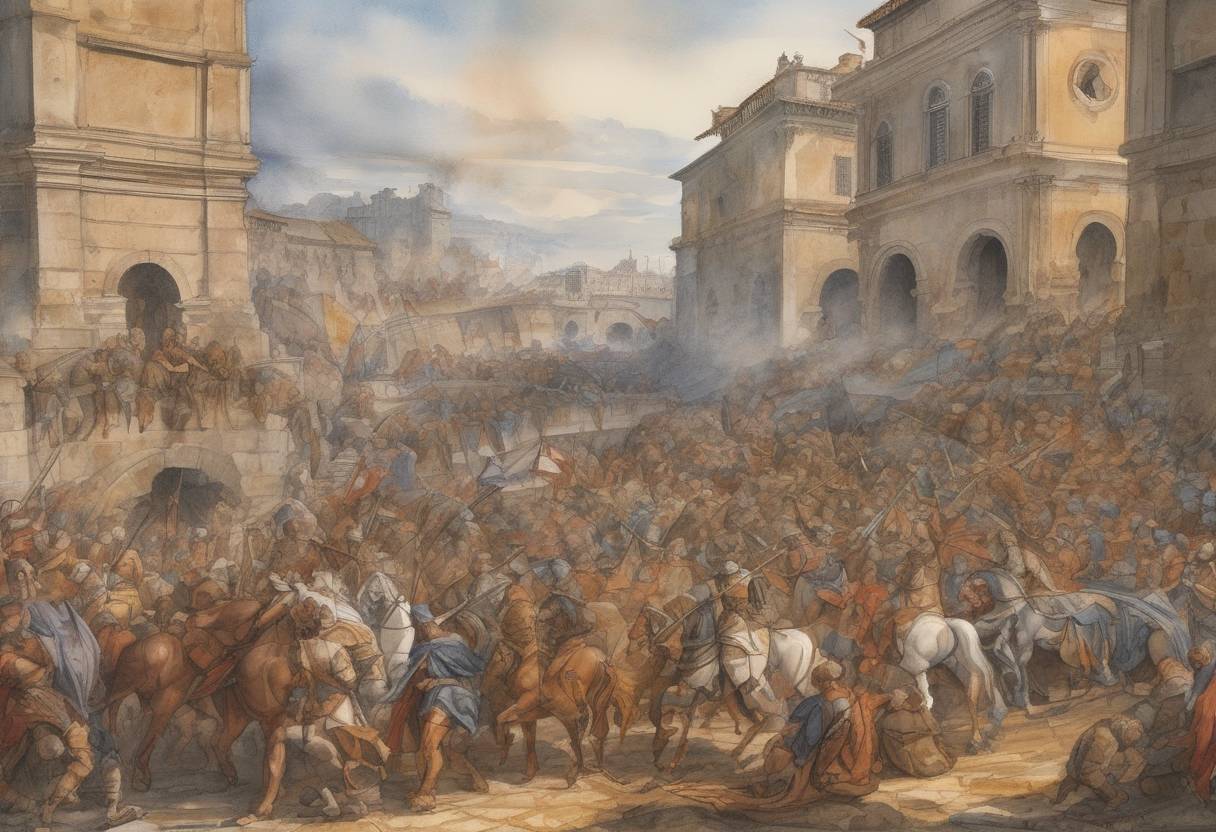
The Sack of Rome on May 6, 1527, was a pivotal event during the Italian Wars, a series of conflicts involving major European powers over control of the Italian Peninsula. This event marked a significant turning point in both the political landscape of Italy and the broader cultural context of the Renaissance.
The Italian Wars (1494–1559) were a protracted series of conflicts primarily involving France and Spain, with various Italian states and the Papal States often caught in the middle. By the early 16th century, the Holy Roman Emperor Charles V and King Francis I of France were the principal antagonists, each vying for dominance in Italy.
Pope Clement VII, seeking to maintain the independence of the Papal States and balance power in Italy, initially allied with France. However, the shifting alliances and the Pope’s political maneuvers led to tensions with Charles V.
On May 6, 1527, Rome was attacked by the troops of Charles V, Holy Roman Emperor. These forces were a mix of Spanish soldiers, German Landsknechts (mercenaries), and Italian troops, numbering around 34,000. The army, under the nominal command of Charles III, Duke of Bourbon, was largely unpaid and mutinous, driven by the promise of plunder.
Assault on Rome: The attack began with the death of Charles III during the initial assault, which left the troops leaderless and further fueled their desire for loot. The city was poorly defended, with only about 5,000 troops and a small contingent of Swiss Guards.
Destruction and Plunder: The sack lasted for several days, during which the city was subjected to extensive looting, destruction, and violence. Churches, palaces, and homes were ransacked, and many inhabitants were killed or taken hostage.
The Sack of Rome had profound implications:
Political Impact: The event significantly weakened the political power of the Papacy. Pope Clement VII was forced to capitulate to Charles V, eventually leading to the Treaty of Barcelona in 1529, which restored some of the Papal States’ territories but confirmed the Emperor’s dominance in Italy.
Cultural and Religious Effects: The sack is often cited as a symbolic end to the High Renaissance in Rome. The destruction and chaos disrupted the flourishing of arts and culture, leading to a period of decline in the city’s status as a cultural hub.
Shift in Power Dynamics: The event underscored the shifting power dynamics in Europe, with Spain and the Holy Roman Empire emerging as dominant forces. It also highlighted the vulnerabilities of the Italian city-states amidst the larger European power struggles.
The Sack of Rome in 1527 is remembered as a brutal and transformative moment in European history. It not only altered the course of the Italian Wars but also had lasting effects on the political and cultural landscape of Italy. The event is a stark reminder of the volatility of the period and the complex interplay of power, politics, and culture during the Renaissance.
Source: en.wikipedia.org