The Delivery of the Tranquility Module to the ISS
2010 · International Space Station, International
The International Space Station (ISS) receives its final major module, the Tranquility module, delivered by the Space Shuttle Endeavour.
September 8, 2014
NASA announced that the MAVEN spacecraft had successfully entered Mars' orbit. The Mars Atmosphere and Volatile EvolutioN (MAVEN) mission was designed to study the Martian atmosphere and its interactions with solar winds.
Mars Orbit, NASA mission (United States) | NASA
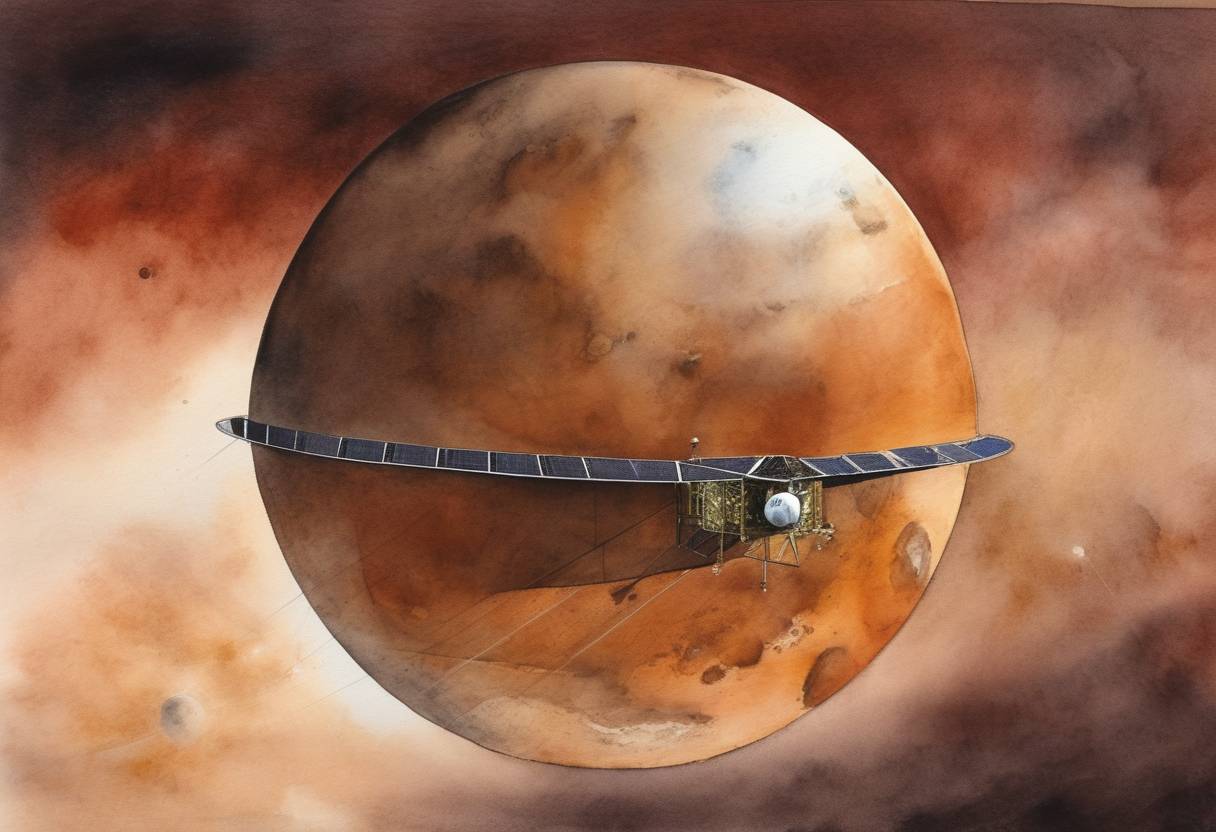
On September 8, 2014, NASA announced that the Mars Atmosphere and Volatile EvolutioN (MAVEN) spacecraft had successfully entered orbit around Mars. This marked a significant milestone in the quest to understand the Martian atmosphere and its interaction with solar winds. The MAVEN mission was specifically designed to explore Mars’ upper atmosphere, ionosphere, and magnetic field, providing insights into the planet’s climate history and atmospheric loss.
MAVEN’s primary scientific objectives included measuring:
By achieving these objectives, MAVEN was intended to help scientists piece together the history of atmospheric loss that may have contributed to Mars’ transformation from a warm, wet planet to the cold, arid one we observe today.
MAVEN was launched from Cape Canaveral Air Force Station in Florida on November 18, 2013. After a 10-month journey covering approximately 442 million miles (711 million kilometers), the spacecraft’s insertion into Martian orbit was crucial. This critical maneuver required precise adjustments and timing, as MAVEN needed to slow down sufficiently to be captured by the planet’s gravitational pull without veering off course.
On September 8, 2014, MAVEN executed a thruster burn that lasted 33 minutes and reduced its speed to 2,750 miles per hour (4,400 kilometers per hour), allowing it to be pulled into an elliptical orbit around Mars. The success of this operation rested on meticulous planning and the flawless performance of both onboard systems and the flight team.
MAVEN’s successful orbit insertion has enabled it to provide critical data about the Martian atmosphere. Data collected by MAVEN have helped scientists understand the planet’s climate evolution, offering clues not only about Mars but also about the climates and habitabilities of other similar planets.
The findings from MAVEN have complemented those of other missions, including the Mars Reconnaissance Orbiter and the Mars Science Laboratory (Curiosity Rover), enriching the scientific community’s understanding of the Red Planet and its history. Its ongoing observations continue to deepen our understanding of how Mars’ atmosphere was lost to space and how changes in solar activity impact planetary atmospheres.
MAVEN’s mission has not only advanced our knowledge of Mars but also provided broader insights into the dynamics of planetary atmospheres, which can be applied to exoplanetary studies and the search for habitable worlds beyond our solar system.
Source: www.nasa.gov