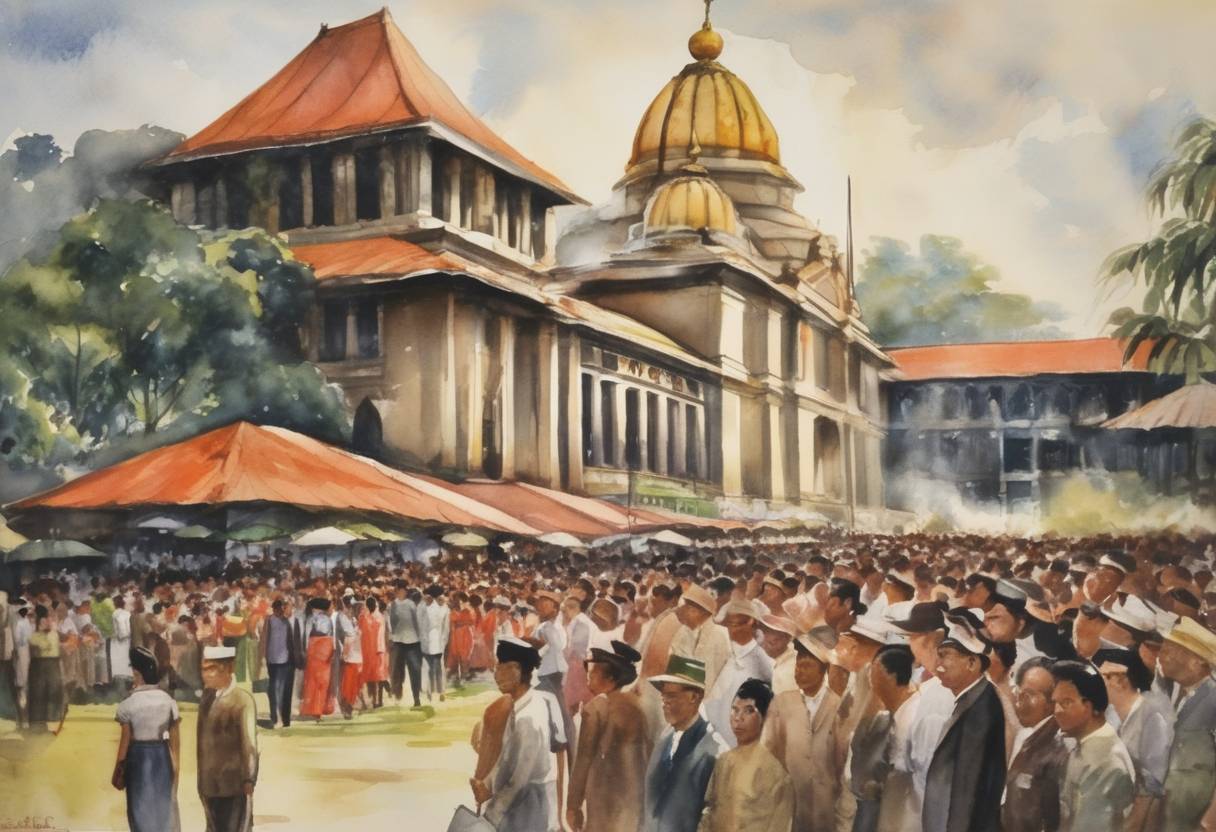
Federation of Malaya Gains Independence
On August 31, 1957, the Federation of Malaya achieved independence from the United Kingdom, marking the end of British colonial rule and the beginning of a new chapter in Southeast Asian politics. This pivotal event set the stage for the eventual formation of Malaysia in 1963, a union also comprising Singapore, Sarawak, and North Borneo (present-day Sabah).
Historical Context
British influence in the Malay Peninsula began in the late 18th century, expanding through a series of treaties and colonial policies. By the mid-20th century, the region was a British protectorate, experiencing significant political and social shifts. The post-World War II era saw a rise in nationalist sentiments as various ethnic groups, primarily Malays, Chinese, and Indians, sought greater representation and self-governance.
The path to independence gained momentum following the Malayan Emergency (1948-1960), a guerrilla war fought between Commonwealth armed forces and the Malayan National Liberation Army. The conflict highlighted the urgent need for political restructuring and decolonization.
Key Events Leading to Independence
In response to these pressures, the British government initiated steps toward self-governance, establishing the Malayan Union in 1946, which was quickly replaced by the Federation of Malaya in 1948 due to strong opposition from Malay nationalists. The federation provided a more favorable framework for greater autonomy and was instrumental in moving toward full independence.
Negotiations took place throughout the early 1950s, involving key local leaders such as Tunku Abdul Rahman, the first Prime Minister of Malaya, who played a crucial role in the talks with the British government. The culmination of these discussions was the independence agreement signed in London in 1956.
Independence Day Celebrations
On the independence day, celebrations were held throughout the country, the most notable taking place at Merdeka Stadium in Kuala Lumpur. Tunku Abdul Rahman proclaimed freedom at the stroke of midnight, with the Union Flag lowered and the Malayan flag raised. This ceremony was attended by dignitaries, including British representatives, and witnessed by thousands of citizens who gathered to celebrate the momentous occasion.
Aftermath and Significance
The independence of the Federation of Malaya marked a significant step towards decolonization in Asia, influencing other regions under colonial rule. It also set the foundation for the establishment of Malaysia in 1963, when Malaya joined with Singapore, Sarawak, and North Borneo.
The formation of Malaysia, however, faced challenges such as ethnic tensions and political disagreements, particularly with Singapore, which eventually left the federation in 1965. Despite these hurdles, the independence of Malaya remains a defining point in the nation’s history, symbolizing the achievement of self-governance and national identity.
Conclusion
The events of August 31, 1957, not only symbolize the triumph of nationalism and self-determination but also highlight the complex interplay of ethnic, political, and international factors that shaped the nation’s journey towards independence and beyond. The legacy of this day continues to resonate in the socio-political fabric of Malaysia today.