Battle of Köse Dağ - July 1, 1243
1243 · Köse Dağ, Turkey
Battle of Köse Dağ: The Seljuk Turks are decisively defeated by the Mongols, resulting in Mongol dominance over Anatolia.
August 26, 1071
The Battle of Manzikert occurred where the Byzantine Empire, led by Emperor Romanos IV Diogenes, was defeated by the Seljuk Turkish forces under Sultan Alp Arslan, a pivotal moment that weakened Byzantine control in Anatolia and paved the way for the expansion of Turkish power in the region.
Manzikert (modern Malazgirt), Turkey | Byzantine Empire; Seljuk Empire
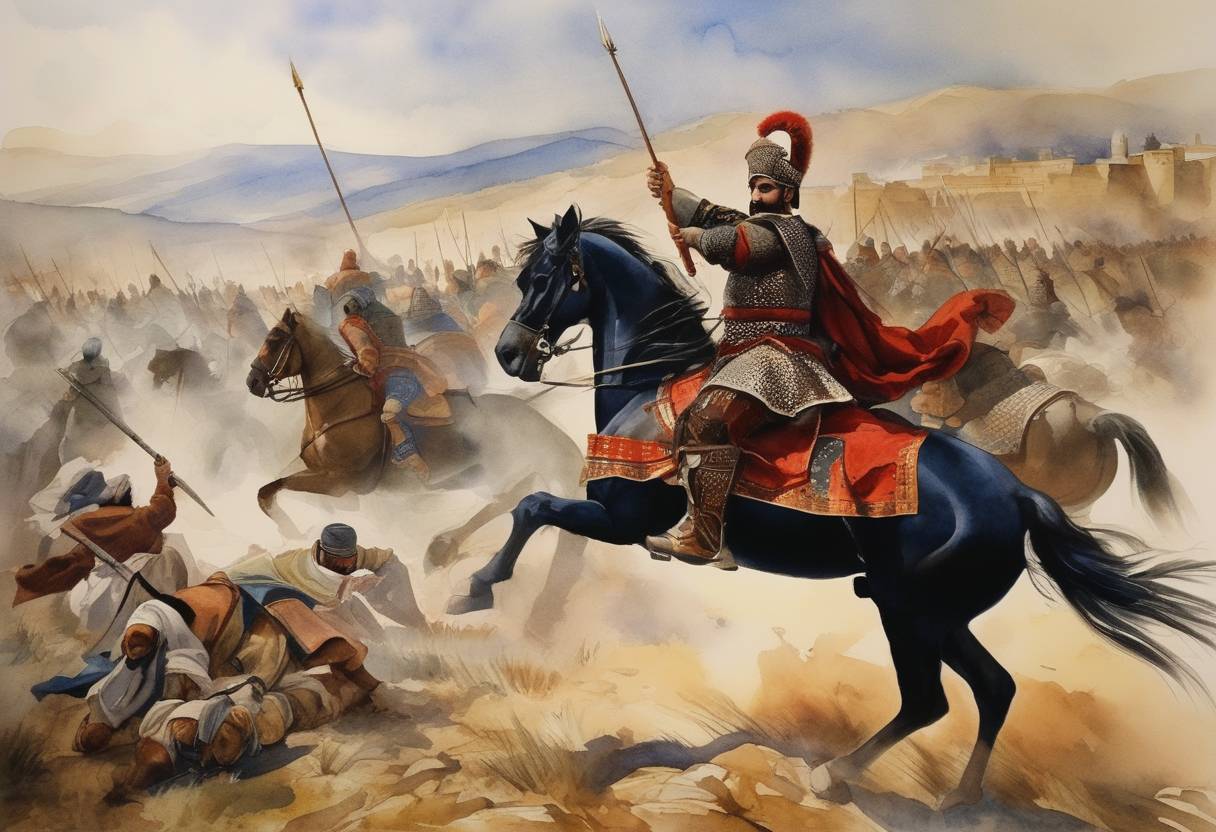
The Battle of Manzikert occurred on August 26, 1071, marking a significant turning point in medieval history. This battle took place near the town of Manzikert, in present-day eastern Turkey, where the Byzantine Empire faced off against the Seljuk Turks.
The Byzantine Empire, under the leadership of Emperor Romanos IV Diogenes, sought to reclaim control over territories encroached upon by the Seljuk Turks. Romanos aimed to reinforce Byzantine influence in Anatolia and secure the eastern borders that had been increasingly threatened by Seljuk incursions.
Emperor Romanos IV led a considerable force to confront the Seljuk Turks, commanded by Sultan Alp Arslan. The Byzantine army was diverse, comprising various ethnic contingents, including Armenians, Normans, Bulgarians, and others. This diversity, while extensive, also revealed issues in communication and coordination.
Despite initial successes, the Byzantines were ultimately ambushed and outmaneuvered by Alp Arslan’s forces. Internal divisions among Romanos’ troops, and a crucial tactical error of dividing his forces, contributed to the downfall of the Byzantine army. The cohesive and highly mobile Seljuk cavalry played a decisive role in the Seljuk victory.
The defeat at Manzikert resulted in the capture of Emperor Romanos IV, who was later released after negotiating a peace treaty with Alp Arslan. However, this did not prevent subsequent civil unrest and political instability within the Byzantine Empire.
The Battle of Manzikert severely weakened Byzantine control over Anatolia, leading to increased Turkish settlement and influence in the region. It laid the groundwork for the eventual rise of the Ottoman Empire. The defeat exposed the vulnerabilities of the Byzantine military and their diminishing regional influence, altering the balance of power in the Middle East.
The battle highlighted the growing power of the Seljuk Turks and set in motion events that would contribute to the Crusades. As a result, Manzikert is often seen as a pivotal moment that changed the course of Byzantine history and shifted the dynamics of power in medieval Anatolia.
Source: en.wikipedia.org