Guglielmo Marconi and the First Transatlantic Radio Signal
1901 · St. John's, Canada
Guglielmo Marconi receives the first transatlantic radio signal in St. John's, Newfoundland, marking a significant milestone in wireless communication.
June 2, 1896
Guglielmo Marconi applies for a patent for his wireless telegraphy system in the United Kingdom.
London, United Kingdom | Marconi Company
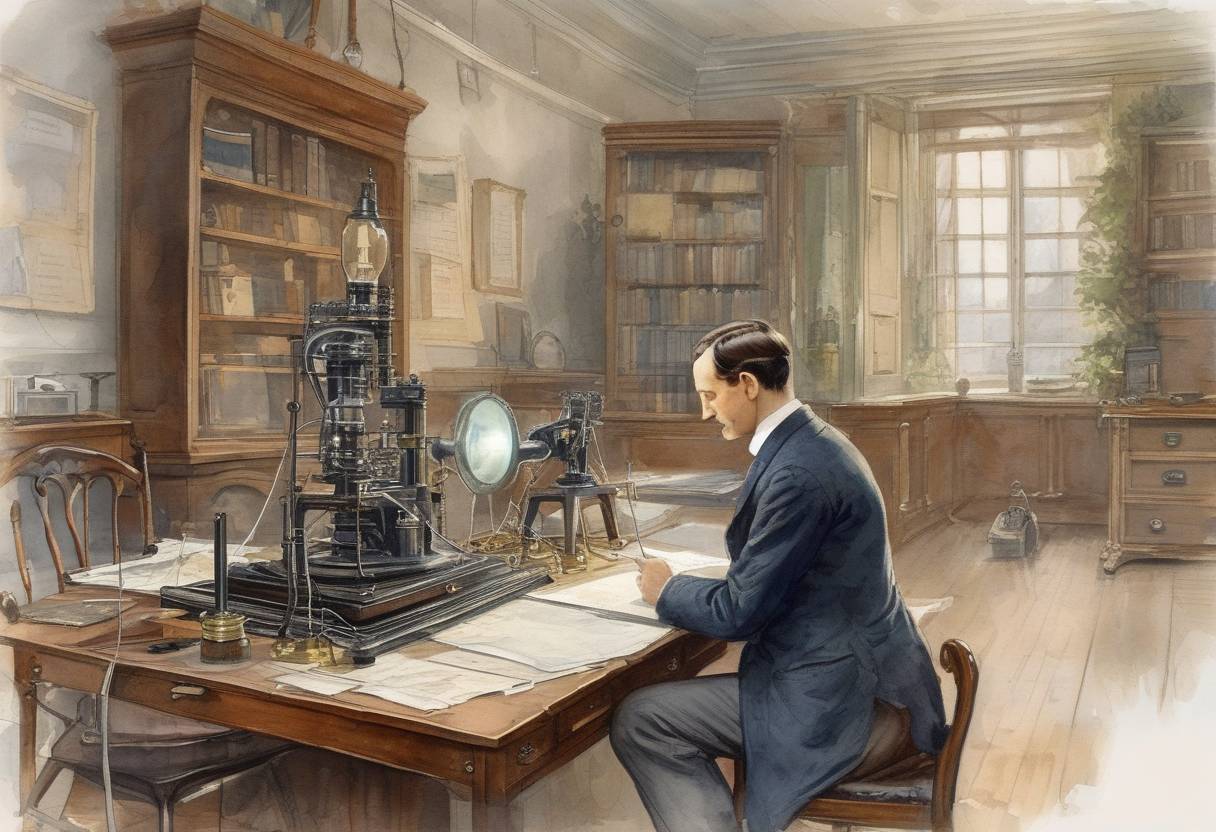
On June 2, 1896, Guglielmo Marconi, an Italian inventor and electrical engineer, applied for a patent in the United Kingdom for his groundbreaking wireless telegraphy system. This event marked a significant milestone in the development of wireless communication, laying the foundation for modern radio technology.
Guglielmo Marconi was born on April 25, 1874, in Bologna, Italy. From a young age, he showed a keen interest in science and electricity. Inspired by the work of Heinrich Hertz, who had demonstrated the existence of electromagnetic waves, Marconi began experimenting with wireless telegraphy in the early 1890s. His goal was to transmit signals over long distances without the need for wires, a concept that was revolutionary at the time.
Early Experiments: Marconi conducted his initial experiments at his family’s estate in Italy. By 1895, he had successfully transmitted signals over a distance of approximately 1.5 miles (2.4 kilometers).
Move to the United Kingdom: Recognizing the potential commercial and military applications of his invention, Marconi moved to the United Kingdom in 1896. The UK, with its vast maritime interests, was particularly receptive to innovations in communication technology.
Support from the British Post Office: Upon arriving in London, Marconi demonstrated his wireless system to officials from the British Post Office. Impressed by its potential, they provided him with support and resources to further develop his technology.
On June 2, 1896, Marconi filed his patent application for “Improvements in Transmitting Electrical Impulses and Signals and in Apparatus therefor.” This patent, granted in 1897, was the first of its kind for wireless telegraphy and described a system capable of transmitting signals over long distances using electromagnetic waves.
Commercialization and Expansion: Following the patent, Marconi established the Wireless Telegraph & Signal Company in 1897, later known as the Marconi Company. This company played a pivotal role in the commercialization of wireless communication.
Transatlantic Communication: In 1901, Marconi achieved another milestone by successfully transmitting the first transatlantic wireless signal from Cornwall, England, to Newfoundland, Canada.
Legacy: Marconi’s work laid the groundwork for the development of radio, broadcasting, and eventually, modern wireless communication technologies. He was awarded the Nobel Prize in Physics in 1909, shared with Karl Ferdinand Braun, for their contributions to wireless telegraphy.
Marconi’s patent application on June 2, 1896, was a pivotal moment in the history of communication, heralding a new era of global connectivity and technological advancement.
Source: en.wikipedia.org