The Treaty of London: Ending the Bishops' Wars
1641 · London, England
The Treaty of London was signed, ending the Bishops' Wars between England and Scotland. This treaty was part of the larger conflict that led to the English Civil War.
November 21, 1640
The Treaty of Ripon was signed, ending the Second Bishops' War between England and Scotland.
Ripon, England | Kingdom of England and Kingdom of Scotland
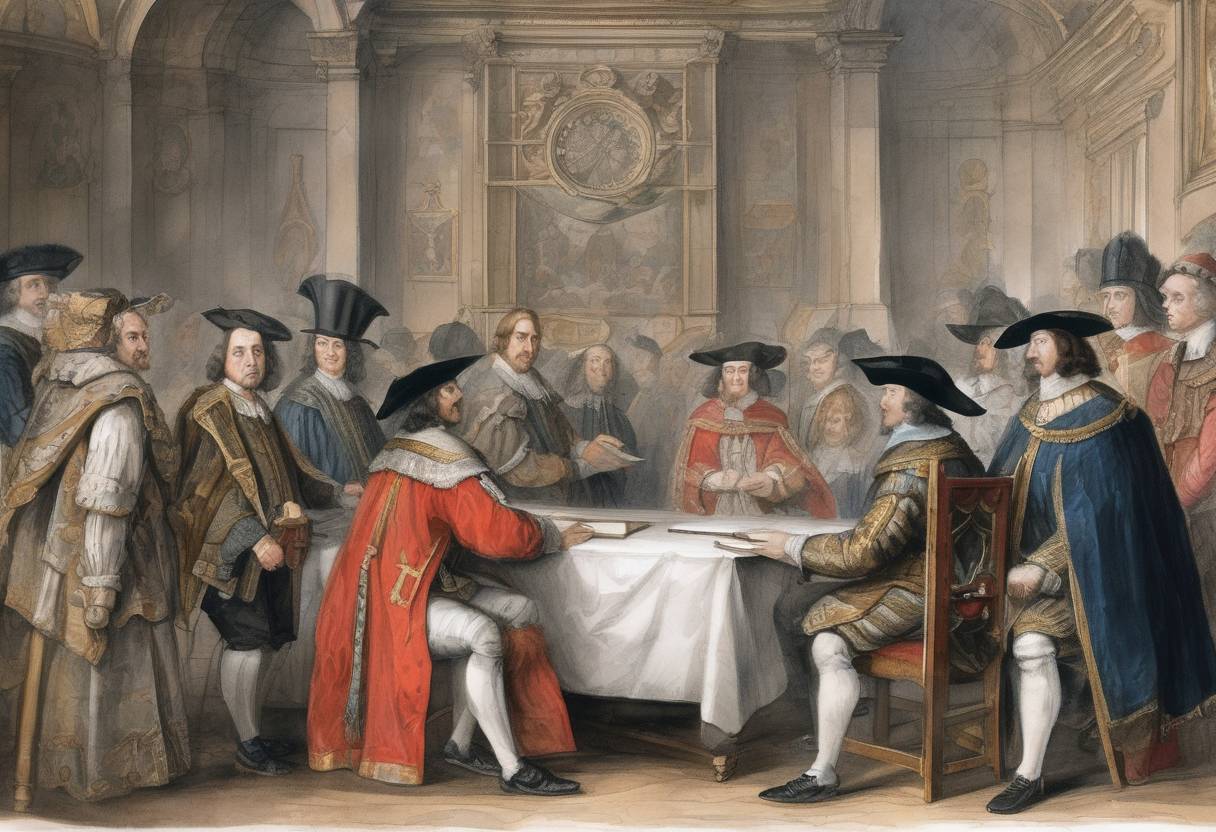
The Treaty of Ripon, signed on November 21, 1640, marked the conclusion of the Second Bishops’ War, a conflict between England and Scotland. This war was part of a series of religious and political disputes that arose during the reign of King Charles I of England. The conflict was primarily fueled by Charles I’s attempts to impose Anglican religious practices on the Presbyterian Church of Scotland, which was met with strong resistance from the Scots.
Religious Tensions: The root of the conflict lay in Charles I’s insistence on religious uniformity across his kingdoms. In 1637, he attempted to introduce a new prayer book in Scotland, modeled on the English Book of Common Prayer. This move was deeply unpopular and led to widespread unrest.
The National Covenant: In 1638, Scottish Presbyterians responded by signing the National Covenant, pledging to resist any changes to their religious practices. This act of defiance set the stage for armed conflict.
First Bishops’ War: The First Bishops’ War (1639) ended inconclusively, with both sides agreeing to disband their armies. However, tensions remained high, and the underlying issues were not resolved.
Second Bishops’ War: In 1640, hostilities resumed. The Scottish Covenanters, better organized and motivated, invaded England and occupied Northumberland and Durham. The English army, poorly funded and demoralized, was unable to repel the invasion.
Negotiations: The Treaty of Ripon was negotiated in the aftermath of the Scottish victory at the Battle of Newburn in August 1640. The Scots had advanced into England, and Charles I, facing financial and military difficulties, was compelled to negotiate.
Terms of the Treaty: Under the terms of the treaty, the Scots were allowed to occupy Northumberland and Durham until a final settlement was reached. Additionally, Charles I agreed to pay the Scots £850 per day to maintain their army in the occupied territories.
Political Consequences: The treaty was a significant humiliation for Charles I, as it forced him to summon the Long Parliament in November 1640 to address the financial crisis and secure funds to pay the Scots. This parliament would become a central player in the events leading to the English Civil War.
The Treaty of Ripon had far-reaching consequences. It highlighted the limitations of Charles I’s authority and exacerbated tensions between the monarchy and Parliament. The financial strain and political concessions required by the treaty weakened the king’s position, setting the stage for the English Civil War (1642–1651). The conflict between the monarchy and Parliament would ultimately lead to the trial and execution of Charles I and the temporary establishment of a republican government in England.
The Treaty of Ripon is a pivotal moment in British history, illustrating the complex interplay of religious, political, and military factors that shaped the 17th century.
Source: en.wikipedia.org