Death of Pol Pot - April 15, 1998
1998 · Anlong Veng, Cambodia
Pol Pot, the notorious leader of the Khmer Rouge regime responsible for the Cambodian genocide, died.
January 7, 1979
Vietnamese forces captured Phnom Penh, the capital of Cambodia, effectively ending the Khmer Rouge regime.
Phnom Penh, Cambodia | Vietnam People's Army
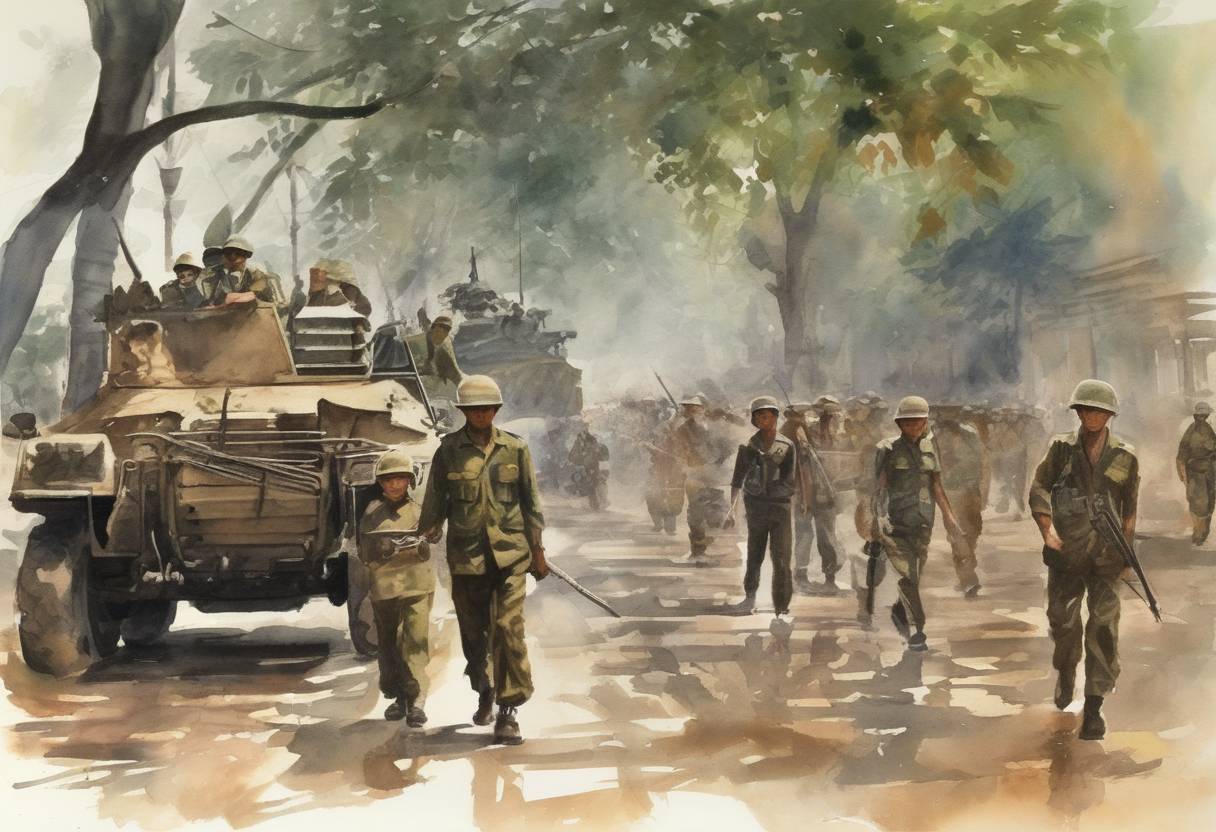
On January 7, 1979, Vietnamese forces captured Phnom Penh, the capital city of Cambodia, marking a significant turning point in Southeast Asian history. This event effectively ended the brutal regime of the Khmer Rouge, led by Pol Pot, which had been in power since April 17, 1975.
The Khmer Rouge, a radical communist movement, seized control of Cambodia in 1975, following years of civil war. Under Pol Pot’s leadership, the regime sought to transform Cambodia into a rural, classless society. This radical transformation involved the forced evacuation of cities, the abolition of currency, and the establishment of collective farms. The Khmer Rouge’s policies led to widespread famine, forced labor, and mass executions, resulting in the deaths of an estimated 1.7 to 2 million people, approximately a quarter of Cambodia’s population at the time.
Tensions between Cambodia and Vietnam had been escalating due to border disputes and the Khmer Rouge’s aggressive policies. The Khmer Rouge conducted cross-border raids into Vietnam, which further strained relations.
In December 1978, Vietnam launched a full-scale invasion of Cambodia, citing self-defense against the Khmer Rouge’s incursions and the need to end the humanitarian crisis. The Vietnamese military, well-equipped and experienced from years of conflict, quickly advanced into Cambodian territory.
By early January 1979, Vietnamese forces, along with Cambodian insurgents opposed to the Khmer Rouge, reached Phnom Penh. On January 7, they captured the city with little resistance, as the Khmer Rouge had already evacuated most of their forces.
The fall of Phnom Penh led to the establishment of the People’s Republic of Kampuchea, a pro-Vietnamese government led by Heng Samrin, a former Khmer Rouge official who had defected. This new government was supported by Vietnam and the Soviet Union but faced international isolation, as many countries continued to recognize the Khmer Rouge as the legitimate government of Cambodia.
The Vietnamese occupation of Cambodia lasted until 1989, during which time they attempted to rebuild the country and stabilize the region. However, the presence of Vietnamese troops was controversial and contributed to ongoing conflict, as the Khmer Rouge continued to wage a guerrilla war from bases along the Thai-Cambodian border.
The capture of Phnom Penh and the end of the Khmer Rouge regime marked a critical moment in Cambodian history. It brought an end to one of the most brutal regimes of the 20th century and initiated a period of reconstruction and recovery for Cambodia. However, the legacy of the Khmer Rouge’s atrocities continues to impact Cambodian society, with ongoing efforts to bring justice to the victims through tribunals and reconciliation processes.
The event also highlighted the complex geopolitical dynamics of the Cold War era in Southeast Asia, with Vietnam’s intervention drawing criticism from China and the United States, while receiving support from the Soviet Union. The Vietnamese invasion and subsequent occupation of Cambodia remain a subject of debate and analysis among historians and political analysts.
Source: en.wikipedia.org