Soviet Invasion of Poland - September 17, 1939
1939 · Eastern Poland, Poland
The Soviet Union invaded Poland from the east during World War II, following the Molotov-Ribbentrop Pact with Nazi Germany.
August 8, 1945
The Soviet Union declared war on Japan and invaded Manchuria, fulfilling a promise made to the Allies at the Yalta Conference.
Manchuria, China | Soviet Union
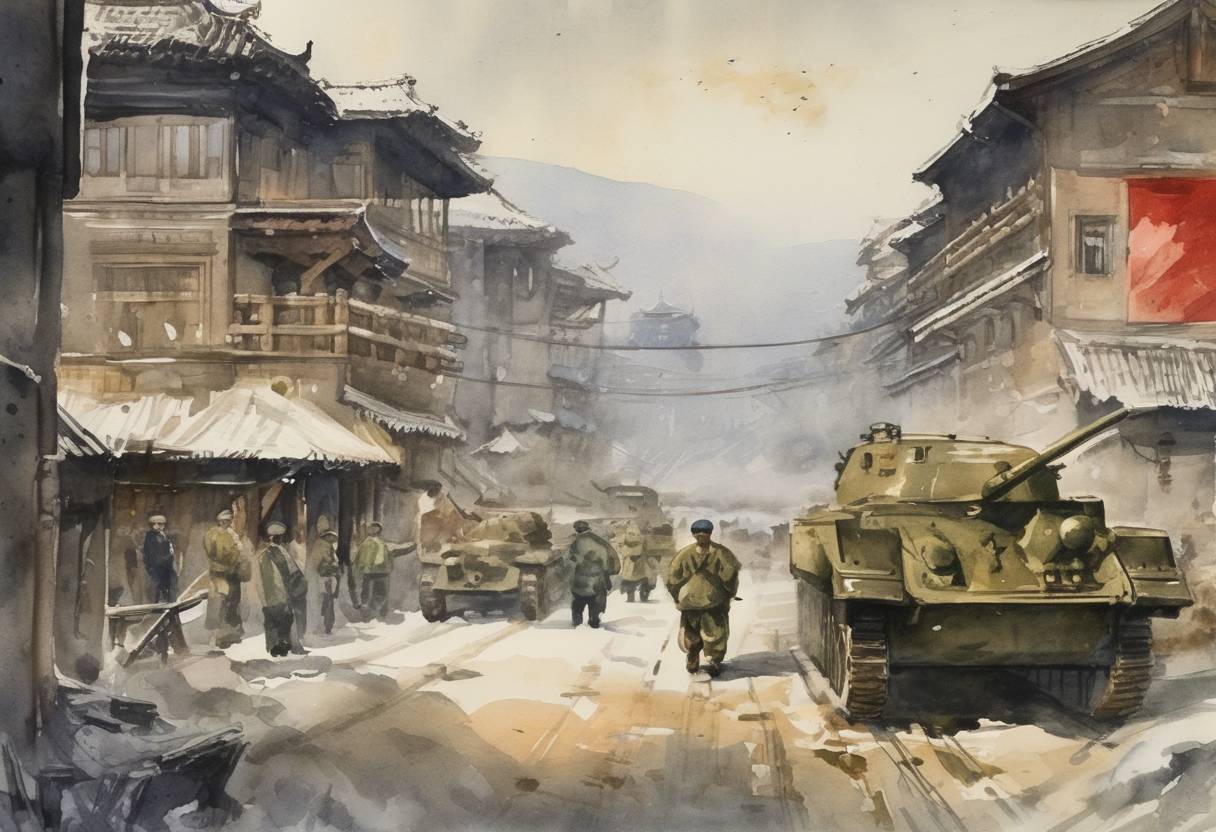
On August 8, 1945, the Soviet Union declared war on Japan and launched an invasion of Manchuria, a significant military campaign that played a crucial role in the final stages of World War II. This action was a fulfillment of a promise made by Soviet Premier Joseph Stalin to the Allies during the Yalta Conference earlier that year.
Yalta Conference (February 1945): During this pivotal meeting between the “Big Three” Allied leaders—U.S. President Franklin D. Roosevelt, British Prime Minister Winston Churchill, and Soviet Premier Joseph Stalin—Stalin agreed to enter the war against Japan within three months after the defeat of Nazi Germany. In return, the Soviet Union was promised territorial gains in Asia, including the southern part of Sakhalin Island and the Kuril Islands.
End of the European War: With the surrender of Nazi Germany in May 1945, the focus of the Allies shifted entirely to the Pacific Theater, where Japan continued to resist despite significant losses.
Strategic Importance: Manchuria, a region in Northeast China, was under Japanese control and served as a critical industrial and military base for Japan. The Soviet invasion aimed to dismantle Japanese power in the region and hasten Japan’s surrender.
Operation August Storm: The Soviet military operation, known as Operation August Storm, was a massive and well-coordinated offensive involving over 1.5 million Soviet troops. It was one of the largest and most successful campaigns of the war, characterized by rapid advances and overwhelming force.
Outcome: The Soviet forces quickly overran Japanese defenses, capturing key cities and infrastructure. The speed and effectiveness of the Soviet advance were instrumental in undermining Japanese military capabilities in the region.
Impact on Japan’s Surrender: The Soviet invasion of Manchuria, coupled with the atomic bombings of Hiroshima and Nagasaki by the United States, exerted immense pressure on Japan. These events contributed significantly to Japan’s decision to surrender unconditionally on August 15, 1945, effectively ending World War II.
Geopolitical Changes: The Soviet occupation of Manchuria and subsequent territorial gains reshaped the geopolitical landscape in East Asia. It also set the stage for future conflicts, including the Chinese Civil War and the Korean War, as the region adjusted to the post-war order.
Legacy: The Soviet entry into the war against Japan demonstrated the global reach and influence of the Soviet Union at the time. It also highlighted the complex interplay of military strategy and diplomatic agreements that characterized the Allied efforts to bring about the end of World War II.
In summary, the Soviet Union’s declaration of war on Japan and the invasion of Manchuria on August 8, 1945, was a decisive moment in the closing chapter of World War II, fulfilling a strategic promise made at Yalta and contributing to the swift conclusion of the conflict.
Source: en.wikipedia.org