Dieselgate Scandal: Volkswagen's Emissions Cheating Admission
2015 · Wolfsburg, Germany
Volkswagen admitted to cheating emissions tests in the United States, leading to the 'Dieselgate' scandal.
July 30, 2003
The last 'old style' Volkswagen Beetle rolls off the assembly line in Puebla, Mexico, marking the end of production for the iconic car model that began in 1938.
Puebla, Mexico | Volkswagen
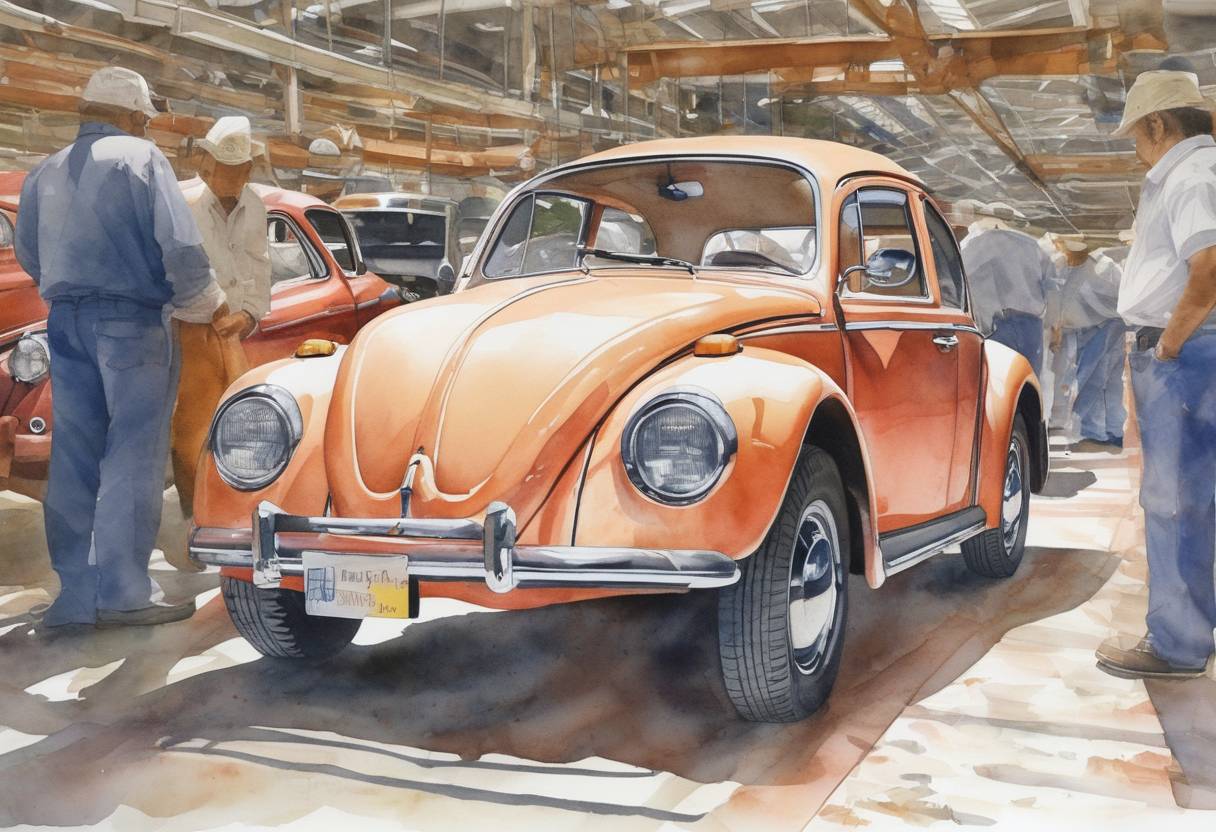
On July 30, 2003, a significant chapter in automotive history came to a close as the last ‘old style’ Volkswagen Beetle rolled off the assembly line in Puebla, Mexico. This event marked the end of production for one of the most iconic car models in history, a vehicle that had been in continuous production since 1938.
The Volkswagen Beetle, originally known as the “Volkswagen Type 1,” was conceived in the 1930s by Ferdinand Porsche at the behest of Adolf Hitler, who wanted a “people’s car” (Volkswagen in German) that was affordable and practical for the average German family. The car’s distinctive design, with its rounded shape and rear-engine layout, became instantly recognizable.
Production of the Beetle was interrupted by World War II but resumed in the post-war years, quickly gaining popularity worldwide. By the 1950s and 1960s, the Beetle had become a symbol of the counterculture movement in the United States and was celebrated for its reliability, simplicity, and affordability.
Global Popularity: The Beetle’s popularity soared globally, with production facilities established in various countries. By 1972, it had surpassed the Ford Model T as the world’s best-selling car.
Decline in Demand: By the late 1970s and 1980s, demand for the Beetle began to decline in favor of more modern vehicles. Production in Germany ceased in 1978, but continued in Brazil and Mexico, where the car remained popular.
Final Production in Mexico: The Puebla plant in Mexico became the last bastion of Beetle production. The car continued to be produced there primarily for the Latin American market, where it was affectionately known as the “Vocho.”
The final Beetle, a light blue model, was part of a special edition series called the “Última Edición” (Last Edition), which consisted of 3,000 units. This last car was sent to the Volkswagen museum in Wolfsburg, Germany, as a tribute to the car’s enduring legacy.
The end of the Beetle’s production in 2003 marked the conclusion of an era, but the car’s legacy continues to influence automotive design and culture. The Beetle remains a beloved classic, celebrated in car shows and collections worldwide. In 1998, Volkswagen introduced the “New Beetle,” a modern reinterpretation of the classic design, which further cemented the Beetle’s status as an enduring icon.
The Volkswagen Beetle is more than just a car; it is a cultural phenomenon that transcended its origins. It played a significant role in post-war economic recovery in Germany, became a symbol of the 1960s counterculture, and remains a testament to innovative automotive design. The Beetle’s story is a reflection of 20th-century history, embodying themes of industrialization, globalization, and cultural change.
In conclusion, the last ‘old style’ Volkswagen Beetle’s departure from the assembly line in 2003 was a poignant moment, marking the end of a remarkable journey for a car that left an indelible mark on the world.
Source: www.nytimes.com