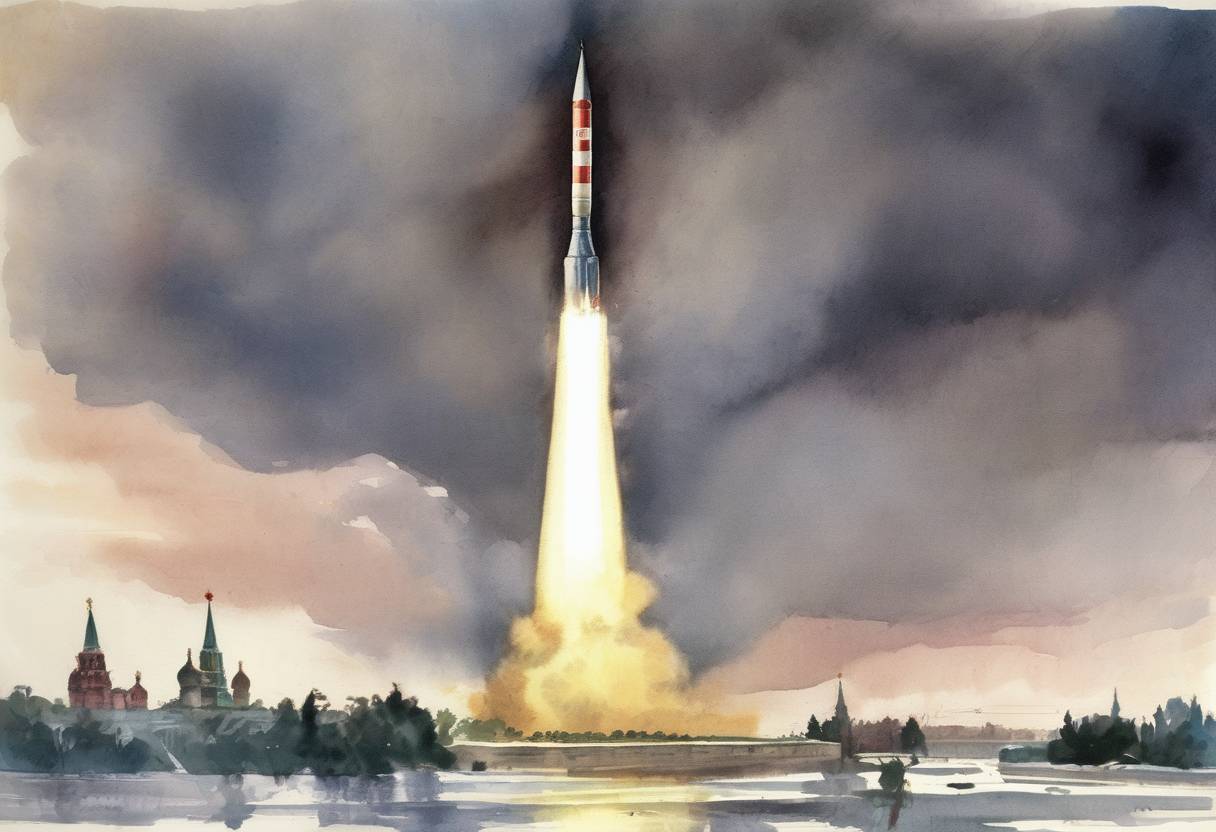
The Soviet Union’s Successful ICBM Test on August 26, 1957
On August 26, 1957, the Soviet Union announced a significant milestone in the Cold War arms race: the successful test of an intercontinental ballistic missile (ICBM). This event marked a pivotal moment in military technology and geopolitical dynamics, as it demonstrated the Soviet Union’s capability to deliver nuclear warheads across continents, thereby altering the strategic balance between the superpowers.
Background
The development of ICBMs was a crucial aspect of the Cold War, as both the United States and the Soviet Union sought to enhance their nuclear arsenals and delivery systems. The Soviet Union’s missile program had been in development for several years, spearheaded by prominent engineers and scientists, including Sergei Korolev, who played a key role in advancing Soviet rocket technology.
The Test
The missile tested on August 26, 1957, was the R-7 Semyorka, the world’s first ICBM. The R-7 was a two-stage rocket capable of delivering a nuclear payload over a distance of approximately 8,000 kilometers (about 5,000 miles). The successful test involved launching the missile from the Baikonur Cosmodrome in Kazakhstan, where it traveled a significant distance before reaching its target area.
Significance
Strategic Impact: The successful test of the R-7 ICBM significantly altered the strategic landscape of the Cold War. It demonstrated that the Soviet Union could potentially strike targets in the United States, thereby introducing a new level of deterrence and escalating the arms race.
Technological Advancement: The test underscored the Soviet Union’s technological capabilities and marked a leap forward in missile technology. It also paved the way for future advancements in space exploration, as the R-7 design would later be adapted for launching satellites, including Sputnik 1.
Political Ramifications: The announcement of the successful ICBM test heightened tensions between the United States and the Soviet Union. It prompted the U.S. to accelerate its own missile development programs and contributed to the intensification of the arms race.
Aftermath
Following the successful test, the Soviet Union continued to develop and deploy ICBMs, enhancing its nuclear deterrent capability. The United States responded by advancing its own missile technology, leading to a period of intense competition known as the “missile gap.” This era saw both superpowers amassing large arsenals of nuclear weapons, which played a central role in Cold War diplomacy and strategy.
The successful test of the R-7 ICBM on August 26, 1957, remains a landmark event in the history of the Cold War, symbolizing the technological prowess and strategic ambitions of the Soviet Union during this tense period.