The Torrijos-Carter Treaties: A Historical Overview
1977 · Washington, D.C., United States
The Torrijos-Carter Treaties were signed, guaranteeing Panama control over the Panama Canal after 1999.
November 18, 1903
The Hay-Bunau-Varilla Treaty was signed, granting the United States the rights to build the Panama Canal.
Washington, D.C., United States | United States Government
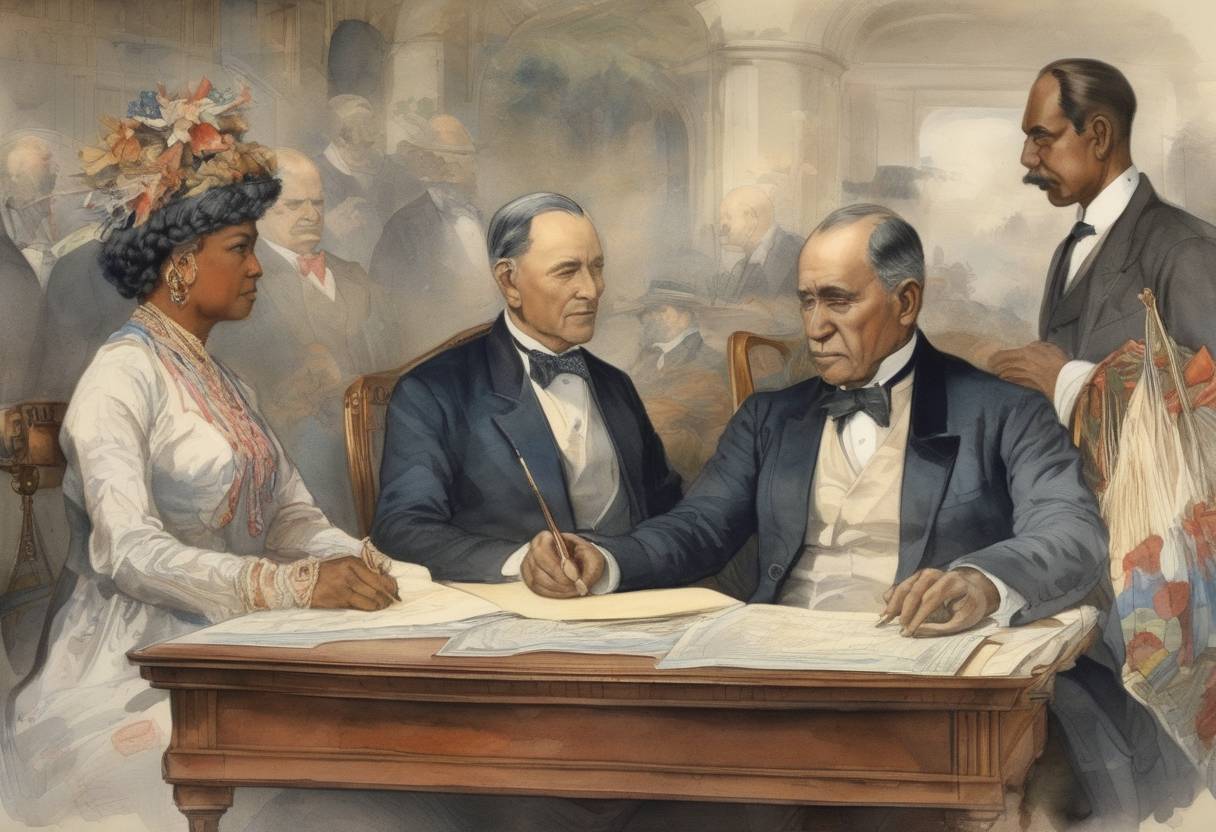
On November 18, 1903, the Hay-Bunau-Varilla Treaty was signed, marking a pivotal moment in the history of the Panama Canal and U.S.-Latin American relations. This treaty granted the United States the rights to construct and control the Panama Canal, a crucial maritime passage connecting the Atlantic and Pacific Oceans.
The idea of a canal across the Isthmus of Panama dates back to the early 16th century, but it wasn’t until the late 19th century that serious efforts were made to realize this vision. Initially, the French, led by Ferdinand de Lesseps, attempted to construct the canal in the 1880s. However, due to engineering challenges, financial difficulties, and high mortality rates among workers due to disease, the project was abandoned.
By the early 20th century, the United States, under President Theodore Roosevelt, recognized the strategic and economic importance of a canal. The U.S. initially negotiated with Colombia, which controlled Panama at the time, but these negotiations failed.
The Hay-Bunau-Varilla Treaty was named after U.S. Secretary of State John Hay and Philippe-Jean Bunau-Varilla, a French engineer and diplomat who represented the newly independent Republic of Panama. Just days before the treaty’s signing, Panama had declared its independence from Colombia, with support from the United States.
The Hay-Bunau-Varilla Treaty was a landmark in the history of engineering and international relations, setting the stage for the construction of one of the world’s most important waterways. The Panama Canal officially opened on August 15, 1914, transforming global trade routes and cementing the United States’ influence in the region.
Source: en.wikipedia.org