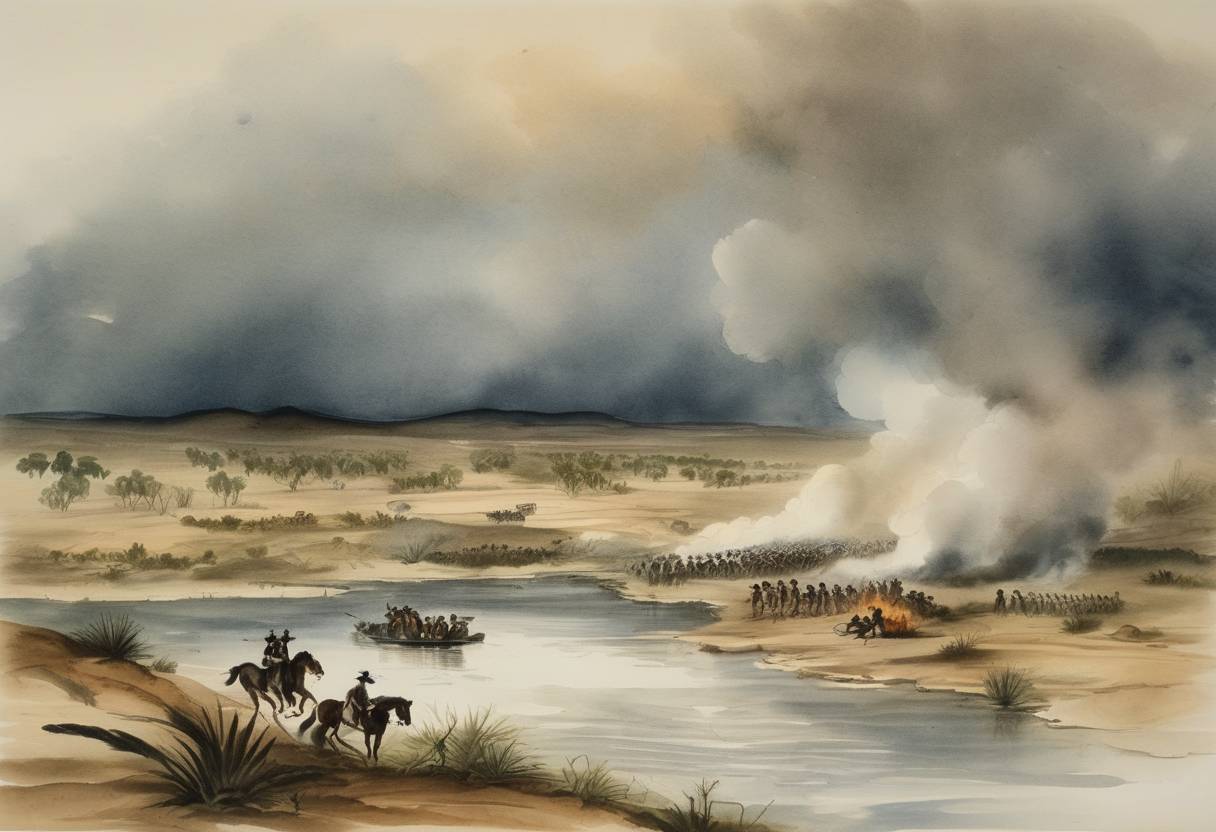
The Thornton Affair: April 25, 1846
The Thornton Affair was a pivotal military skirmish that significantly escalated tensions between the United States and Mexico, ultimately leading to the outbreak of the Mexican-American War. This conflict took place on April 25, 1846, in a disputed region along the Rio Grande, north of the river in an area claimed by both countries.
Background
The roots of the Thornton Affair can be traced back to the annexation of Texas by the United States in 1845. Following Texas’s independence from Mexico in 1836, the U.S. and Mexico were embroiled in a territorial dispute, with the U.S. claiming the Rio Grande as the southern boundary of Texas, while Mexico argued the boundary was at the Nueces River, further to the northeast.
In early 1846, President James K. Polk, a proponent of Manifest Destiny, sent U.S. troops under the command of General Zachary Taylor to the disputed territory between the Nueces River and the Rio Grande. Their presence was intended to assert U.S. claims over the area, provoke a response from Mexico, and potentially justify a declaration of war.
The Skirmish
On April 25, 1846, a detachment of about 70 U.S. dragoons, led by Captain Seth Thornton, was dispatched to patrol the terrain near the Rio Grande. This contingent unknowingly encountered a significantly larger Mexican force of nearly 2,000 troops under the command of Colonel Anastasio Torrejón.
The confrontation led to a brief engagement, during which the overwhelming Mexican forces encircled and attacked the U.S. patrol. The clash resulted in the death or capture of several U.S. soldiers, with Thornton and his remaining men taken as prisoners. The loss underscored the volatile situation in the contested territory.
Aftermath
The attack on U.S. forces was promptly reported to President Polk, who used the incident to justify a call for war against Mexico. On May 11, 1846, Polk informed Congress of the skirmish, asserting that Mexico had “shed American blood upon American soil.” This message, coupled with the existing expansionist sentiment, led Congress to declare war on Mexico on May 13, 1846.
Broader Significance
The Thornton Affair marked the official outset of open hostilities in the Mexican-American War, a conflict lasting until 1848. The war ended with the Treaty of Guadalupe Hidalgo, which resulted in Mexico ceding vast territories to the United States, including present-day California, Arizona, New Mexico, and parts of Colorado and Nevada. This expansion significantly shaped the future territorial and political landscape of the United States.