The Battle of Capo Colonna: July 13, 982
982 · Capo Colonna, Italy
The Battle of Capo Colonna takes place, where the forces of the Holy Roman Emperor Otto II are defeated by the Muslim forces of the Emirate of Sicily.
June 14, 0982
Otto II, Holy Roman Emperor, defeats an Arab force near Crotone in Southern Italy, marking a significant moment in his campaign to extend influence into Italy.
Crotone, Italy | Holy Roman Empire
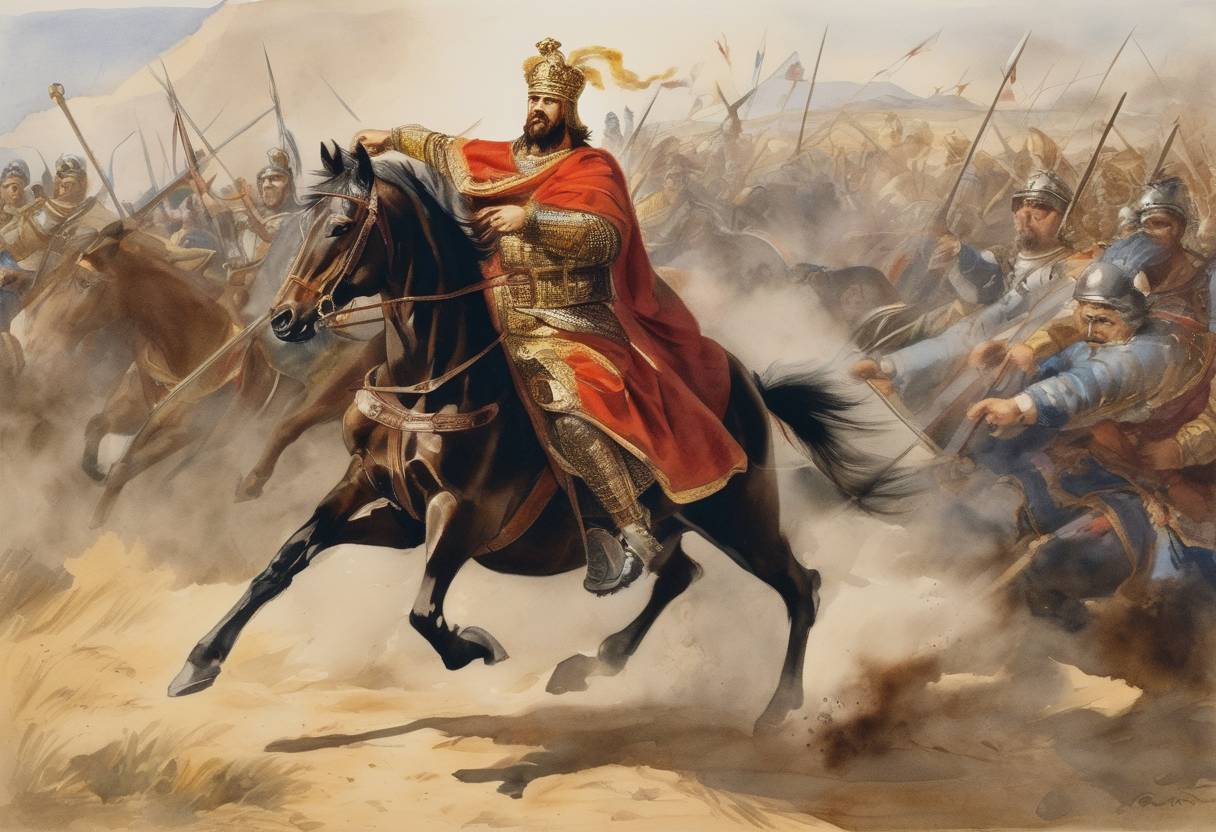
On June 14, 982, Otto II, Holy Roman Emperor, achieved a significant military victory near Crotone in Southern Italy, marking a crucial moment in his efforts to solidify and expand Imperial influence across Italy. This battle, often referred to as the Battle of Stilo, was part of a larger campaign aimed at curbing the expansion of Muslim forces and securing the southern Italian territories.
Otto II, who ascended to the throne in 973, inherited an empire that faced significant external pressures, particularly from the Muslim forces who had established footholds in the Mediterranean, including the island of Sicily and parts of Southern Italy. The emperor’s strategic interest in Italy was driven both by the need to confront these threats and by the ambition to consolidate Imperial control over the fractured Italian principalities.
The confrontation near Crotone witnessed Otto II leading his forces against the Emirate of Sicily’s troops, who were expanding their influence on the Italian peninsula. The battle was part of Otto’s broader offensive aimed at securing the Byzantine’s southern Italian territories and asserting dominance. The clash was intense and characterized by the harsh conditions of Southern Italy, which posed logistical challenges for both sides.
Despite initial success in this engagement, which disrupted the Arab forces’ plans, Otto’s victory was not without losses and setbacks. Though he achieved a tactical win at Crotone, the broader campaign eventually faced difficulties culminating in a major defeat at the Battle of Capo Colonna later in 982. This defeat, where Otto narrowly escaped with his life, highlighted the challenges of maintaining control and preserving gains against well-entrenched opponents.
The events around this battle underscore the turbulent dynamics of 10th-century Italy, a theater of competition among emerging European powers, the Papacy, and Muslim emirates. Otto II’s campaign reflects the complex interplay of military might and strategic diplomacy in medieval Europe, shaped by both local and wider Mediterranean geopolitical currents.
Despite setbacks in the south, Otto II’s actions contributed to the larger narrative of the Holy Roman Empire’s intermittent influence over Italian territories, setting the stage for future endeavors by his successors to unify and stabilize these regions under Imperial authority. His efforts echoed throughout history as part of the longstanding contest between Christian Europe and the Muslim states of the Mediterranean.
Source: en.wikipedia.org