USS Triton's Submerged Circumnavigation: May 10, 1960
1960 · New London, United States
The nuclear submarine USS Triton completes the first submerged circumnavigation of the globe.
June 9, 1959
The USS George Washington, the first submarine to be built from keel up as a guided missile firing submarine, is launched.
Groton, United States | United States Navy
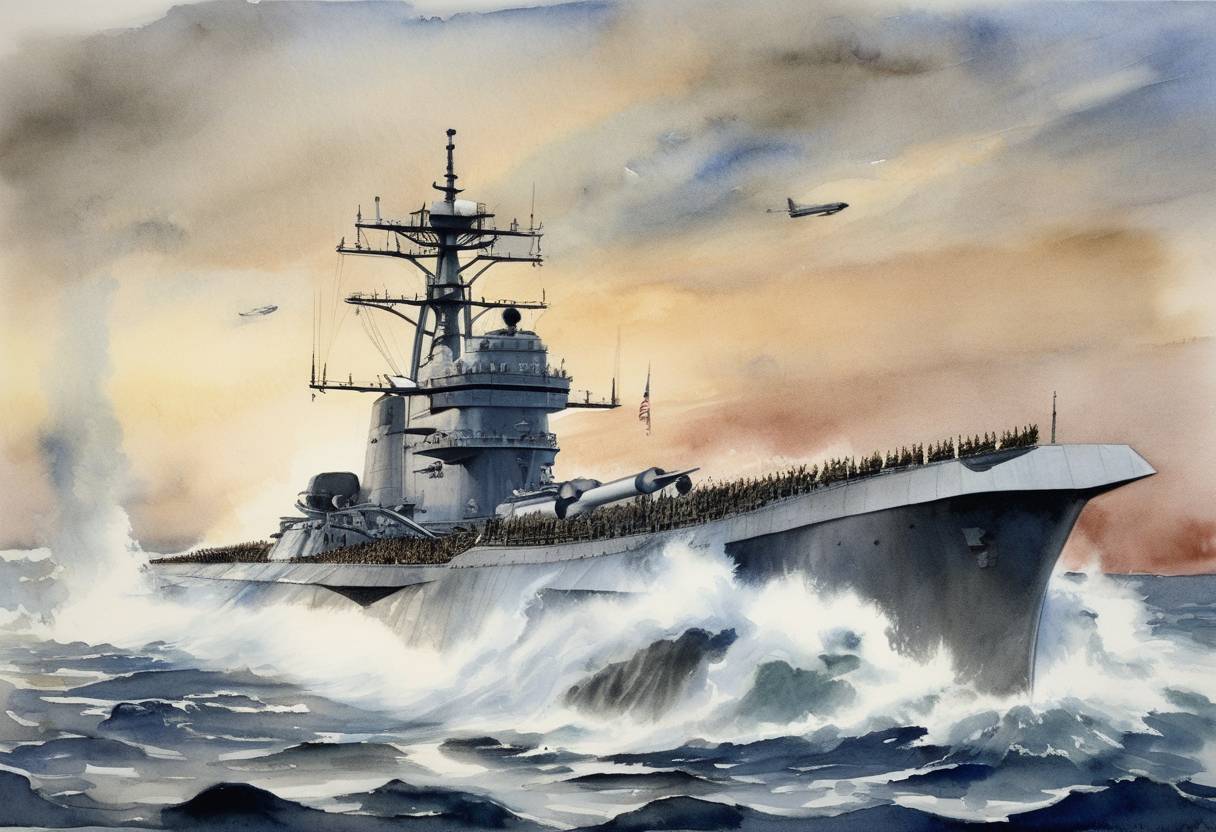
On June 9, 1959, the United States Navy launched the USS George Washington (SSBN-598), marking a pivotal moment in naval history as it became the first submarine built from the keel up to be a ballistic missile submarine. This event took place in Groton, Connecticut, at the Electric Boat Division of General Dynamics, heralding a new era in strategic nuclear deterrence.
The USS George Washington was a groundbreaking project for the U.S. Navy, representing a significant advancement in submarine warfare technology. The Cold War had prompted the United States to develop new strategies and technologies for nuclear deterrence. The idea was to create a platform capable of carrying and launching long-range missiles from submerged positions, thus providing a stealthy and mobile launch capability that was hard to detect and neutralize.
Construction of the USS George Washington began in 1958. The submarine was based on the existing Skipjack-class submarines but was specifically adapted and designed to carry the Polaris ballistic missile, a new type of underwater-launched missile. This integration of missile technology into submarine design significantly enhanced the strategic capabilities of the United States.
The launch of the USS George Washington signified a transformative step in naval weapons systems. With its ability to remain hidden and mobile underwater, the submarine added a new dimension of security, effectively changing nuclear strategy worldwide by providing a second-strike capability that was less vulnerable to enemy attacks.
Equipped with 16 Polaris missiles, the submarine could patrol undetected for extended periods. This capability acted as a deterrent against potential adversaries, underpinning the doctrine of Mutual Assured Destruction (MAD) by ensuring that a retaliatory strike could be launched even if the United States was attacked first.
After her commissioning in December 1959, USS George Washington conducted several successful test launches of the Polaris missiles, demonstrating the viability of strategic missile submarines. This class of submarines played a crucial role throughout the Cold War, becoming the backbone of the United States’ nuclear triad.
The success of the USS George Washington led to the construction of more ballistic missile submarines, collectively known as the “41 for Freedom” boats. These submarines were instrumental in maintaining a balance of power between the United States and the Soviet Union.
In conclusion, the launch of the USS George Washington on June 9, 1959, marked a significant advancement in military technology and strategy, highlighting the ongoing evolution of naval forces and their role in global security.
Source: www.history.navy.mil