The Battle of Gravelines: July 13, 1558
1558 · Gravelines, France
The Battle of Gravelines took place during the Italian War of 1551–1559, where the Spanish forces defeated the French.
September 4, 1557
The Battle of St. Quentin, an engagement in the Italian War of 1551–1559, was concluded with a decisive victory for the Spanish and allied forces over France, severely weakening French influence.
Saint-Quentin, France | Spanish Empire
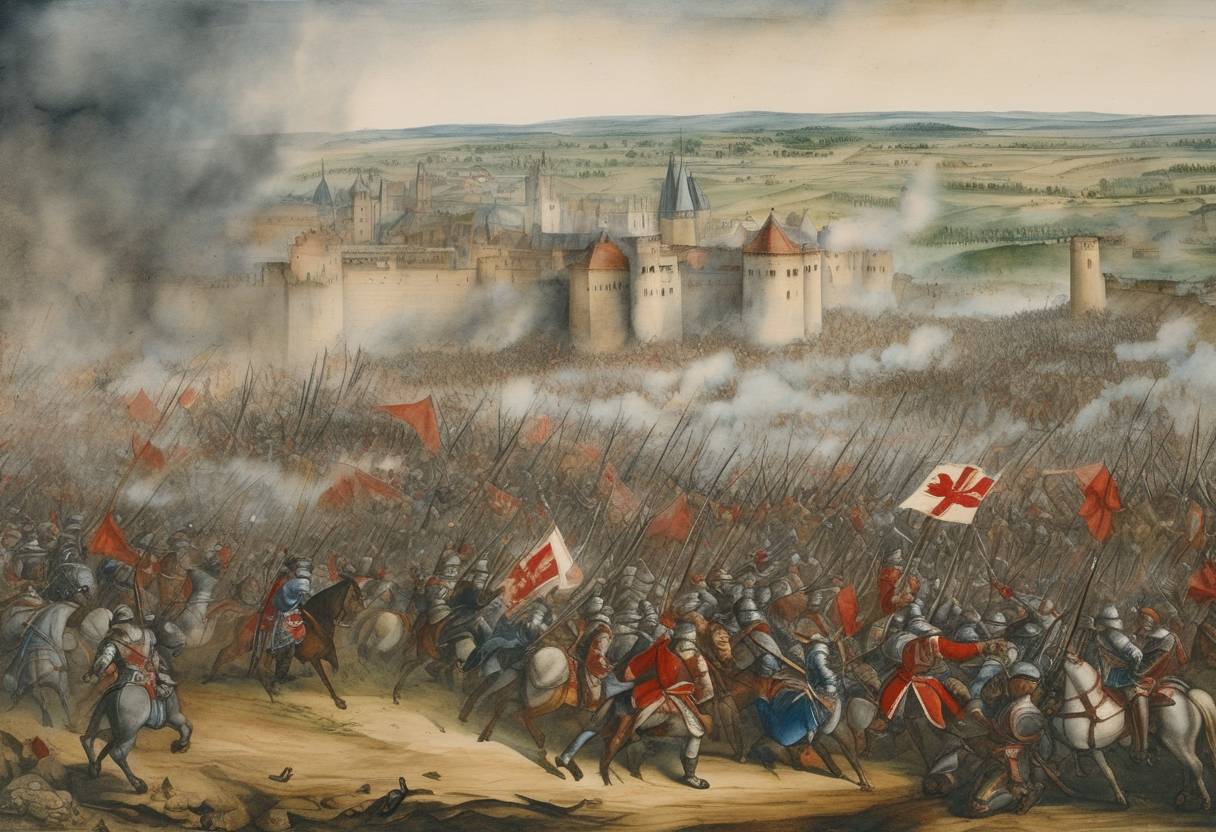
The Battle of St. Quentin, fought on August 10, 1557, was a significant military engagement during the Italian War of 1551–1559, marking a pivotal moment in the conflict between Spain and France. Despite being part of the larger series of conflicts known as the Italian Wars, this battle specifically demonstrated the shifting balance of power towards the Spanish and its allies, significantly altering the geopolitical landscape of the time.
The Italian War of 1551–1559 was primarily driven by territorial disputes between the Valois monarchy of France and the Holy Roman Empire, led by the Habsburgs of Spain. The ascendancy of Charles V and later his son Philip II as monarchs of Spain matched against Henry II of France fueled this ongoing rivalry. Key European powers were drawn into the conflict, with Spain aligning with England and Savoy, and France securing alliances with Scotland and the Papal States.
The Spanish coalition was commanded by Duke Emmanuel Philibert of Savoy, an accomplished general under the service of King Philip II of Spain. The French forces were led by the experienced Constable Anne de Montmorency. The Spanish army outnumbered the beleaguered French, supported by a well-coordinated contingent of English and Netherlandish troops, which showcased a blend of military innovation and strategic acumen.
The battle commenced on August 10, 1557, near the town of Saint-Quentin in Picardy, northern France. Taking advantage of their superior position and the element of surprise, the Spanish forces assaulted the French positions during a critical time when Montmorency sought to reinforce his siege of the town. The Spaniards utilized their artillery to great effect, breaching the defenses rapidly and surrounding the French troops.
The Spanish victory at St. Quentin was both decisive and demonstrative of the Habsburg military supremacy. With significant casualties, including many high-ranking French officers captured or killed, France’s hold in the region was severely undermined. The defeat forced King Henry II of France to sue for peace, leading eventually to the Treaty of Cateau-Cambrésis in 1559. This treaty confirmed Spanish dominance in Italy and other territories, while France was left to rebuild its military and political strategies.
Furthermore, the battle had profound implications for the internal politics of France. It weakened the central authority of the Valois monarchy and accelerated factional rivalries within the French nobility, sowing the seeds for future civil strife.
The Battle of St. Quentin stands as a testament to the significance of military strategy and coalition warfare during the Italian Wars, highlighting the complex interplay of power politics and dynastic ambition in 16th-century Europe.
Source: example.com