Establishment of the French Foreign Legion - March 10, 1831
1831 · Paris, France
The French Foreign Legion is established by King Louis-Philippe to support troops in Algeria.
December 7, 1815
Michel Ney, a Marshal of France, was executed by firing squad for treason following his role in supporting Napoleon during the Hundred Days.
Paris, France | French Government
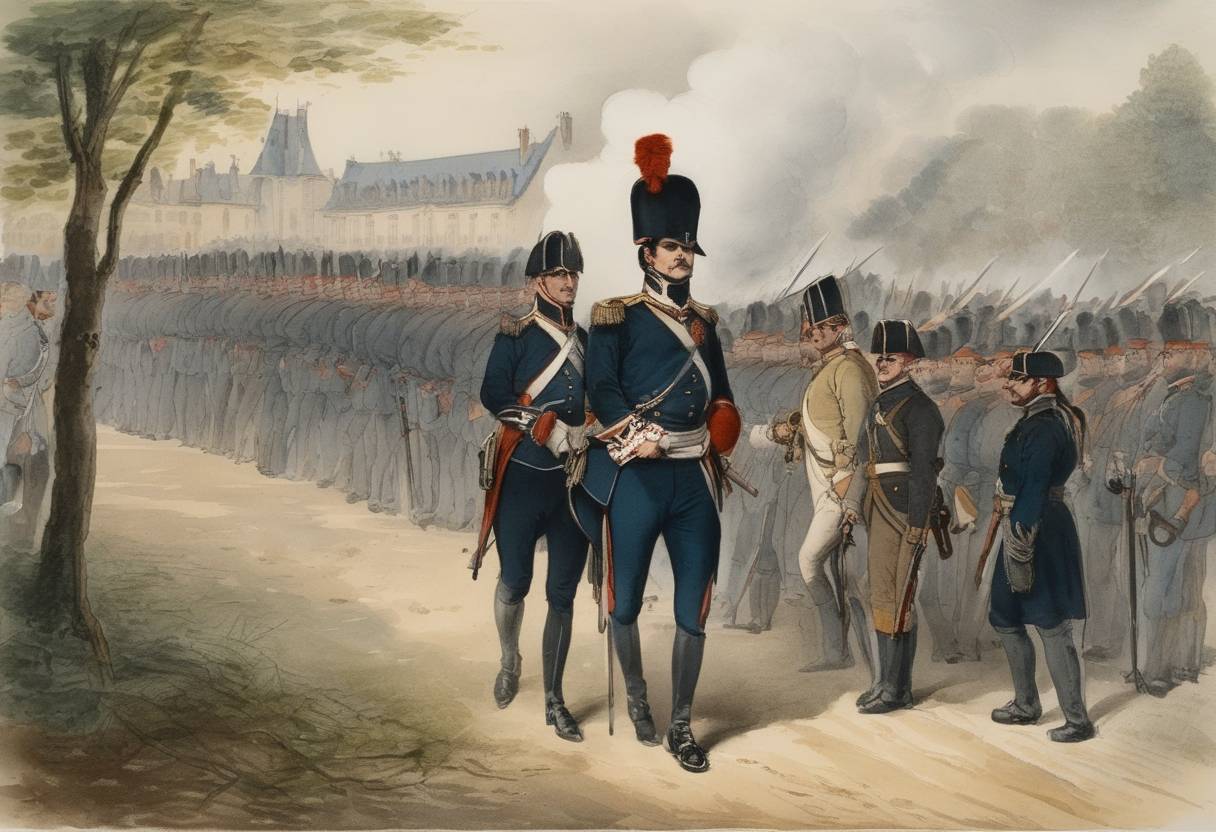
On December 7, 1815, Michel Ney, one of Napoleon Bonaparte’s most renowned Marshals, was executed by firing squad for treason in Paris, France. Ney’s execution marked the end of a turbulent period following Napoleon’s return from exile, known as the Hundred Days.
Michel Ney, born in 1769 in Saarlouis, rose through the ranks of the French Revolutionary Army to become one of Napoleon’s most trusted commanders. He was made a Marshal of France in 1804 and gained the nickname “the Bravest of the Brave” for his leadership during numerous Napoleonic Wars engagements, including the battles of Elchingen, Friedland, and Borodino.
After Napoleon’s initial abdication in 1814, Ney pledged loyalty to the restored monarchy of Louis XVIII. Despite his promise to bring Napoleon back to Paris in an iron cage, Ney defected to Napoleon’s side when the Emperor escaped from Elba in March 1815. Ney’s support was crucial to Napoleon’s brief return to power during the Hundred Days.
Following Napoleon’s defeat at the Battle of Waterloo in June 1815 and his subsequent second abdication, Ney was arrested by the restored Bourbon regime led by Louis XVIII. He was charged with treason due to his earlier pledge of allegiance to the monarchy and his subsequent defection to Napoleon.
Ney’s trial was politically charged, with many regarding it as a symbol of the restored monarchy’s effort to reassert control after the chaotic years of revolution and Napoleonic rule. Despite appeals and arguments that Ney’s actions were driven by a broader patriotism and lingering doubts about the legitimacy of the restored monarchy, Ney was found guilty of treason.
On December 7, 1815, Ney was executed by firing squad in the gardens of the Luxembourg Palace. Displaying his characteristic courage, Ney himself gave the command to fire, refusing to be blindfolded and reportedly declaring, “Soldiers, when I give the command to fire, fire straight at my heart.”
Ney’s execution was met with mixed reactions. To royalists, it represented a necessary step in consolidating the restoration of the monarchy. To others, especially Bonapartist sympathizers, Ney became a martyr—a symbol of loyalty and tragedy amid France’s turbulent political transformations.
The execution of such a prominent military figure underscored the shifting allegiances and harsh reprisals that characterized post-Napoleonic France. Ney’s reputation as a military leader endured, with even his adversaries acknowledging his bravery and skill on the battlefield. His legacy continued to be honored in military history as one of Napoleon’s most dedicated and formidable commanders.
Source: www.britannica.com