First Five-Man College Basketball Game - January 16, 1896
1896 · Iowa City, United States
The first college basketball game with five-man teams was played by the University of Iowa and the University of Chicago in Iowa City, Iowa.
October 7, 1916
Georgia Tech defeats Cumberland University 222-0 in the most lopsided college football game in American history.
Atlanta, United States | Georgia Institute of Technology
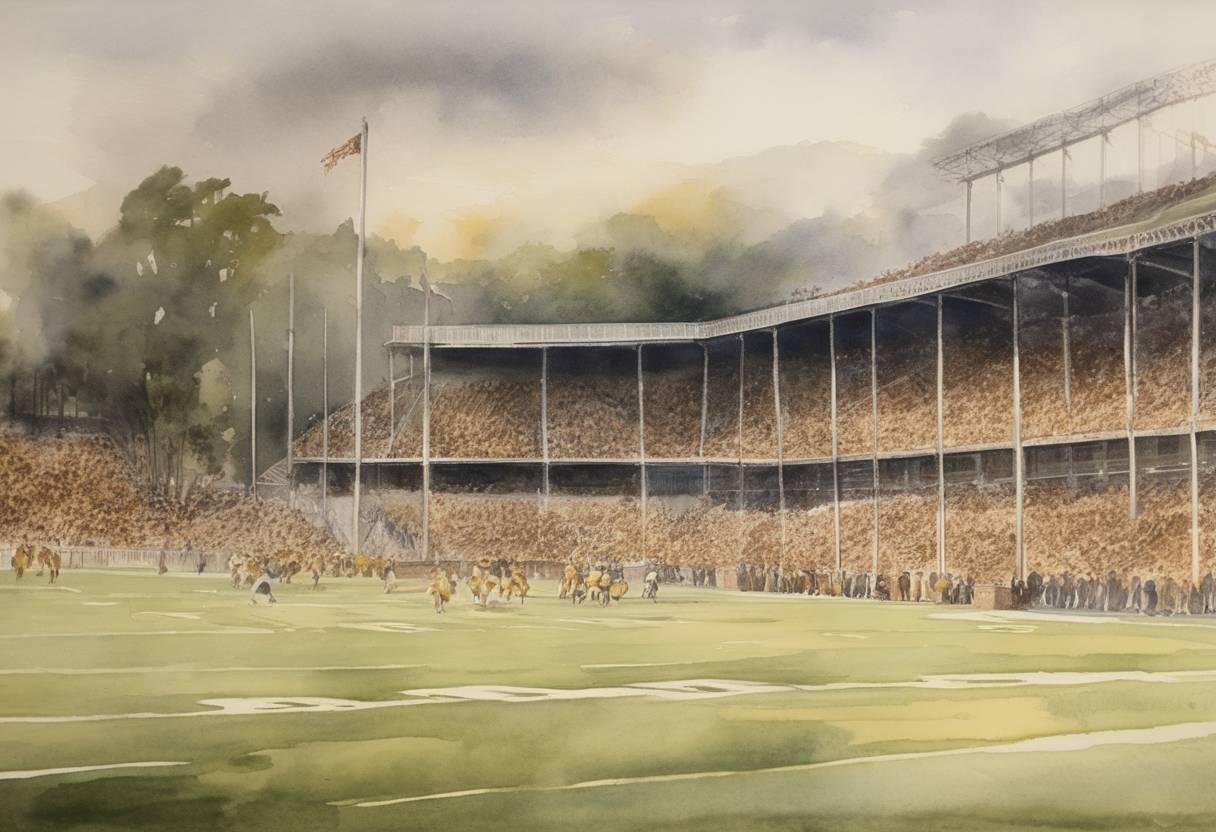
On October 7, 1916, Georgia Tech Engineers defeated Cumberland University Bulldogs with a score of 222-0 in what is widely recognized as the most lopsided college football game in American history. This game, held at Grant Field in Atlanta, Georgia, stands as a testament to the offensive strategy and coaching prowess of John Heisman, the head coach of Georgia Tech.
The events leading up to the game reveal a curious and somewhat controversial narrative. Cumberland University had discontinued its football program before the 1916 season due to financial difficulties. However, Cumberland was obligated to fulfill their scheduled games to avoid a significant breach of contract penalty, which included a game against Georgia Tech.
Coach John Heisman, who was also an ardent critic of dishonest play and sportsmanship in football, insisted on Cumberland playing to exact revenge for an earlier defeat in baseball, where Cumberland allegedly fielded semi-professional players. To ensure the game took place, Heisman reportedly offered to pay Cumberland’s travel expenses.
Georgia Tech’s domination began as they took advantage of Cumberland’s makeshift team, comprised mostly of students with minimal experience. They executed a relentless and well-coordinated offense, scoring 32 touchdowns and 30 extra points. The Engineers utilized their full suite of players, often swapping them out to ensure continued high-level performance. The first quarter alone ended with a 63-0 lead for Georgia Tech. By halftime, the score was 126-0, and the trend continued unbated through the second half.
Cumberland’s inability to advance the ball or halt Georgia Tech’s offense resulted in a series of turnovers, including multiple interceptions and fumbles. Georgia Tech did not attempt a single pass throughout the game, showcasing a powerful running game instead.
The outcome of this game remains pivotal in the historical landscape of college football. It highlighted issues of sportsmanship, competitiveness, and the financial implications associated with collegiate sports scheduling. Furthermore, the lopsided nature of the match contributed to growing discourse around rule changes that aimed to promote competitive balance and sportsmanship, eventually influencing the evolution of the game into a more equitable spectacle.
The legacy of the game lives in sports history as an example of the disparities that can exist in athletic talent and the lengths institutions might go to maintain athletic schedules. John Heisman himself, for whom the prestigious Heisman Trophy is named, remains a significant figure in the establishment of strategic football coaching and the promotion of integrity in the sport.
This game is a quintessential moment in college sports history, echoing the sometimes dramatic and unpredictable nature of athletic competition.
Source: en.wikipedia.org