The Siege of Lisbon: A Pivotal Moment in the Second Crusade
1147 · Lisbon, Portugal
The Siege of Lisbon ends as the city is captured by Afonso I of Portugal and his Christian forces, marking a significant victory during the Second Crusade.
December 31, 1147
The Siege of Lisbon concluded in a decisive Christian victory during the Second Crusade, leading to the establishment of the Kingdom of Portugal as a recognized Christian kingdom, eventually contributing to the expansion over the Iberian Peninsula.
Lisbon, Portugal | Crusaders
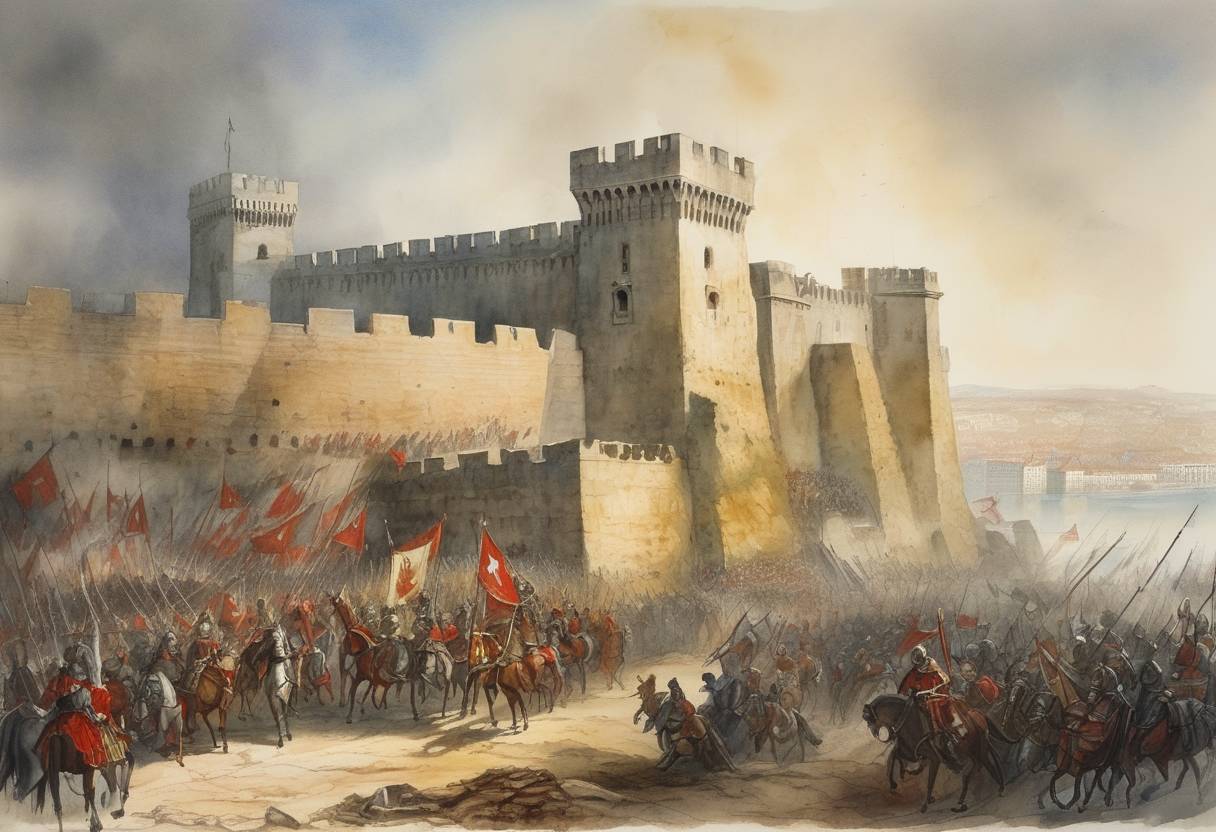
The Siege of Lisbon was a pivotal event during the Second Crusade, marking a decisive Christian victory and solidifying the establishment of Portugal as a recognized Christian kingdom. However, the siege itself concluded on October 25, 1147, rather than December 31, 1147.
The Second Crusade (1147–1150) was launched in response to the fall of the County of Edessa, but its influence extended to the Iberian Peninsula, where Christian forces aimed to reclaim territories from Muslim control. Portugal, then led by King Afonso I, sought to expand and secure its borders against the Almoravid Muslims. The siege provided an opportunity for Afonso to gain valuable military assistance from passing Crusaders.
The involvement of Crusaders en route to the Holy Land was crucial. These Crusaders, drawn mainly from England, Flanders, and some from Germany, were persuaded by King Afonso I to assist in seizing Lisbon, the strategic port city controlled by the Moors.
The siege began on July 1, 1147, as Christian forces laid a prolonged attack on Lisbon. Under the leadership of King Afonso I and supported by a formidable Crusader army, the siege sustained for approximately four months. The Christians implemented both land and maritime blockades, gradually wearing down the defenses of the Moorish inhabitants.
Persistent attacks, combined with fortuitous internal strife and lack of supplies, weakened the city’s resistance. On October 24, 1147, the city’s defenders agreed to surrender terms. By the morning of October 25, 1147, Lisbon was officially under Christian control. The terms granted safety to the Muslim inhabitants as they departed, an uncommon outcome in sieges of the era.
The successful capture of Lisbon was a major contribution to the Christian Reconquista, a long-standing effort to reclaim Iberian territories from Muslim rule. The victory consolidated King Afonso I’s power, strengthening his rule and Portugal’s territorial claims.
The fall of Lisbon also signaled to the wider Christian world that significant victories were achievable in the Iberian Peninsula. Lisbon’s capture helped spur further military campaigns in the region, fostering the eventual expansion and solidification of Christian states.
The siege underscored the efficacy of alliances between local rulers and Crusaders while enhancing Lisbon’s standing as a vital urban center. By establishing trade and securing local stability, Lisbon would eventually develop as a cornerstone for future Portuguese maritime endeavors, considerably shaping the region’s history and its role in global exploration.
Despite the discrepancy in the dates, the Siege of Lisbon represents a cornerstone in the history of medieval Europe, illustrating the profound impacts of the Crusades beyond their intended scope.
Source: www.history.com