Second Italo-Ethiopian War Begins: October 2, 1935
Context
The Second Italo-Ethiopian War, a significant conflict that marked an aggressive expansion of Fascist Italy, began on October 2, 1935, with the invasion of Ethiopia under the command of Italian dictator Benito Mussolini. This was not Italy’s first attempt to conquer Ethiopia; a previous attempt had failed in the Italo-Ethiopian War of 1895-1896, in which Ethiopia retained its sovereignty after its victory at the Battle of Adwa.
Key Events Leading Up to the Invasion
Mussolini’s ambitions aimed at expanding Italy’s colonial empire by capturing Ethiopia, a nation rich in cultural heritage and one of the few Africa countries not yet colonized by European powers. Citing a skirmish at the Walwal oasis in December 1934 as a pretext, where clashes occurred between Ethiopian and Italian forces, Mussolini claimed that Ethiopian aggression necessitated a military response.
Mussolini sought to demonstrate Italian military prowess and provide a sense of nationalism and pride to his Fascist regime. The plan received initial tacit acceptance from major world powers, who were preoccupied with their internal states or other international engagements, despite Ethiopia’s membership in the League of Nations, which was founded on principles of collective security and conflict resolution.
The Invasion
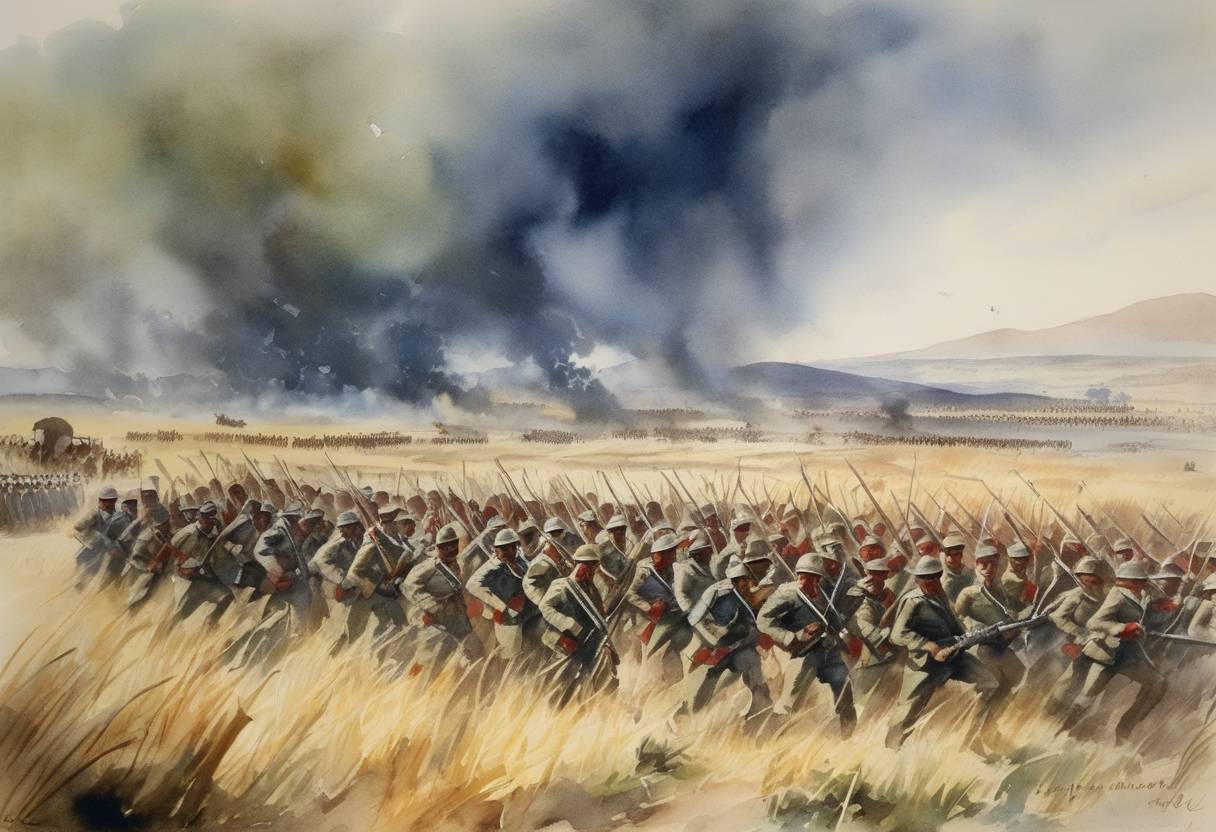
On October 2, 1935, Mussolini ordered the Italian armed forces to invade Ethiopia, an operation that began with air raids. Italian forces, well-equipped with modern weaponry, including tanks and aircraft, crossed into Ethiopian territory from Eritrea in the north and Italian Somaliland in the southeast. Ethiopian forces, despite their larger numbers, were equipped with outmoded arms and faced significant challenges due to Italy’s modern military machinery and tactics.
The invasion was marked by brutal warfare, with Italy employing chemical weapons and engaging in widespread atrocities against the Ethiopian populace. Despite courageous resistance by Ethiopian troops, who were commanded primarily by their Emperor Haile Selassie, the technological and logistical superiority of the Italians gave them the upper hand.
Aftermath and Consequences
The League of Nations, tasked with maintaining peace, proved ineffective in stopping the invasion. Although it imposed economic sanctions, these were insufficient and poorly enforced, highlighting the weakness of the League’s collective security mechanism.
By May 1936, after several months of fighting, Italian forces managed to capture Addis Ababa, the Ethiopian capital, leading to the eventual annexation of Ethiopia into Italian East Africa. Haile Selassie fled to exile, making a famous appeal to the League of Nations in June 1936, highlighting the aggression and pleading for international intervention, albeit to little effect.
The successful invasion by Mussolini’s forces had long-standing repercussions, bolstering Italy’s imperial ambitions but also contributing to global tensions that would eventually escalate into World War II. The event underscored the fragility of international peacekeeping institutions of the time and the aggressive expansionist policies of totalitarian regimes during the interwar period.