The Battle of Marengo: June 14, 1800
1800 · Marengo, Italy
The Battle of Marengo takes place, where Napoleon Bonaparte's French forces defeat the Austrians in Italy.
October 17, 1797
The Treaty of Campo Formio is signed between France and Austria, ending the War of the First Coalition in favor of France. This treaty resulted in significant territorial gains for France and ended Austria's participation in the first phase of the French Revolutionary Wars.
Campo Formio, Italy | French Republic
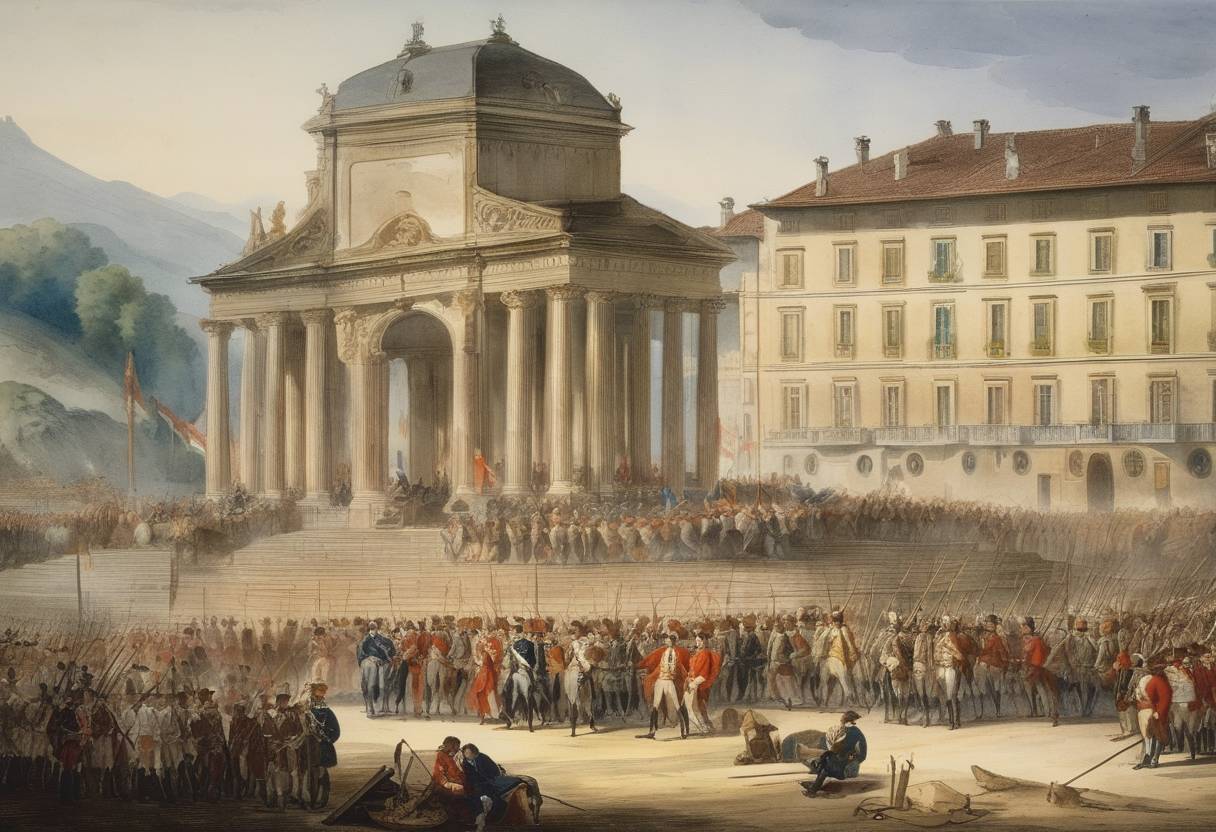
On October 17, 1797, the Treaty of Campo Formio was signed between France and Austria, marking the end of the War of the First Coalition and resulting in significant territorial realignments in Europe. This peace agreement was largely negotiated by the French military leader, General Napoleon Bonaparte, following his successful Italian campaign.
The War of the First Coalition (1792-1797) was part of a broader series of conflicts collectively known as the French Revolutionary Wars. These wars were sparked by revolutionary France’s attempts to spread its new republican ideals and secure its borders against hostile monarchies. France faced a coalition comprised primarily of Austria, Prussia, Great Britain, and various other European powers aimed at countering the revolutionary threat.
Napoleon Bonaparte’s military prowess in the Italian Peninsula was instrumental in shifting the balance in favor of France. After a series of decisive victories, most notably the Battle of Arcola and the Siege of Mantua, Napoleon advanced into Austrian territory, compelling Austria to negotiate.
The Treaty of Campo Formio resulted in several crucial territorial and political shifts:
The Treaty of Campo Formio had significant implications in European geopolitics:
In essence, the treaty not only marked the end of the first phase of the French Revolutionary Wars but also demonstrated the diplomatic shift accompanying France’s military victories. The implications of Campo Formio reverberated through Europe, influencing political dynamics well into the 19th century.
Source: www.britannica.com