Launch of USS George Washington (SSBN-598)
1959 · Groton, United States
The USS George Washington, the first submarine to be built from keel up as a guided missile firing submarine, is launched.
September 30, 1954
The first atomic powered ship, the USS Nautilus, is commissioned by the U.S. Navy.
Groton, United States | U.S. Navy
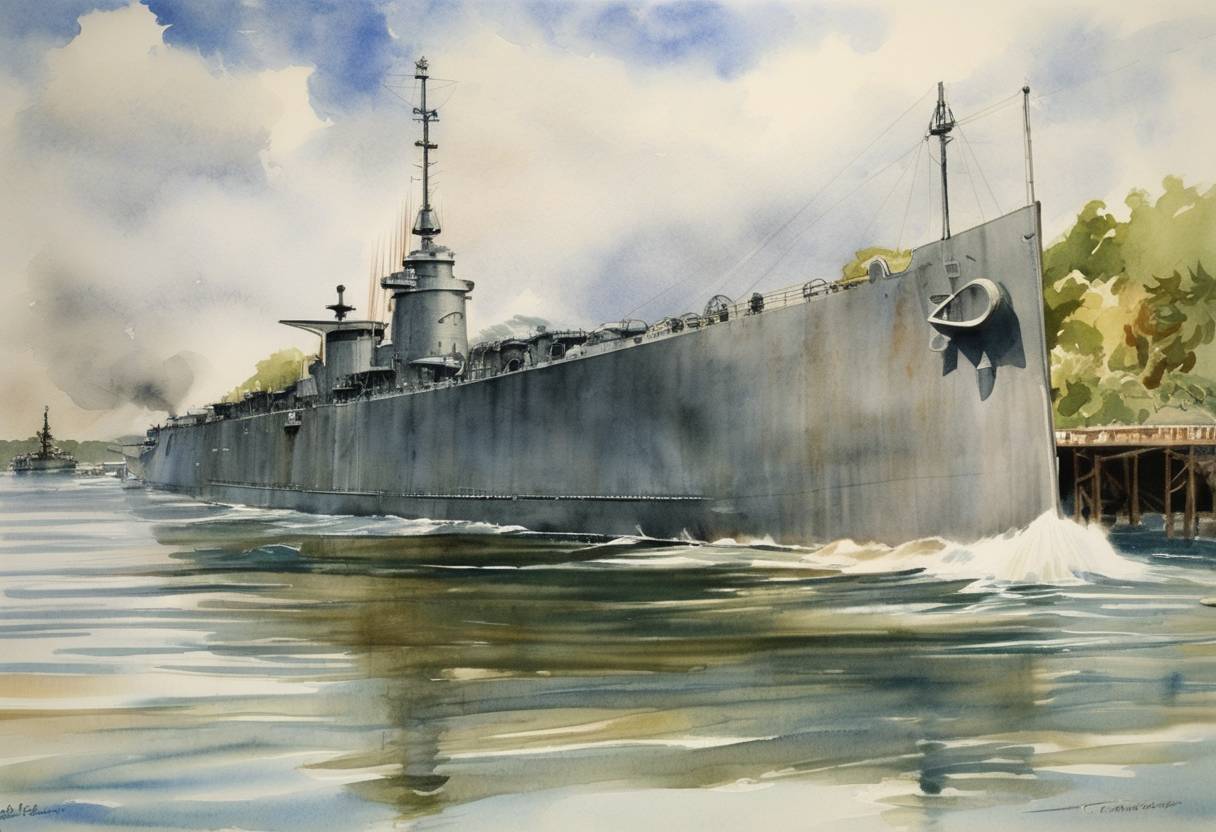
The commissioning of the USS Nautilus (SSN-571) on September 30, 1954, marked a monumental milestone in naval and technological history as the world’s first operational nuclear-powered submarine. This event introduced a new era in military maritime capabilities and nuclear technology.
The development of the USS Nautilus stemmed from the United States’ post-World War II interest in expanding nuclear technology beyond weapons. The idea of a nuclear-powered submarine was motivated by the potential for extended underwater operations, independent of refueling, which would grant strategic advantages over conventional diesel-electric submarines.
The concept took shape under the leadership of Admiral Hyman G. Rickover, often referred to as the “Father of the Nuclear Navy.” He advocated for nuclear propulsion’s revolutionary capabilities, which offered virtually unlimited range and endurance due to the energy-density of nuclear fuel compared to diesel.
Construction of the USS Nautilus began with its keel laying on June 14, 1952, at the Electric Boat Division of General Dynamics in Groton, Connecticut. The submarine was officially launched into the Thames River on January 21, 1954, in a ceremony attended by prominent figures, including Mamie Eisenhower, who sponsored the ship.
The commissioning of the Nautilus on September 30, 1954, was a formal process that brought the submarine into active duty with the U.S. Navy. The ceremony solidified its status as the first of a new class of submarines, capable of dramatic operational changes due to its groundbreaking propulsion system.
Following its commissioning, the USS Nautilus quickly demonstrated its capabilities through a series of trials and missions. Most famously, in 1958, it reached the geographic North Pole during a historic transpolar voyage under the Arctic ice, showcasing the navigational and endurance capabilities made possible by its nuclear reactor.
The introduction of nuclear propulsion represented a significant strategic shift in naval operations. It ushered in an era where submarines could remain submerged for extended periods, limited only by crew endurance and supplies, rather than fuel capacity. This revolutionary technology laid the foundation for the development of future nuclear submarines, significantly impacting the balance of naval power during the Cold War and beyond.
The commissioning of the USS Nautilus on September 30, 1954, was more than just a military advancement; it was a leap forward in engineering and a testament to the transformative power of nuclear energy. The success of the Nautilus opened the door to widespread adoption of nuclear propulsion in the U.S. submarine fleet, leaving a lasting legacy that continues to influence naval strategy and operations to this day.
Source: en.wikipedia.org