Discovery of Ancient Streambed on Mars by Curiosity Rover
2012 · Gale Crater, Mars
NASA's Mars rover Curiosity discovered evidence of ancient streambed on Mars, suggesting that water once flowed on the planet's surface.
August 22, 2012
The Curiosity rover, part of NASA's Mars Science Laboratory mission, successfully performs its first test drive on the surface of Mars.
Gale Crater, Mars | NASA
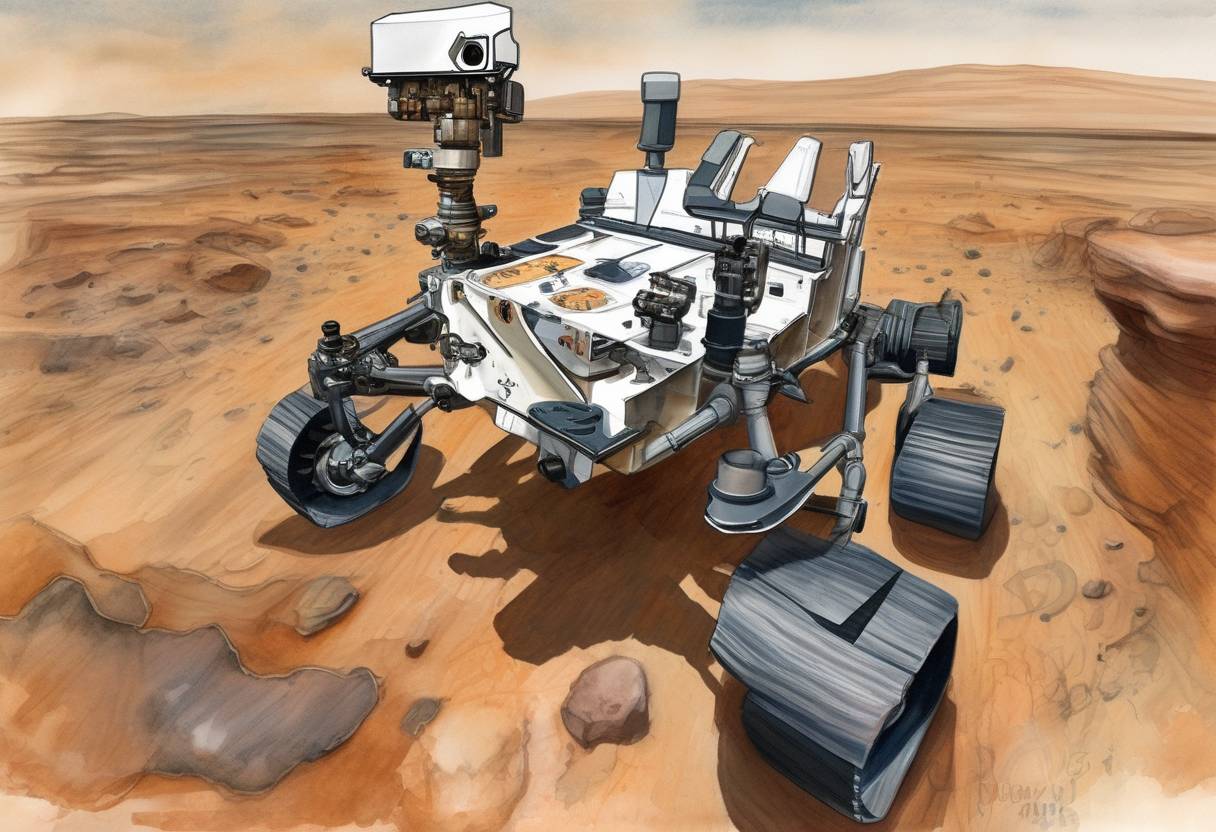
On August 22, 2012, NASA’s Curiosity rover, part of the Mars Science Laboratory (MSL) mission, successfully performed its first test drive on the Martian surface. This event marked a significant milestone in the mission, demonstrating the rover’s mobility and operational capabilities on Mars.
The Curiosity rover was launched from Cape Canaveral, Florida, on November 26, 2011, and successfully landed on Mars in Gale Crater on August 6, 2012. The primary goal of the MSL mission is to explore the Martian surface and assess its past and present ability to support microbial life. Curiosity is equipped with a suite of scientific instruments designed to analyze the planet’s climate and geology.
During this initial drive, Curiosity moved forward about 4.5 meters, turned 90 degrees, and then reversed slightly. This maneuver was a critical test of the rover’s mobility system, which includes six wheels designed to navigate the challenging Martian terrain.
The successful test drive demonstrated that Curiosity was fully operational and ready to begin its scientific mission. The rover’s ability to move and navigate is crucial for reaching various scientific targets within Gale Crater, including the base of Mount Sharp, a central peak that rises about 5.5 kilometers (3.4 miles) above the crater floor.
Curiosity’s mission has provided invaluable data about Mars, contributing to our understanding of the planet’s history and its potential to have supported life. The rover’s findings have included evidence of ancient riverbeds and the presence of key chemical ingredients for life.
Following the successful test drive, Curiosity continued its journey across the Martian surface, conducting experiments and sending data back to Earth. The rover’s mission has been extended multiple times, and it continues to operate beyond its initial two-year mission timeline, offering ongoing insights into Mars’ past and present conditions.
Curiosity’s successful operations have paved the way for future Mars missions, including the Mars 2020 Perseverance rover, which builds on the technological and scientific advancements achieved by Curiosity.
The first test drive of the Curiosity rover on August 22, 2012, was a pivotal moment in space exploration, showcasing human ingenuity and the ongoing quest to explore our solar system.
Source: mars.nasa.gov