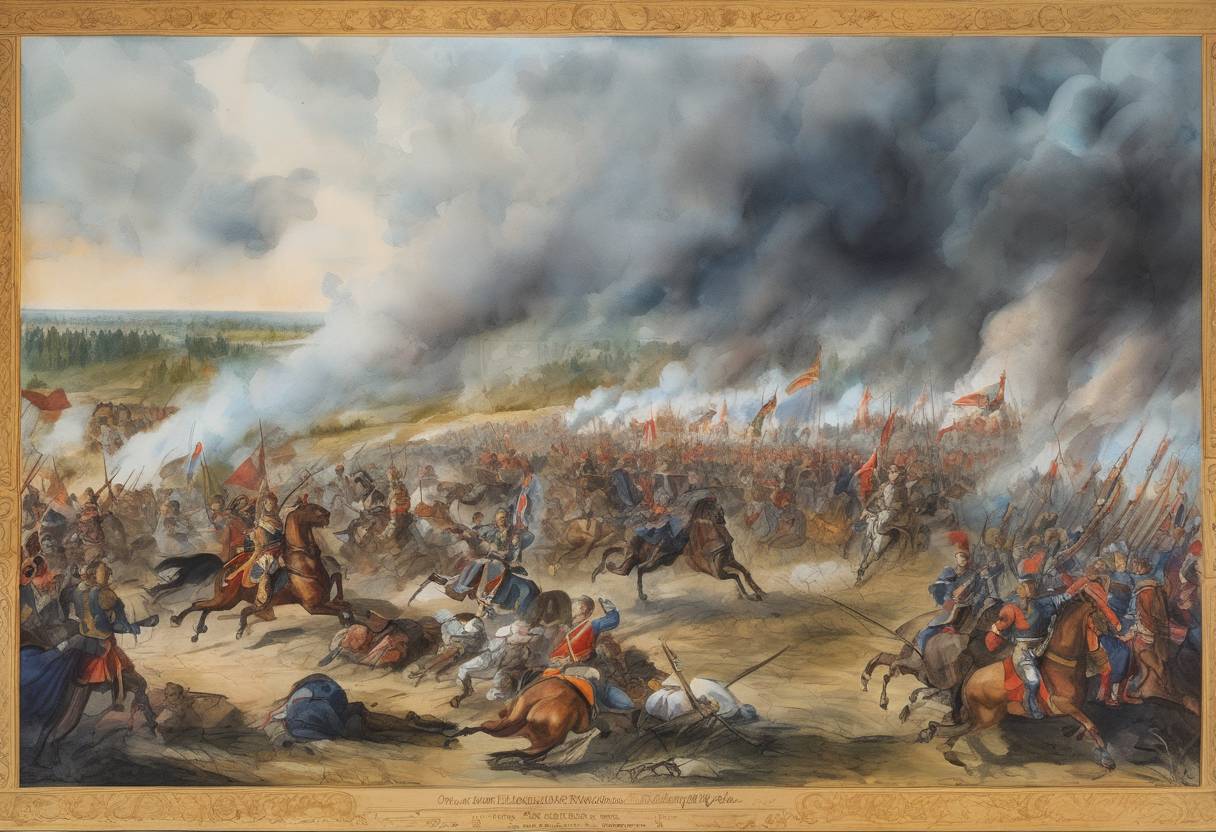
The Battle of Poltava: A Turning Point in the Great Northern War
Context and Background
The Battle of Poltava, fought on July 8, 1709 (June 27 in the Julian calendar used by Russia at the time), was a pivotal event in the Great Northern War (1700-1721). This conflict saw a coalition led by Tsar Peter I of Russia, known as Peter the Great, challenging the supremacy of the Swedish Empire under King Charles XII. The war was primarily about control over the Baltic Sea and the surrounding territories, which were crucial for trade and military power.
Lead-up to the Battle
Swedish Dominance: At the outset of the Great Northern War, Sweden was a dominant military power in Northern Europe. Charles XII had achieved several early victories, including the notable Battle of Narva in 1700.
Russian Resilience: Despite early setbacks, Peter the Great embarked on extensive military reforms, modernizing the Russian army and navy. He also founded the city of St. Petersburg in 1703, which would become a “window to the West.”
Swedish Invasion of Russia: In 1708, Charles XII launched an ambitious invasion of Russia, aiming to decisively defeat Peter. However, the harsh Russian winter and scorched earth tactics severely weakened the Swedish forces.
The Battle of Poltava
Location: The battle took place near the town of Poltava, in present-day Ukraine.
Forces Involved: The Russian army, numbering approximately 42,000 men, faced a Swedish force of about 23,000, significantly reduced by the harsh campaign conditions.
Battle Tactics: Peter the Great employed strategic defensive positions and artillery, while Charles XII, despite being injured, attempted an aggressive assault.
Outcome: The battle resulted in a decisive Russian victory. The Swedish army was effectively destroyed, with many soldiers killed or captured. Charles XII fled to the Ottoman Empire, seeking refuge.
Aftermath and Significance
Turning Point: The Battle of Poltava marked a turning point in the Great Northern War. It ended Sweden’s status as a major European power and shifted the balance of power in the region.
Rise of Russia: The victory solidified Russia’s emergence as a major European power. Peter the Great’s reforms and military successes laid the groundwork for the Russian Empire’s expansion.
Long-term Consequences: The defeat at Poltava led to a series of losses for Sweden, culminating in the Treaty of Nystad in 1721, which ended the war and confirmed Russia’s territorial gains.
The Battle of Poltava remains a significant event in European history, illustrating the impact of military strategy, leadership, and the shifting dynamics of power in the early 18th century.