Sinking of the German Battleship Scharnhorst
1943 · North Cape, Norway
The German battleship Scharnhorst was sunk by the Royal Navy during the Battle of the North Cape in World War II.
May 27, 1941
The German battleship Bismarck is sunk in the North Atlantic by British naval forces during World War II.
North Atlantic, International Waters | Royal Navy
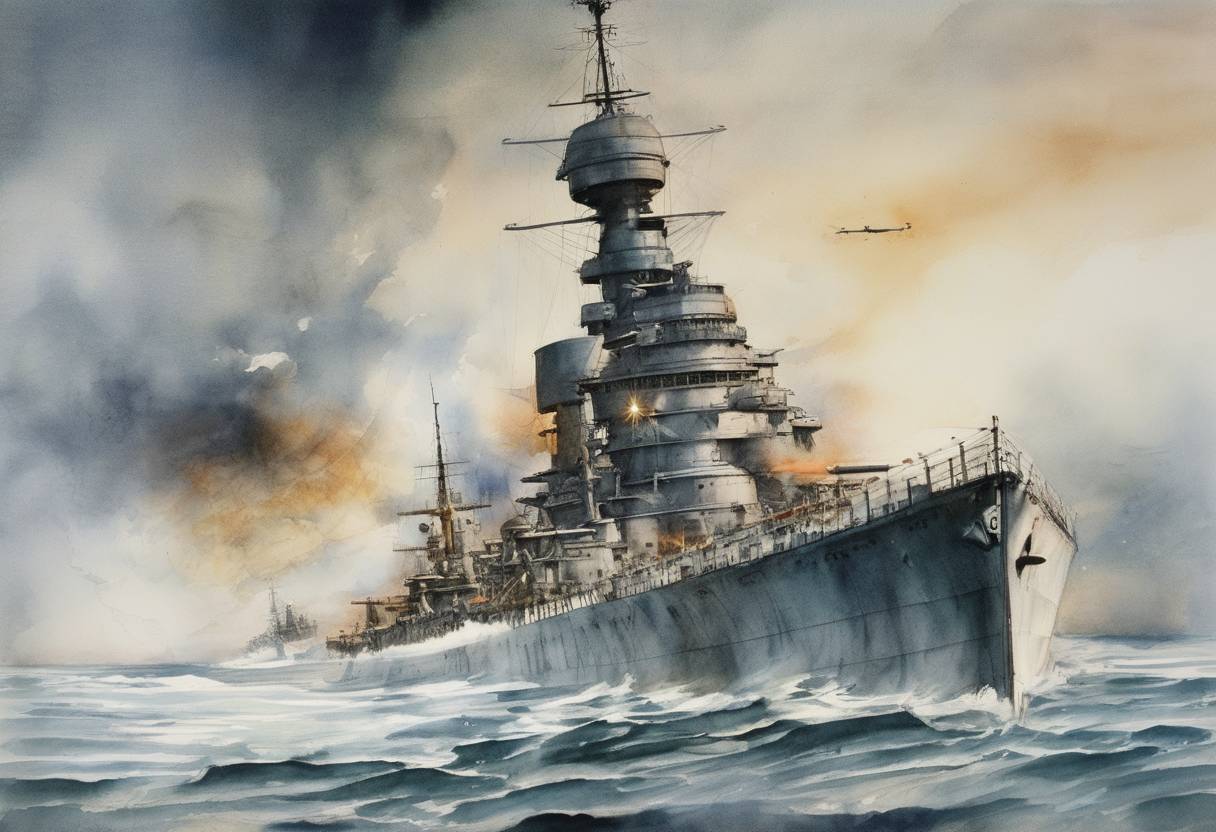
The German battleship Bismarck was one of the most formidable warships of World War II, representing the pinnacle of German naval engineering. Launched in February 1939 and commissioned in August 1940, the Bismarck was designed to break the British naval blockade and disrupt Allied shipping across the Atlantic.
The Bismarck’s first and only mission, Operation Rheinübung, began on May 18, 1941. Alongside the heavy cruiser Prinz Eugen, the Bismarck aimed to target Allied convoys. On May 24, 1941, during the Battle of the Denmark Strait, the Bismarck sank the British battlecruiser HMS Hood, which was a significant blow to British morale.
Following this engagement, the Bismarck was damaged and attempted to reach occupied France for repairs. The British Royal Navy launched a relentless pursuit, involving numerous ships and aircraft, determined to prevent the Bismarck from reaching safety.
On May 26, 1941, British aircraft from the carrier HMS Ark Royal launched a torpedo attack, successfully hitting the Bismarck and jamming its rudder. This critical damage left the battleship unable to steer, making it a vulnerable target.
On the morning of May 27, 1941, British naval forces, including battleships HMS King George V and HMS Rodney, engaged the Bismarck. After a fierce battle, the British ships, supported by cruisers and destroyers, overwhelmed the Bismarck with heavy gunfire. The German crew scuttled the ship to prevent its capture, and it sank at 10:39 AM.
The sinking of the Bismarck was a significant victory for the Allies, boosting British morale and demonstrating the effectiveness of coordinated naval and air operations. It marked the end of the Bismarck’s threat to Allied shipping lanes and underscored the importance of air power in naval warfare.
The loss of the Bismarck also highlighted the strategic challenges faced by the German Kriegsmarine, which struggled to maintain a surface fleet capable of challenging the Royal Navy. The event remains one of the most famous naval engagements of World War II, symbolizing the intense and deadly nature of the Atlantic naval battles.
The destruction of the Bismarck was a pivotal moment in the Battle of the Atlantic, showcasing the determination and resourcefulness of the British Royal Navy. It also served as a reminder of the strategic importance of naval supremacy during World War II.
Source: en.wikipedia.org