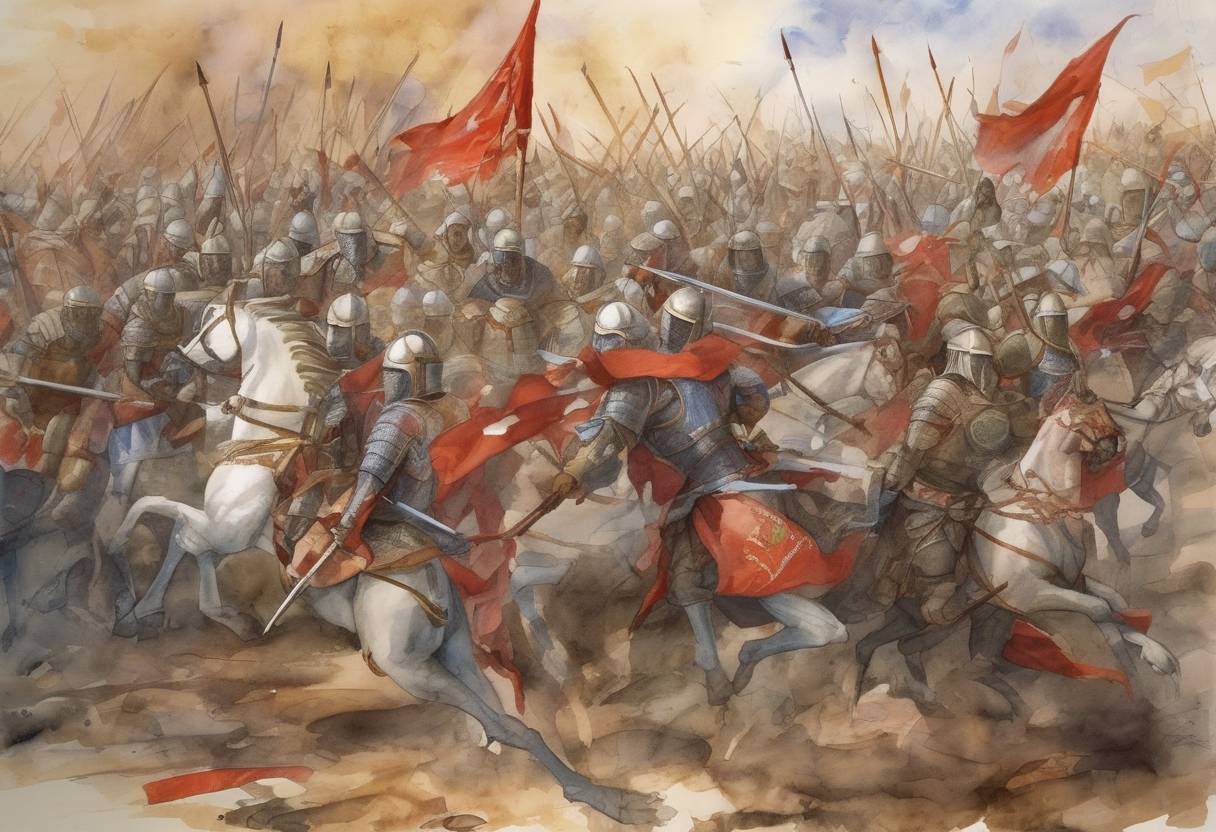
The Battle of Inab: June 29, 1149
The Battle of Inab was a significant military engagement during the period of the Second Crusade, marking a pivotal moment in the Crusader-Muslim conflicts in the Levant. This battle took place on June 29, 1149, near the town of Inab, located in present-day Syria. It was a decisive victory for Nur ad-Din Zangi, the ruler of Aleppo and a prominent Muslim leader, against the Crusader forces led by Raymond of Antioch.
Context and Prelude
The Second Crusade (1147–1150) was launched in response to the fall of the County of Edessa, the first Crusader state established in the Levant. The Crusaders aimed to regain lost territories and strengthen their hold in the region. However, the campaign was largely unsuccessful, with the Crusader forces suffering several setbacks.
Nur ad-Din Zangi, a key figure in the Muslim resistance against the Crusaders, sought to consolidate Muslim territories and push back the Crusader states. His strategic acumen and military prowess made him a formidable opponent to the Crusader lords.
Key Events Leading to the Battle
Tensions in Antioch: Raymond of Antioch, a prominent Crusader leader, was determined to defend his principality against Muslim incursions. The region of Antioch was under constant threat from Nur ad-Din’s forces, leading to heightened tensions.
Nur ad-Din’s Campaign: In 1149, Nur ad-Din launched a campaign to capture key territories around Antioch. His forces moved strategically, capturing smaller fortresses and weakening the Crusader hold.
Raymond’s Response: In response to Nur ad-Din’s advances, Raymond of Antioch gathered his forces, including knights and local levies, to confront the Muslim army. He was joined by the Assassins, a sect known for their political influence and military capabilities.
The Battle
Location: The battle took place near the fortress of Inab, strategically located between Aleppo and Antioch.
Forces Involved: Nur ad-Din’s army was composed of seasoned warriors, including cavalry and infantry, while Raymond’s forces were primarily knights and local troops.
Outcome: The battle resulted in a decisive victory for Nur ad-Din. Raymond of Antioch was killed in the engagement, and his forces were routed. The defeat significantly weakened the Crusader presence in the region.
Aftermath and Significance
Impact on Antioch: The death of Raymond of Antioch and the loss at Inab left the Principality of Antioch vulnerable. Nur ad-Din capitalized on this victory to exert greater influence over the region.
Strengthening Muslim Unity: The victory at Inab bolstered Nur ad-Din’s reputation and helped unify Muslim factions against the Crusaders. It marked a turning point in the Muslim resistance, setting the stage for future successes.
Legacy: The Battle of Inab demonstrated the strategic and military capabilities of Nur ad-Din, paving the way for the eventual rise of Saladin, who would continue the struggle against the Crusader states.
In summary, the Battle of Inab was a crucial event during the Second Crusade, highlighting the shifting balance of power in the Levant and the growing strength of Muslim forces under leaders like Nur ad-Din Zangi.