Dmitri Mendeleev's Balloon Ascent for the 1887 Solar Eclipse
1887 · Moscow, Russia
Dmitri Mendeleev made a balloon ascent to an altitude of 11,500 feet (3,500 meters) to observe a solar eclipse.
August 18, 1868
French astronomer Pierre Janssen discovered helium in the solar spectrum during a total solar eclipse in Guntur, India.
Guntur, India | French Academy of Sciences
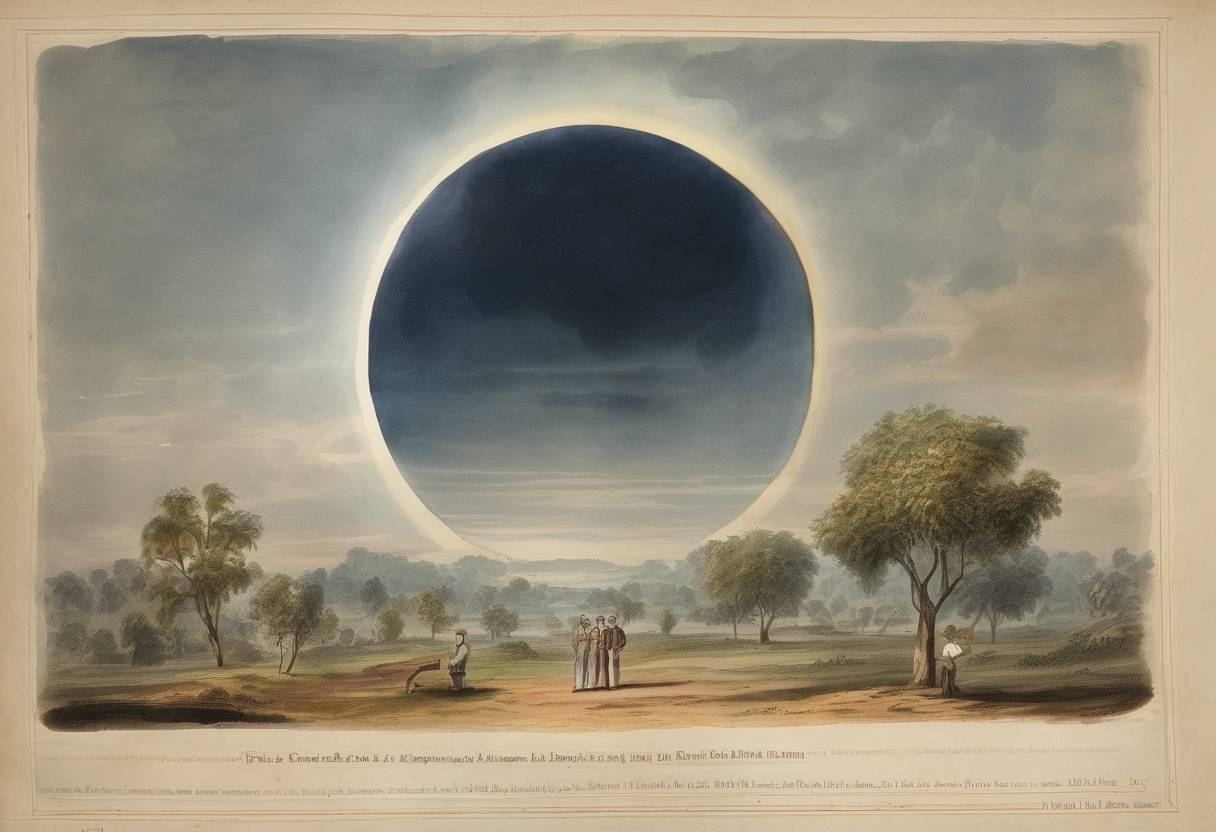
On August 18, 1868, French astronomer Pierre Janssen made a groundbreaking discovery during a total solar eclipse in Guntur, India. This event marked a significant milestone in the field of astronomy and chemistry, as Janssen identified a new element, helium, in the solar spectrum.
During the 19th century, the study of the sun and its composition was a major focus for astronomers. The use of spectroscopy, a technique that analyzes the light spectrum emitted by celestial bodies, had become a powerful tool for understanding the chemical makeup of stars. Prior to Janssen’s discovery, the elements known to science were primarily those found on Earth.
Pierre Janssen traveled to Guntur, India, to observe the total solar eclipse on August 18, 1868. Utilizing a spectroscope, Janssen observed the solar chromosphere and noticed a bright yellow line in the spectrum. This line did not correspond to any known elements at the time. Janssen’s observations were meticulous, and he concluded that this line indicated the presence of a new element in the sun.
Remarkably, Janssen’s discovery was independently confirmed by English astronomer Joseph Norman Lockyer just a few months later. Lockyer observed the same spectral line and, together with chemist Edward Frankland, named the new element “helium,” derived from “Helios,” the Greek word for the sun.
The discovery of helium was significant for several reasons:
New Element: Helium was the first element to be discovered in space before being found on Earth, highlighting the potential of spectroscopy in astronomical research.
Advancement in Spectroscopy: Janssen’s work demonstrated the power of spectroscopic techniques in identifying elements and understanding the composition of celestial bodies.
Scientific Collaboration: The simultaneous discovery by Janssen and Lockyer underscored the importance of international collaboration and verification in scientific research.
Helium was not isolated on Earth until 1895 by chemists Sir William Ramsay, Per Teodor Cleve, and Nils Abraham Langlet, further cementing its place in the periodic table.
The identification of helium expanded the understanding of the universe’s composition and paved the way for future discoveries in both astronomy and chemistry. It also exemplified the interconnectedness of scientific disciplines and the global nature of scientific inquiry.
Janssen’s discovery remains a testament to the power of observation and innovation in the pursuit of knowledge about our universe.
Source: en.wikipedia.org