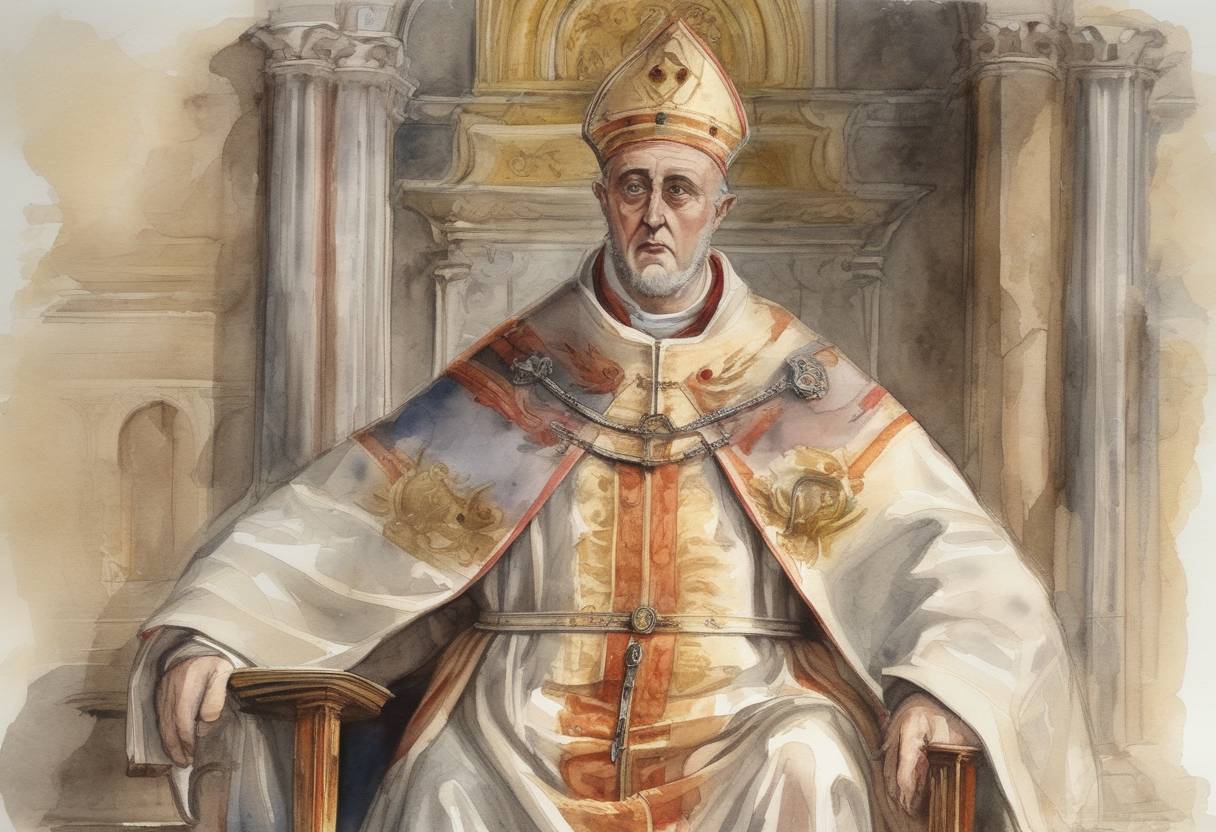
The Death of Pope Adrian IV: September 1, 1159
Pope Adrian IV, born Nicholas Breakspear, holds the distinction of being the only Englishman to have ascended to the papacy. His tenure as pope, from 1154 until his death on September 1, 1159, was marked by significant political and ecclesiastical challenges, most notably his contentious relationship with the Holy Roman Emperor Frederick I Barbarossa.
Early Life and Rise to Papacy
Nicholas Breakspear was born around 1100 in Abbots Langley, Hertfordshire, England. His early life was marked by a pursuit of religious education, which eventually led him to France, where he joined the Augustinian canons. His administrative and diplomatic skills were recognized, leading to his appointment as the abbot of St. Rufus monastery near Avignon. In 1149, Pope Eugene III appointed him as a cardinal and sent him as a papal legate to Scandinavia, where he successfully reorganized the church structure.
His effective leadership and diplomatic success paved the way for his election as pope on December 4, 1154, following the death of Pope Anastasius IV.
Papacy and Tensions with Frederick I Barbarossa
Adrian IV’s papacy coincided with a period of significant political tension in Europe. One of the most notable conflicts was with Frederick I Barbarossa, the Holy Roman Emperor. The tension between the papacy and the emperor was rooted in the struggle for supremacy between the papal authority and the secular power of the empire.
Key Events:
The Diet of Besançon (1157): A critical moment in their conflict occurred at the Diet of Besançon, where papal legates presented a letter from Adrian IV that was interpreted by the imperial court as suggesting that the emperor held his title as a fief from the pope. This interpretation led to a heated dispute, with Frederick asserting the independence of his imperial authority.
The Lombard League: Adrian IV’s support for the Lombard League, a coalition of northern Italian city-states opposed to Frederick’s expansionist policies, further strained relations. The pope’s backing of the league was part of a broader strategy to curb the emperor’s influence in Italy.
Death and Legacy
Pope Adrian IV died on September 1, 1159, in Anagni, Italy. His death marked the end of a papacy that had navigated complex political landscapes and sought to assert the spiritual authority of the papacy over secular rulers.
Aftermath:
Papal Succession: Adrian IV’s death led to a contested papal election, resulting in the election of Pope Alexander III, who continued to face challenges from Frederick I Barbarossa.
Historical Significance: Adrian IV’s papacy is remembered for its diplomatic endeavors and the ongoing struggle between the papacy and the Holy Roman Empire, a theme that would continue to shape European politics for centuries.
Pope Adrian IV’s legacy is a testament to the intricate balance of power between religious and secular authorities during the medieval period, highlighting the enduring influence of the papacy in European affairs.