Sinking of the German Battleship Scharnhorst
1943 · North Cape, Norway
The German battleship Scharnhorst was sunk by the Royal Navy during the Battle of the North Cape in World War II.
February 16, 1940
The British destroyer HMS Cossack boarded the German tanker Altmark in Norwegian waters, freeing 299 British prisoners.
Jøssingfjord, Norway | Royal Navy
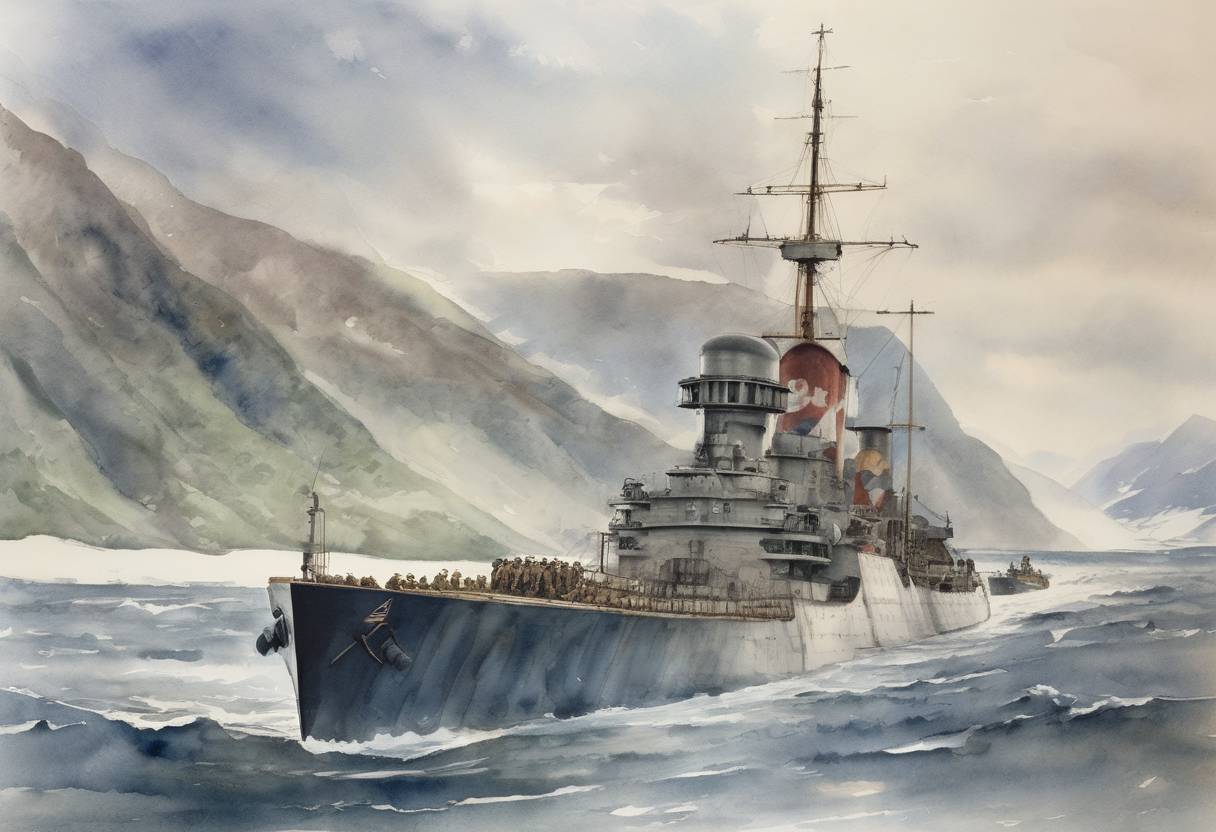
On February 16, 1940, a significant event unfolded during the early months of World War II, known as the Altmark Incident. This event involved the British destroyer HMS Cossack and the German tanker Altmark in the neutral waters of Norway.
The Altmark was a German tanker serving as a supply ship for the German pocket battleship Admiral Graf Spee. During its operations in the South Atlantic, the Graf Spee had captured several Allied merchant ships, transferring their crews to the Altmark. By February 1940, the Altmark was carrying 299 British prisoners of war, captured from these merchant vessels.
As the Altmark attempted to return to Germany, it navigated through Norwegian waters, seeking to avoid detection by the British Royal Navy. Norway, maintaining a stance of neutrality, allowed the Altmark to pass through its territorial waters under the condition that it carried no prisoners. However, the British government, suspecting otherwise, dispatched HMS Cossack to intercept the tanker.
On February 16, 1940, HMS Cossack located the Altmark in the Jøssingfjord, a fjord in southern Norway. Despite Norway’s protests and its neutral status, the British decided to take action. Under the command of Captain Philip Vian, HMS Cossack boarded the Altmark. After a brief confrontation, the British sailors discovered the imprisoned British seamen and successfully freed all 299 captives.
The Altmark Incident had several important consequences:
Diplomatic Tensions: The incident strained relations between the United Kingdom and Norway. Norway protested the violation of its neutrality, but the British justified their actions as a necessary measure against German aggression.
Boost to British Morale: The successful rescue operation was celebrated in Britain and provided a morale boost during the early, challenging months of the war.
Impact on Neutrality: The incident highlighted the difficulties faced by neutral countries during World War II, as they struggled to maintain their neutrality amidst the pressures from both Axis and Allied powers.
Precedent for Future Actions: The Altmark Incident set a precedent for future British naval operations, demonstrating a willingness to take decisive action even in neutral territories when it came to rescuing their nationals and countering German activities.
Overall, the Altmark Incident is remembered as a daring naval operation that underscored the complexities of wartime diplomacy and the challenges of maintaining neutrality during a global conflict.
Source: en.wikipedia.org