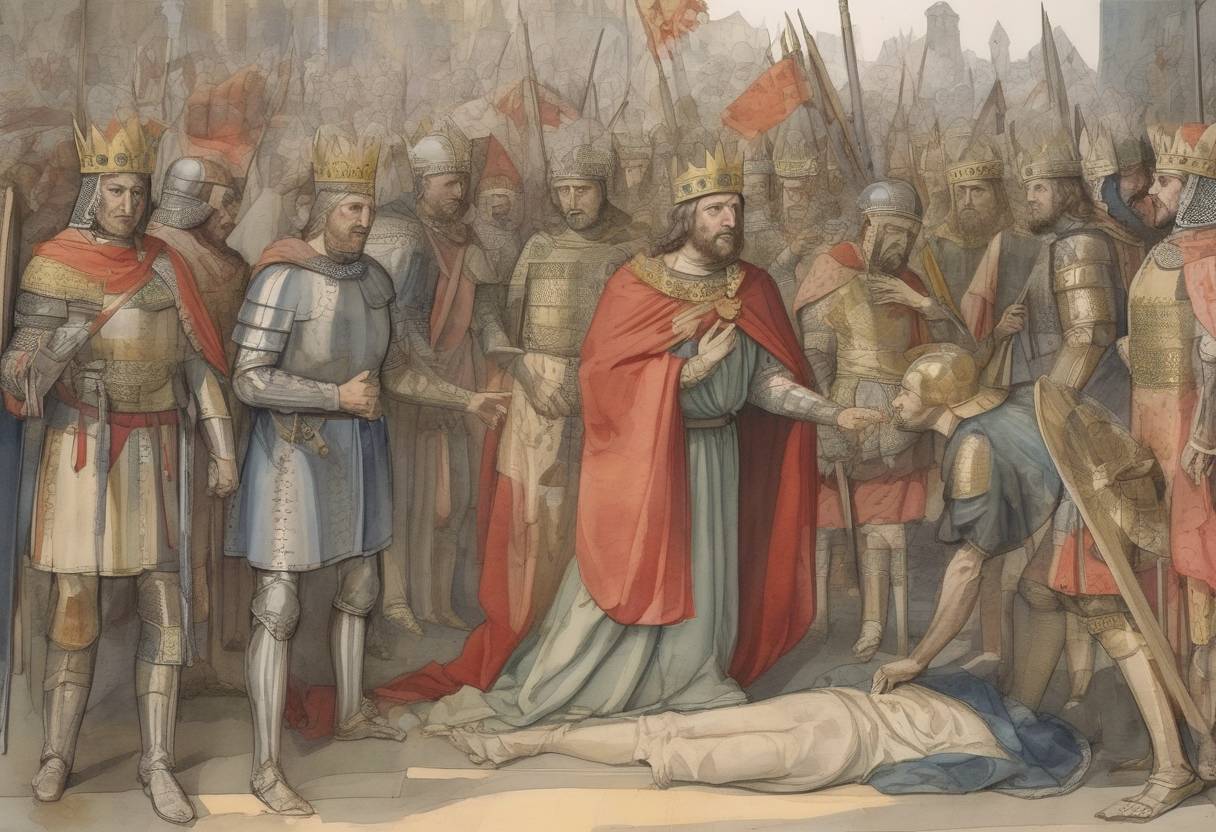
The Deposition of Charles the Fat: November 10, 887
On November 10, 887, Charles the Fat was deposed as the Emperor of the Carolingian Empire, marking a significant turning point in European history. His removal from power effectively ended the last attempt to maintain the unity of the Carolingian Empire, leading to its fragmentation into separate kingdoms.
Background
Charles the Fat, born in 839, was the youngest son of Louis the German and a grandson of Charlemagne. He became King of West Francia, East Francia, and Italy, and was crowned Emperor in 881. His reign was characterized by a series of challenges, including Viking invasions, internal strife, and his own health issues, which were believed to be epilepsy or some form of mental illness.
Key Events Leading to the Deposition
Viking Threats: Charles faced numerous Viking incursions, most notably the siege of Paris in 885-886. His decision to pay off the Vikings rather than confront them militarily was seen as a sign of weakness.
Internal Dissent: Charles’s inability to effectively manage the vast territories of the Carolingian Empire led to dissatisfaction among the nobility. His reliance on favoritism and lack of decisive leadership eroded his support.
Health Issues: Charles’s health problems further undermined his ability to govern, leading to questions about his capability to rule.
Political Fragmentation: The empire was already showing signs of fragmentation, with local rulers gaining more power and autonomy. Charles’s inability to assert control accelerated this process.
The Deposition
The deposition of Charles the Fat was orchestrated by a coalition of nobles led by Arnulf of Carinthia, an illegitimate son of Charles’s brother Carloman. On November 10, 887, at the Diet of Tribur, Charles was formally deposed. Arnulf was elected as the King of East Francia, marking the end of Charles’s reign.
Aftermath and Consequences
Fragmentation of the Empire: The deposition of Charles the Fat led to the permanent division of the Carolingian Empire into distinct kingdoms. These included West Francia, East Francia, and the Kingdom of Italy, among others.
Rise of Regional Powers: The power vacuum left by the fall of the Carolingian Empire allowed for the rise of regional powers and the eventual emergence of new political entities, such as the Holy Roman Empire and the Kingdom of France.
End of Carolingian Unity: Charles’s deposition marked the end of any realistic attempts to restore the unity of the Carolingian Empire, which had been established by Charlemagne.
Historical Significance
The deposition of Charles the Fat is a pivotal moment in medieval European history, symbolizing the transition from a unified Carolingian Empire to a more fragmented political landscape. It set the stage for the development of modern European states and the feudal system that would dominate the Middle Ages.
In summary, the removal of Charles the Fat from power on November 10, 887, was a decisive event that underscored the challenges of maintaining a vast empire and highlighted the shifting dynamics of power in medieval Europe.