The Clock Tower at the Houses of Parliament: Big Ben Begins Keeping Time
1859 · London, England
The clock tower at the Houses of Parliament, which houses Big Ben, began keeping time for the first time.
January 23, 1571
The Royal Exchange opens in London, founded by financier Thomas Gresham as the first purpose-built center for trading stocks in England.
London, England | Royal Exchange
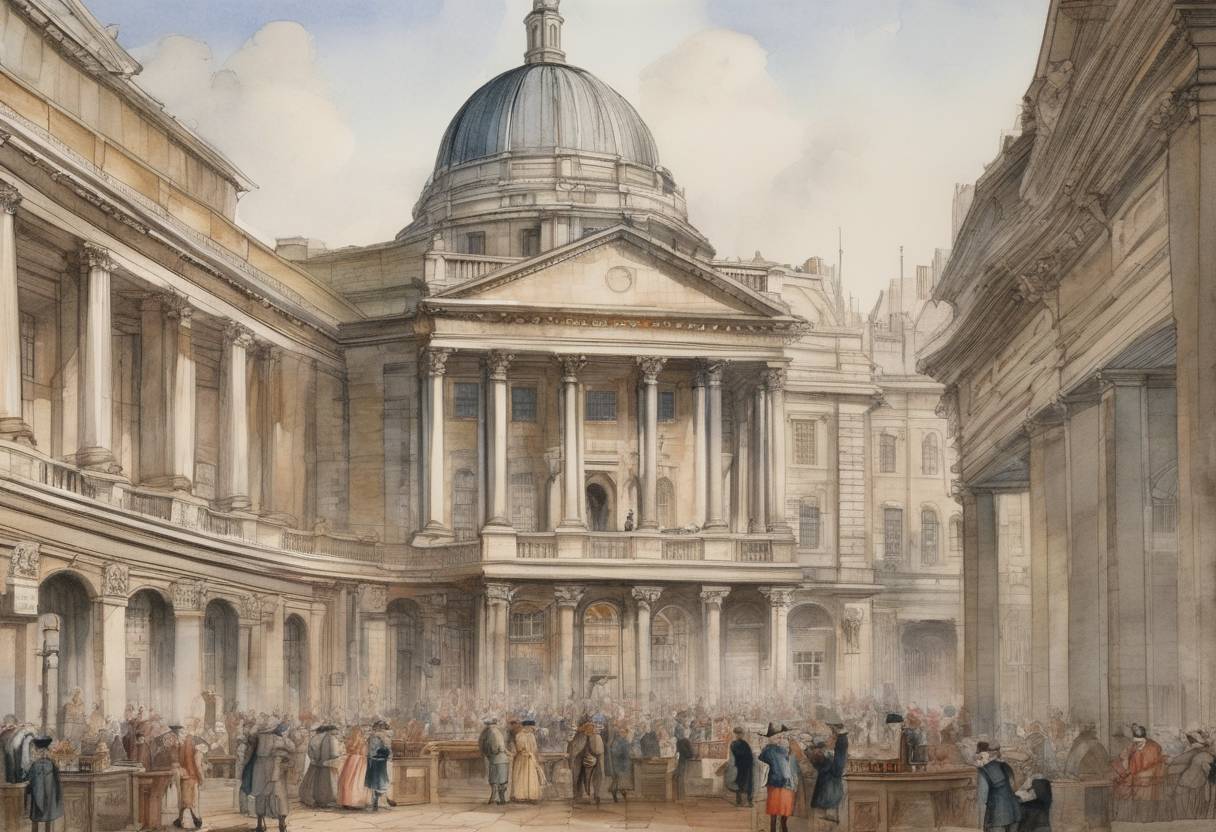
On January 23, 1571, The Royal Exchange in London was officially opened by Queen Elizabeth I. This event marked a significant milestone in the history of commerce and finance in England. The Royal Exchange was founded by the prominent financier Sir Thomas Gresham, who envisioned it as the first purpose-built center for trading stocks in England.
Thomas Gresham: A successful merchant and financier, Gresham served as an agent for the English Crown in Antwerp, one of the leading financial centers of the time. His experiences abroad inspired him to establish a similar hub in London to facilitate trade and finance.
Need for a Trading Hub: Prior to the establishment of The Royal Exchange, London lacked a centralized location for merchants and traders to conduct business. Transactions were often carried out in open-air markets or informal settings, which were not conducive to efficient or secure trading.
Construction: The Royal Exchange was constructed between 1566 and 1570. Gresham personally funded the project, donating the land and covering the costs of construction. The building was designed to accommodate merchants and traders, providing a sheltered space for business activities.
Design and Structure: The architecture of The Royal Exchange was inspired by the Bourse in Antwerp. It featured a large courtyard surrounded by arcades, with shops and offices on the upper floors. This design facilitated both trading and social interaction among merchants.
Royal Endorsement: The opening ceremony was a grand affair, attended by Queen Elizabeth I, who granted the building its royal title. Her presence underscored the importance of the Exchange to the English economy and its endorsement by the Crown.
Significance: The Royal Exchange quickly became the heart of London’s financial district. It provided a centralized location for merchants to meet, negotiate, and conduct business, significantly boosting the efficiency and volume of trade in the city.
Economic Impact: The establishment of The Royal Exchange played a crucial role in transforming London into a major financial center. It facilitated the growth of commerce and laid the groundwork for the development of modern financial markets in England.
Legacy: Although the original building was destroyed by the Great Fire of London in 1666, it was rebuilt and continued to serve as a key financial hub. The Royal Exchange remains a symbol of London’s enduring status as a global center of finance.
In summary, the opening of The Royal Exchange on January 23, 1571, was a pivotal event in the history of English commerce, setting the stage for the evolution of modern financial markets and solidifying London’s role as a leading financial capital.
Source: en.wikipedia.org