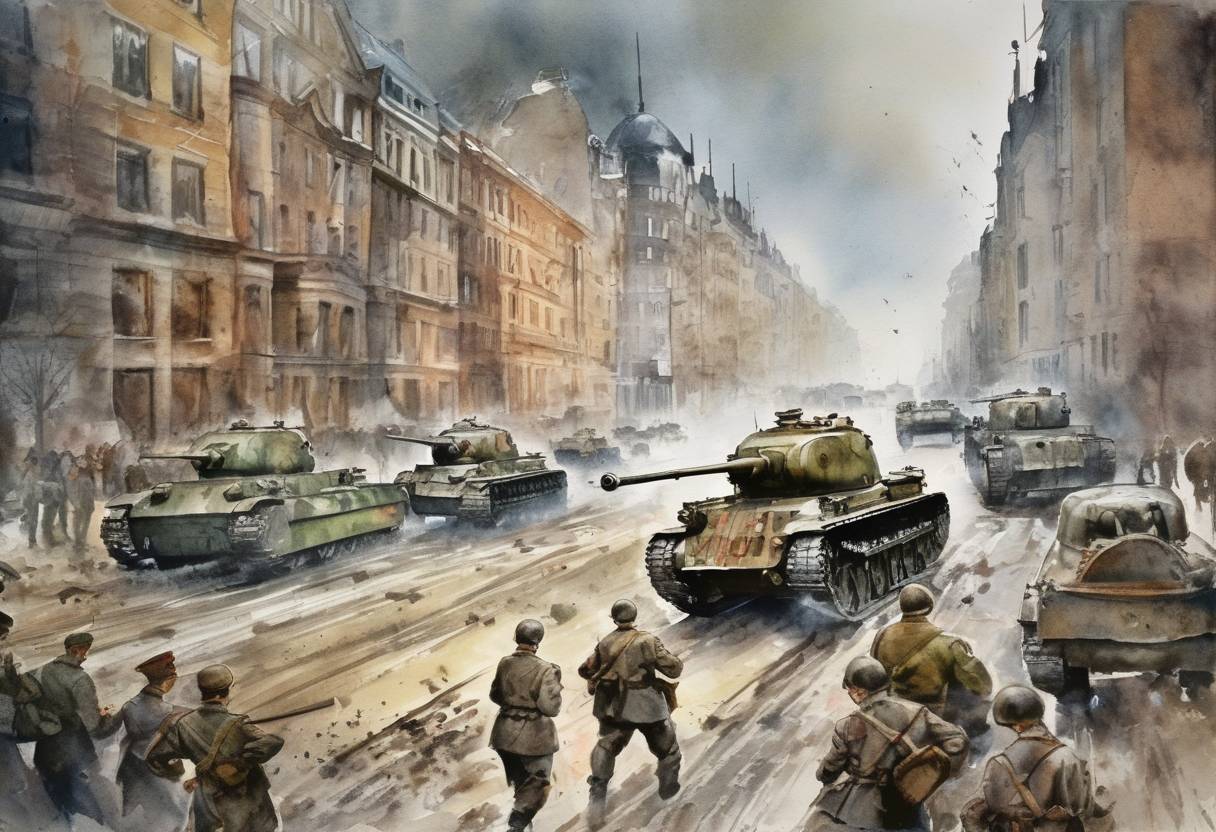
The Battle of Berlin: Soviet Offensive Begins on April 16, 1945
The Battle of Berlin, one of the final major offensives of World War II in Europe, commenced on April 16, 1945. This pivotal battle marked the beginning of the end for Nazi Germany as Soviet forces launched a massive assault on the German capital, Berlin.
Context and Prelude
By early 1945, the Allies had made significant advances against Axis powers on both the Western and Eastern Fronts. The Soviet Union, having successfully pushed German forces back through Eastern Europe, was poised to deliver a decisive blow to the heart of Nazi Germany. The Red Army, under the command of Marshal Georgy Zhukov and Marshal Ivan Konev, was tasked with capturing Berlin, a strategic and symbolic target.
Key Events Leading Up to the Battle
- Yalta Conference (February 1945): Allied leaders, including Joseph Stalin, Franklin D. Roosevelt, and Winston Churchill, met to discuss post-war reorganization and strategies for the final defeat of Germany.
- Vistula-Oder Offensive (January-February 1945): The Soviet advance from the Vistula River to the Oder River brought them within striking distance of Berlin.
- Western Allies’ Progress: As the Soviets prepared for their assault, Western Allied forces were advancing from the west, having crossed the Rhine River in March 1945.
The Offensive Begins
On April 16, 1945, the Soviet Union launched its final offensive against Berlin. The operation involved two main Soviet fronts:
- 1st Belorussian Front: Led by Marshal Zhukov, this force attacked from the east, crossing the Oder River.
- 1st Ukrainian Front: Commanded by Marshal Konev, this group advanced from the south.
Key Features of the Battle
- Seelow Heights: The initial phase of the battle involved intense fighting at the Seelow Heights, a heavily fortified German defensive position east of Berlin. Despite fierce resistance, Soviet forces eventually broke through.
- Urban Warfare: As Soviet troops entered Berlin, they encountered brutal urban combat, with German forces, including the Volkssturm (militia) and Hitler Youth, mounting a desperate defense.
- Encirclement: By April 25, Soviet forces had encircled Berlin, effectively cutting off all escape routes for the German defenders.
Aftermath and Significance
The Battle of Berlin lasted until May 2, 1945, culminating in the surrender of the city. Adolf Hitler, refusing to flee, committed suicide on April 30, 1945, in his bunker. The fall of Berlin was a decisive moment in World War II, leading to Germany’s unconditional surrender on May 8, 1945, and marking the end of the war in Europe.
Broader Historical Impact
- Division of Germany: The capture of Berlin set the stage for the division of Germany into occupation zones, eventually leading to the Cold War and the division of Berlin itself.
- Human Cost: The battle resulted in significant casualties on both sides, with estimates of up to 81,000 Soviet soldiers killed and hundreds of thousands wounded, alongside massive civilian casualties.
The Battle of Berlin remains a significant historical event, symbolizing the collapse of Nazi Germany and the shifting geopolitical landscape of post-war Europe.