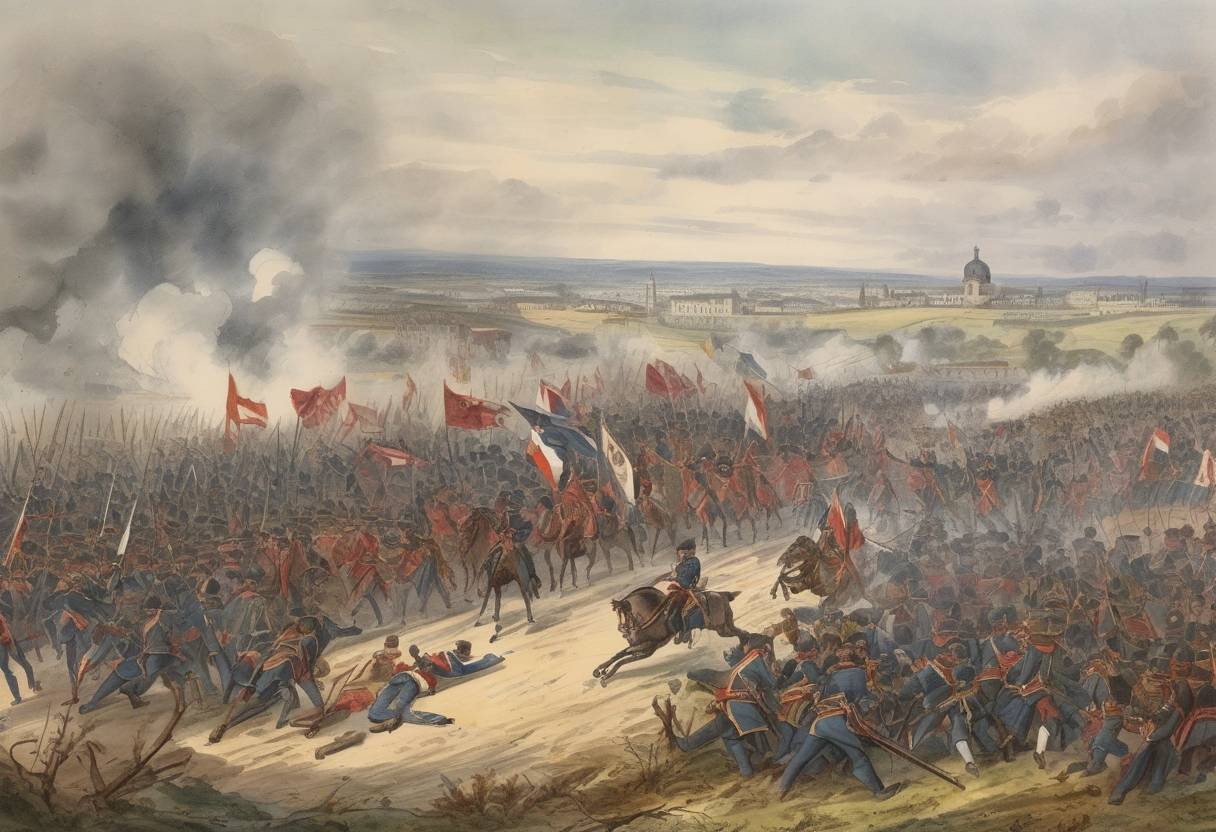
The Battle of Sedan: September 2, 1870
The Battle of Sedan, fought on September 2, 1870, was a pivotal engagement during the Franco-Prussian War, marking a decisive victory for the Prussian-led German forces and leading to the capture of French Emperor Napoleon III. This battle had profound implications for both France and the future of Europe.
Context and Prelude
The Franco-Prussian War began in July 1870, primarily due to tensions between the Second French Empire, led by Napoleon III, and the Kingdom of Prussia, under the leadership of Chancellor Otto von Bismarck. The war was part of Bismarck’s broader strategy to unify the German states under Prussian dominance, excluding Austria.
By late August 1870, the French army, suffering from poor leadership, logistical issues, and strategic missteps, found itself in a precarious position. The French forces, commanded by Marshal Patrice de MacMahon, were attempting to relieve the besieged city of Metz but were intercepted by the Prussian army near the town of Sedan, close to the Belgian border.
The Battle
The battle commenced on September 1, 1870, with the Prussian forces, commanded by King Wilhelm I and his chief of staff, Helmuth von Moltke, encircling the French army. The Prussians, utilizing superior artillery and tactics, effectively trapped the French in a valley surrounded by hills.
The French forces, numbering around 120,000, were outmaneuvered and outgunned by the Prussian coalition of approximately 200,000 troops. The Prussian artillery played a crucial role, bombarding French positions and causing significant casualties.
By the afternoon of September 1, the French situation was dire. Napoleon III, present on the battlefield, realized the hopelessness of their position. On September 2, he made the decision to surrender to avoid further bloodshed.
Consequences
The surrender at Sedan had immediate and far-reaching consequences:
Capture of Napoleon III: The French Emperor was taken prisoner, effectively ending his reign and leading to the collapse of the Second French Empire. This event paved the way for the establishment of the Third Republic in France.
German Unification: The victory at Sedan was a significant step towards the unification of Germany. It bolstered Bismarck’s position and led to the proclamation of the German Empire in January 1871, with King Wilhelm I of Prussia becoming the German Emperor.
End of the War: Although the war continued for several months, the defeat at Sedan was a critical blow to French morale and military capability. The war officially ended with the Treaty of Frankfurt in May 1871, resulting in significant territorial losses for France, including Alsace and Lorraine.
Historical Significance
The Battle of Sedan is often seen as a turning point in European history. It not only reshaped the political landscape of France and Germany but also set the stage for future conflicts, including World War I. The battle demonstrated the effectiveness of modern military tactics and technology, influencing military strategies in the years to come.
The defeat and capture of Napoleon III marked the end of an era for France, leading to a period of political instability and social change. For Germany, the victory solidified its position as a major European power, altering the balance of power on the continent.