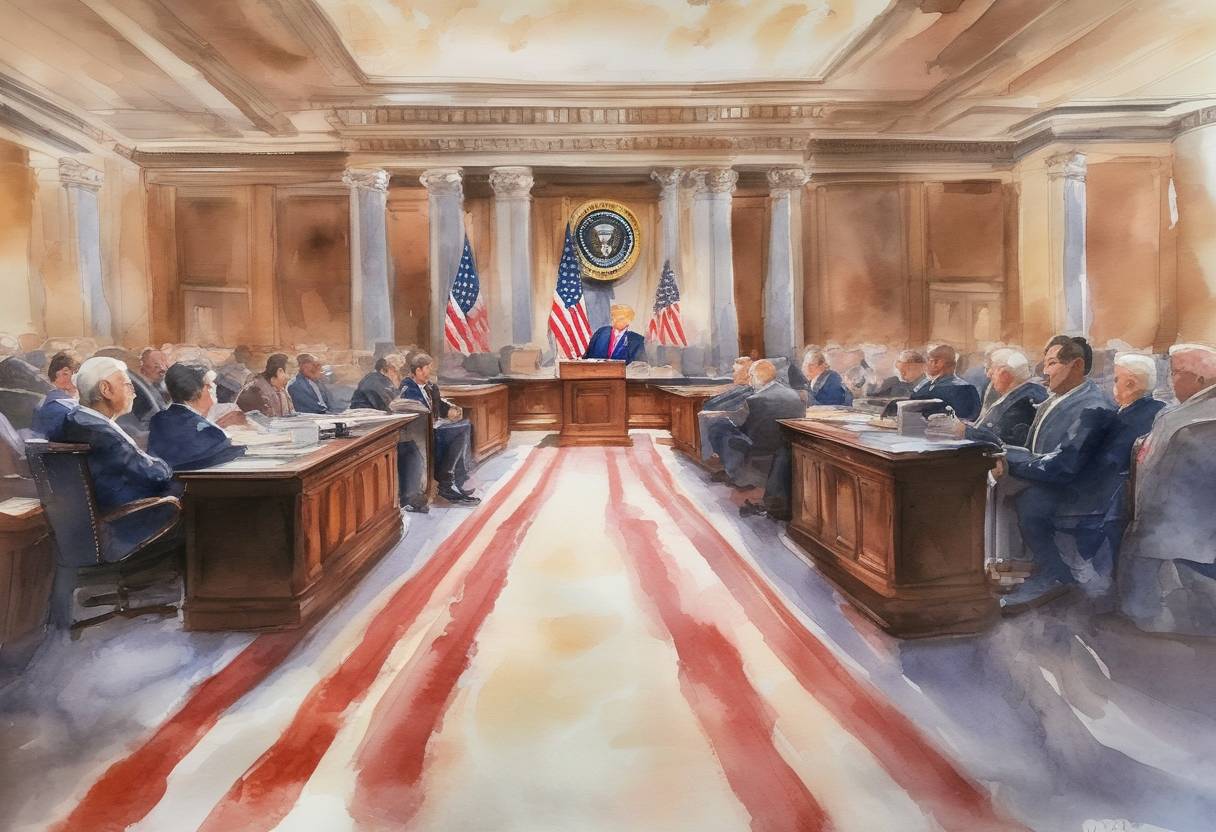
Limiting Presidential Military Authority: The House Vote on July 12, 2019
On July 12, 2019, the United States House of Representatives took a significant step to curtail the President’s unilateral military powers by voting to limit President Donald Trump’s ability to engage in military action against Iran without obtaining prior congressional approval. This legislative move was part of a broader debate on the balance of power between the executive and legislative branches concerning military engagements.
Context and Background
The vote came amid heightened tensions between the United States and Iran, following a series of incidents that escalated fears of potential military conflict. These included the U.S. withdrawal from the Iran nuclear deal in 2018, the re-imposition of sanctions on Iran, and several confrontations in the Persian Gulf, including the downing of a U.S. drone by Iran in June 2019.
The House’s decision was influenced by concerns over the potential for an unauthorized military escalation and the need to reaffirm Congress’s constitutional role in declaring war.
Key Details of the Vote
- Legislation: The measure was an amendment to the National Defense Authorization Act (NDAA) for Fiscal Year 2020.
- Provisions: It specifically prohibited the use of federal funds for military action against Iran unless Congress had declared war or enacted specific authorization for the use of military force.
- Vote Outcome: The amendment passed with a vote of 251-170, reflecting bipartisan support. Notably, 27 Republicans joined Democrats in favor of the measure.
Broader Implications
The vote underscored a growing bipartisan concern over the executive branch’s expansive military powers, which had been a point of contention in U.S. politics for decades. It also highlighted the legislative branch’s efforts to reassert its constitutional authority over decisions of war and peace.
Aftermath and Significance
While the House passed the amendment, it faced challenges in the Senate, where similar measures had previously been blocked. Nonetheless, the vote was a symbolic assertion of congressional authority and a reflection of the legislative branch’s desire to have a more significant role in foreign policy decisions.
The event was part of a broader discourse on the War Powers Resolution of 1973, which was designed to check the president’s power to commit the United States to armed conflict without the consent of Congress. The House’s action in July 2019 was a reminder of the ongoing debate over the separation of powers and the need for checks and balances in U.S. governance.
In summary, the House vote on July 12, 2019, was a pivotal moment in the ongoing dialogue about the scope of presidential military authority and the role of Congress in authorizing military actions.