The Battle of Capo Colonna: July 13, 982
982 · Capo Colonna, Italy
The Battle of Capo Colonna takes place, where the forces of the Holy Roman Emperor Otto II are defeated by the Muslim forces of the Emirate of Sicily.
July 14, 0982
The Battle of Capo Colonna occurred, where the forces of the Holy Roman Empire, led by Emperor Otto II, were defeated by the Muslim forces of the Emirate of Sicily.
Capo Colonna, Italy | Holy Roman Empire
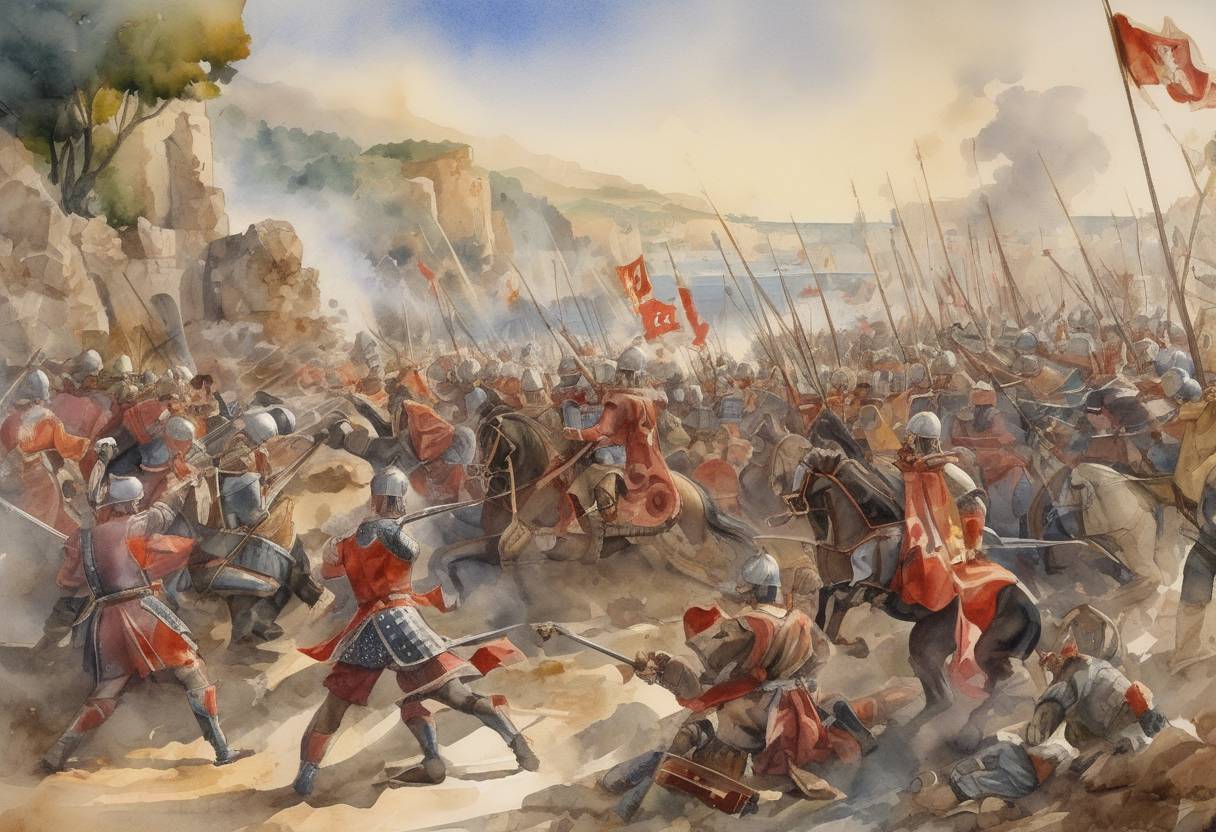
The Battle of Capo Colonna, fought on July 14, 982, was a significant military engagement between the forces of the Holy Roman Empire, led by Emperor Otto II, and the Muslim forces of the Emirate of Sicily. This battle took place near Capo Colonna, in southern Italy, and marked a pivotal moment in the struggle for control over the Italian peninsula during the late 10th century.
Holy Roman Empire’s Ambitions: Otto II, who became Holy Roman Emperor in 973, sought to expand his influence in Italy and secure the southern regions against Muslim incursions. His ambitions included consolidating power over the fragmented Italian territories and countering the growing influence of the Emirate of Sicily.
Emirate of Sicily: By the late 10th century, the Emirate of Sicily, under the Kalbid dynasty, had established itself as a formidable power in the Mediterranean. The emirate frequently engaged in raids and military campaigns on the Italian mainland, posing a significant threat to Christian territories.
Forces Involved: Otto II led a diverse coalition of forces, including German, Lombard, and Byzantine troops. The Muslim forces were commanded by Abu al-Qasim, the emir of Sicily, who had mobilized a well-organized army to confront the imperial forces.
Location: The battle occurred near Capo Colonna, a strategic coastal point in Calabria, southern Italy. This location was crucial as it provided a gateway for further incursions into the Italian mainland.
Outcome: The battle resulted in a decisive defeat for Otto II’s forces. The imperial army was overwhelmed by the well-coordinated and tactically superior Muslim forces. Otto II narrowly escaped with his life, but many of his troops, including prominent nobles, were killed or captured.
Impact on Otto II: The defeat at Capo Colonna was a severe blow to Otto II’s ambitions in Italy. It weakened his position and diminished his influence over the southern Italian territories. The loss also exposed the vulnerabilities of the Holy Roman Empire’s military capabilities in the region.
Muslim Dominance: The victory solidified the Emirate of Sicily’s control over southern Italy and demonstrated the military prowess of the Muslim forces. It allowed the emirate to continue its raids and maintain a strong presence in the Mediterranean.
Long-term Consequences: The battle underscored the complex and volatile nature of medieval Italian politics, characterized by shifting alliances and frequent conflicts. It also highlighted the ongoing struggle between Christian and Muslim powers for dominance in the Mediterranean.
In summary, the Battle of Capo Colonna was a critical event that shaped the power dynamics in southern Italy during the late 10th century. It reflected the broader geopolitical struggles of the era and had lasting implications for the Holy Roman Empire and the Emirate of Sicily.
Source: en.wikipedia.org