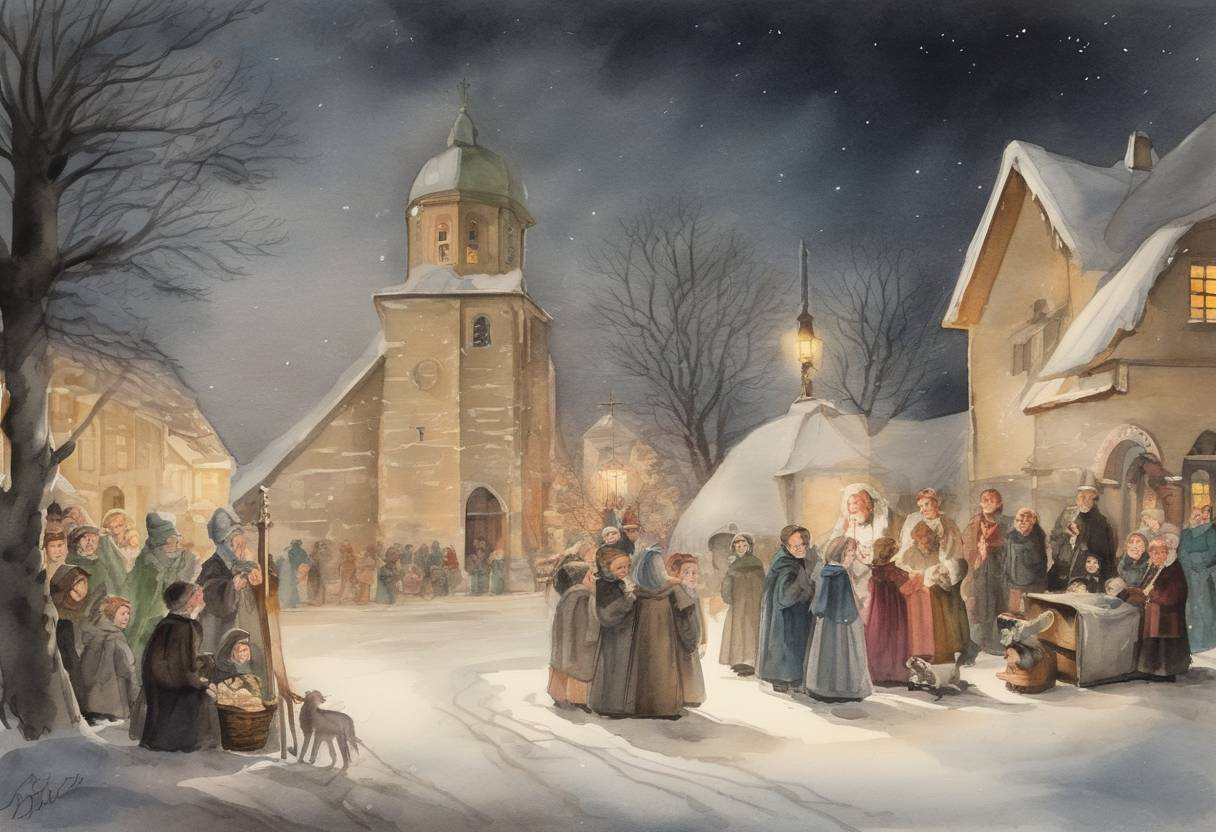
On December 25, 1818, the beloved Christmas carol “Silent Night” was performed for the first time at St. Nicholas parish church in Oberndorf, Austria. This event marked the beginning of a song that would become a staple of Christmas celebrations around the world.
Background
The origins of “Silent Night” can be traced back to the small town of Oberndorf, located near Salzburg, Austria. The carol was the result of a collaboration between two local men: Joseph Mohr, a young priest, and Franz Xaver Gruber, a schoolteacher and organist.
Joseph Mohr
Joseph Mohr was born in Salzburg in 1792. He became a priest in 1815 and was assigned to the parish of St. Nicholas in Oberndorf. Mohr was known for his compassion and dedication to his parishioners, often seeking ways to bring comfort and joy to their lives.
Franz Xaver Gruber
Franz Xaver Gruber was born in 1787 in the village of Hochburg, Austria. He worked as a schoolteacher and served as the organist at St. Nicholas Church. Gruber was a talented musician, and his skills would play a crucial role in the creation of “Silent Night.”
Creation of “Silent Night”
The story of “Silent Night” began in 1816 when Joseph Mohr wrote the poem “Stille Nacht, heilige Nacht” while stationed in Mariapfarr, Austria. Two years later, on Christmas Eve 1818, Mohr approached Gruber with the poem, asking him to compose a melody that could be performed with a guitar, as the church organ was reportedly damaged.
Gruber composed the melody in a matter of hours, and the two performed the carol together during the Christmas Eve mass. Mohr sang the tenor part and played the guitar, while Gruber sang bass. The simple yet profound performance resonated deeply with the congregation.
Significance and Legacy
The initial performance of “Silent Night” was met with great appreciation, and the carol quickly spread beyond Oberndorf. It was published in 1831 and gradually gained popularity throughout Europe. By the mid-19th century, “Silent Night” had been translated into multiple languages and was being sung in churches worldwide.
Today, “Silent Night” is one of the most recorded and performed Christmas carols, cherished for its serene melody and message of peace. It has been recognized by UNESCO as an intangible cultural heritage, underscoring its enduring impact on global culture.
The first performance of “Silent Night” in 1818 is a testament to the power of music to bring people together and inspire hope, a legacy that continues to this day.