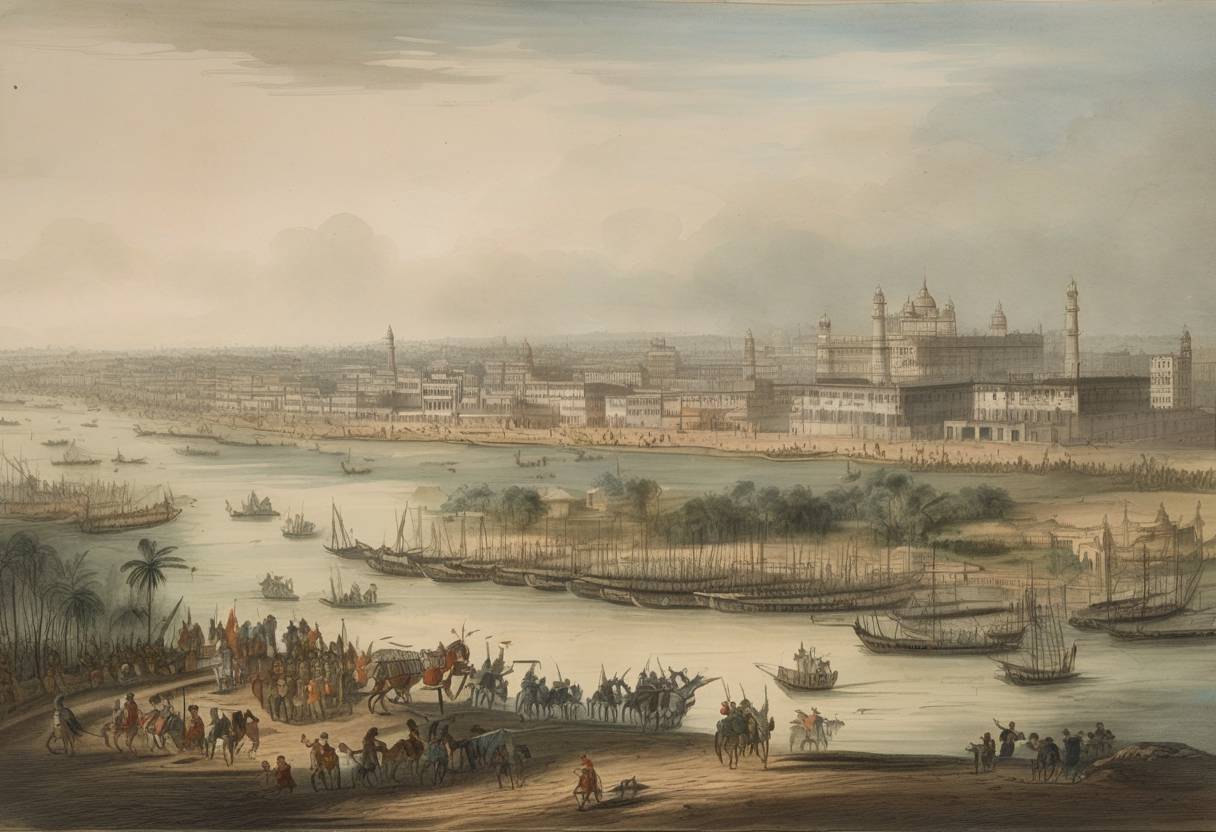
Capture of Calcutta by the British, January 2, 1757
On January 2, 1757, British forces successfully recaptured the city of Calcutta in Bengal, India, from the Nawab of Bengal. This event was a significant development in the early phases of British colonial expansion in the Indian subcontinent.
Context and Background
Calcutta, established in 1690 by Job Charnock as a trading post for the British East India Company, had grown in strategic and economic importance by the mid-18th century. The region of Bengal was one of the wealthiest in India, and control over its trade was highly prized.
In 1756, tensions rose between the Nawab of Bengal, Siraj-ud-Daulah, and the British due to the latter’s fortifications without seeking the Nawab’s permission and their overall increasing influence. The conflict culminated in the “Black Hole of Calcutta” incident in June 1756, where many British prisoners reportedly perished after being confined by Nawab’s forces following their capture of the city. This event escalated tensions further and became a rallying point for the British.
The Siege of Calcutta and Recapture
In response to the Nawab’s capture of Calcutta and the subsequent “Black Hole” tragedy, the British East India Company dispatched a force led by Robert Clive and Admiral Charles Watson to retake the city. Arriving in December 1756, the British forces laid siege to Calcutta with a force composed of British soldiers and local allies.
On January 2, 1757, after a series of naval and land-based operations, the British successfully recaptured Calcutta. The operation reinstated British control over their important trading post and marked a pivotal rekindling of hostilities that would further escalate the conflict between the British and the Nawab.
Aftermath and Historical Significance
The recapture of Calcutta was not just a military victory; it set the stage for further British military and political maneuvers in India. In the months following the recapture, Robert Clive would lead British forces in the decisive Battle of Plassey in June 1757, defeating the Nawab’s army and significantly altering the power dynamics in Bengal in favor of the British East India Company. This marked the beginning of British dominance in Bengal and ultimately, a substantial portion of the Indian subcontinent.
Calcutta’s recapture is often viewed as a pivotal moment that marked the dawn of the British Empire’s significant territorial control in India, which had far-reaching implications for the subcontinent’s political, social, and economic landscape over the following two centuries.