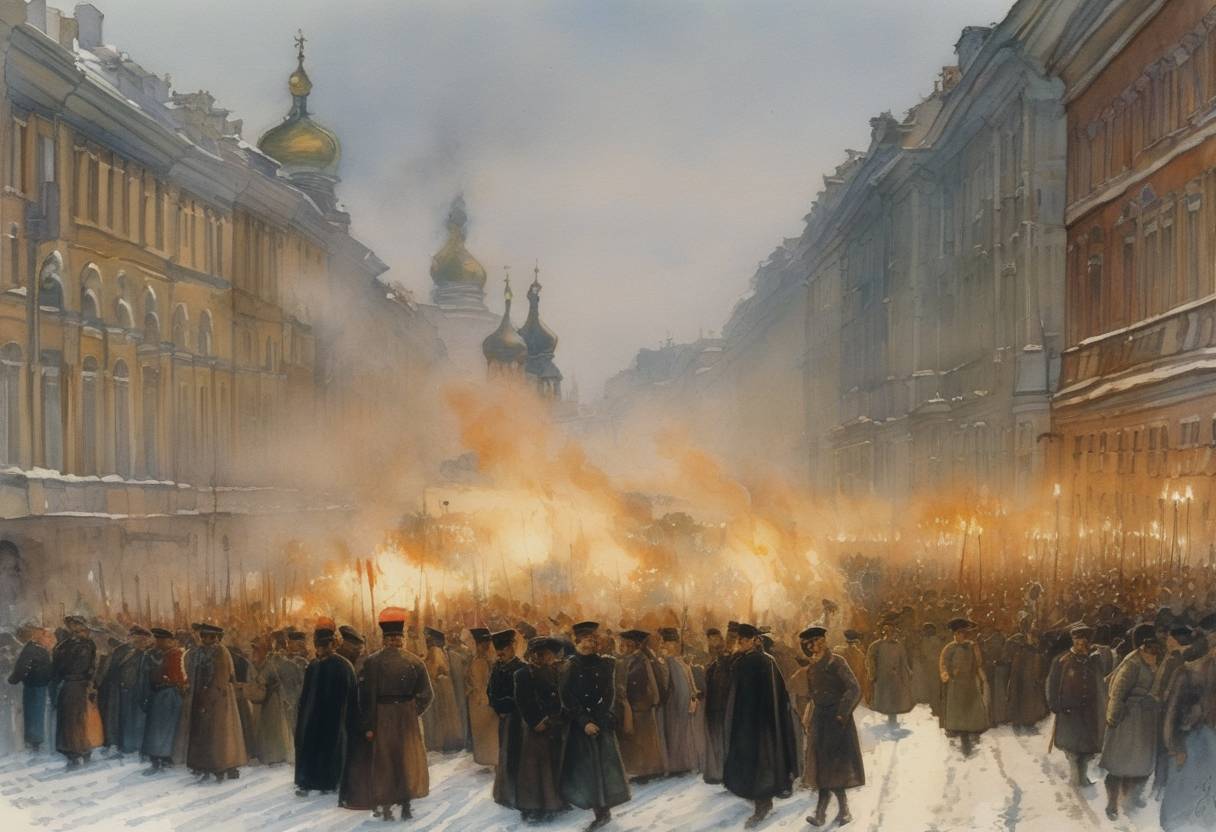
Bloody Sunday: January 22, 1905
On January 22, 1905, in St. Petersburg, Russia, a seminal event unfolded that would become a catalyst for the Russian Revolution of 1905. This day is infamously remembered as “Bloody Sunday.”
Background
In the early 20th century, Russia was an autocratic empire under the rule of Tsar Nicholas II. The country faced profound social unrest due to widespread industrialization disparities, poor working conditions, political repression, and the defeat in the Russo-Japanese War (1904-1905), which aggravated public discontent.
The Demonstration
Father Georgy Gapon, a Russian Orthodox priest and charismatic labor leader, organized workers to voice their grievances peacefully. He led a large procession of workers and their families, estimated to be around 150,000 people, toward the Winter Palace, the official residence of Tsar Nicholas II. The demonstration aimed to deliver a petition to the Tsar, detailing demands for better working conditions, fair wages, and political reforms, including the establishment of a democratically-elected assembly.
The Massacre
As the procession neared the Winter Palace, they were confronted by the Imperial Guard. Despite the peaceful nature of the protest, the guards were ordered to fire upon the unarmed crowd. Chaos ensued as volleys of gunfire echoed through the streets, resulting in the deaths of approximately 200 demonstrators, with several hundred more wounded.
Consequences and Significance
Bloody Sunday shattered the image of the Tsar as a paternal figure or “Little Father” to the Russian people. Public outrage over the massacre fueled strikes and uprisings across the empire, significantly undermining the autocracy’s legitimacy. The events prompted Tsar Nicholas II to make political concessions—most notably, the October Manifesto, which promised the formation of a State Duma (legislative assembly) and granted limited civil liberties.
The tragedy on January 22, 1905, marked a turning point in Russian history. It set the stage for widespread revolutionary activity, leading to further instability and ultimately contributing to the upheavals of the 1917 Russian Revolution. Bloody Sunday remains a potent symbol of the struggle against imperial autocracy and a pivotal moment in the emergence of modern Russian political consciousness.