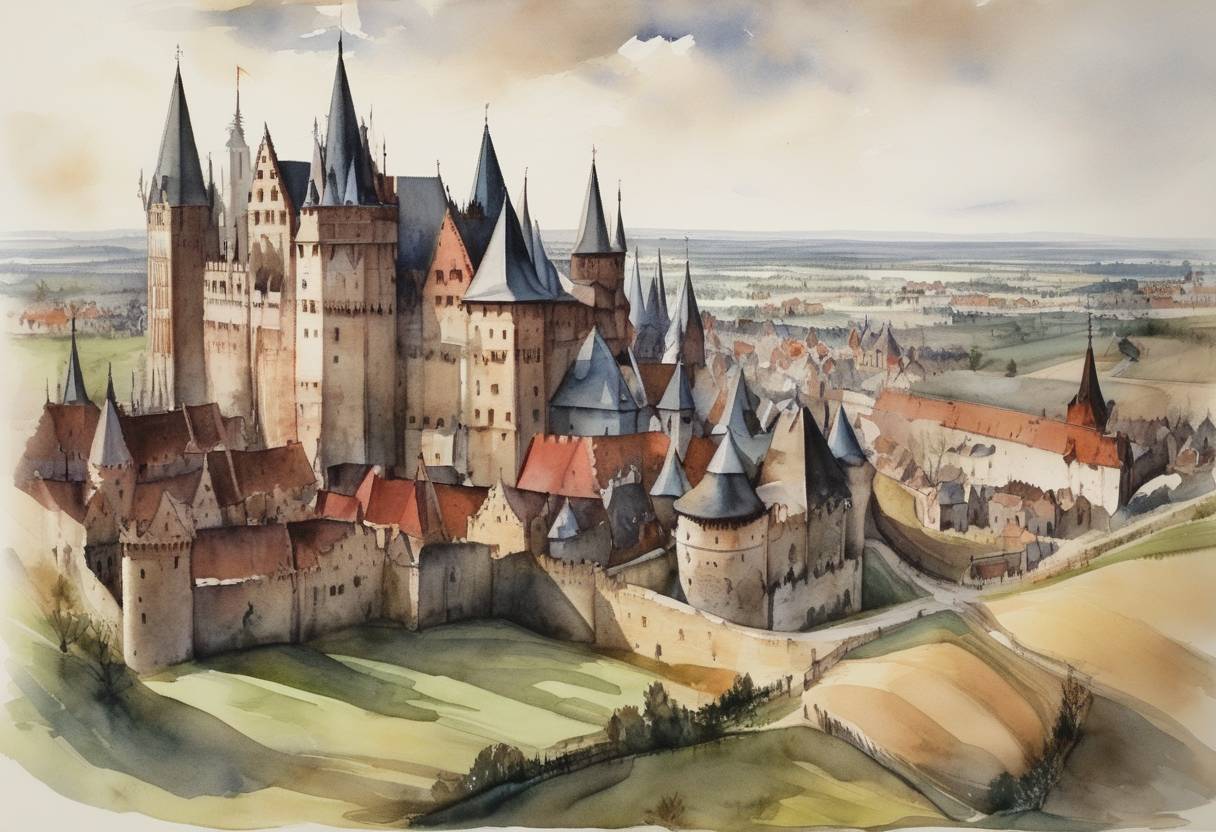
The Thirteen Years’ War: Beginning and Impact
Introduction
On February 4, 1454, a significant event set the stage for the Thirteen Years’ War between the Kingdom of Poland and the Teutonic Order—the signing of the Confederation of Prussian cities in Marienburg (now Malbork, Poland). This conflict, which lasted from 1454 to 1466, would greatly influence the political dynamics in Eastern Europe.
Background
The roots of the conflict lay in the growing dissatisfaction among the towns and nobility of the Prussian region with the rule of the Teutonic Order. The Order, a religious military group, had established a powerful state in parts of what is now Poland and the Baltic states. However, its dominance began to decline due to internal administration issues and increasing financial burdens imposed on the local populace.
In 1454, the towns of Prussia and the local gentry, seeking greater autonomy and protection of their economic interests, formed the Prussian Confederation. Notably, this confederation sought Polish support to overthrow the Order’s rule.
The Signing of the Confederation
On February 4, 1454, representatives of the confederated Prussian cities gathered in Marienburg, the Teutonic capital, to formalize their opposition to the Order. They invoked the protection of Casimir IV Jagiellon, King of Poland, effectively setting the stage for a military campaign that would see the Kingdom of Poland support the confederation against their common adversary.
The Outbreak of War
The appeal from the Prussian Confederation was met with a positive response from King Casimir IV who saw an opportunity to increase Polish influence in the region at the expense of the weakening Teutonic Order. This request led to the outbreak of the Thirteen Years’ War, with Poland officially declaring war on the Order shortly after the confederation’s appeal.
Consequences
The war ultimately resulted in significant territorial and political changes. By the end of the war in 1466, the Second Peace of Toruń was signed, which recognized Polish sovereignty over the western part of Prussia. The Teutonic Order was left with only the eastern parts, effectively reduced to a vassal state under Polish overlordship. This marked a decline in the Teutonic Order’s power and marked a shift in the balance of power in Eastern Europe, with the Kingdom of Poland emerging as a dominant force.
Conclusion
The signing of the Confederation of Prussian cities on February 4, 1454, was more than just a diplomatic maneuver; it was a catalyst for a conflict that would redefine regional power structures. The Thirteen Years’ War not only illustrated the end of an era for the Teutonic Order but also reinforced the Kingdom of Poland’s role as a significant player in the economic and political spheres of Eastern Europe.