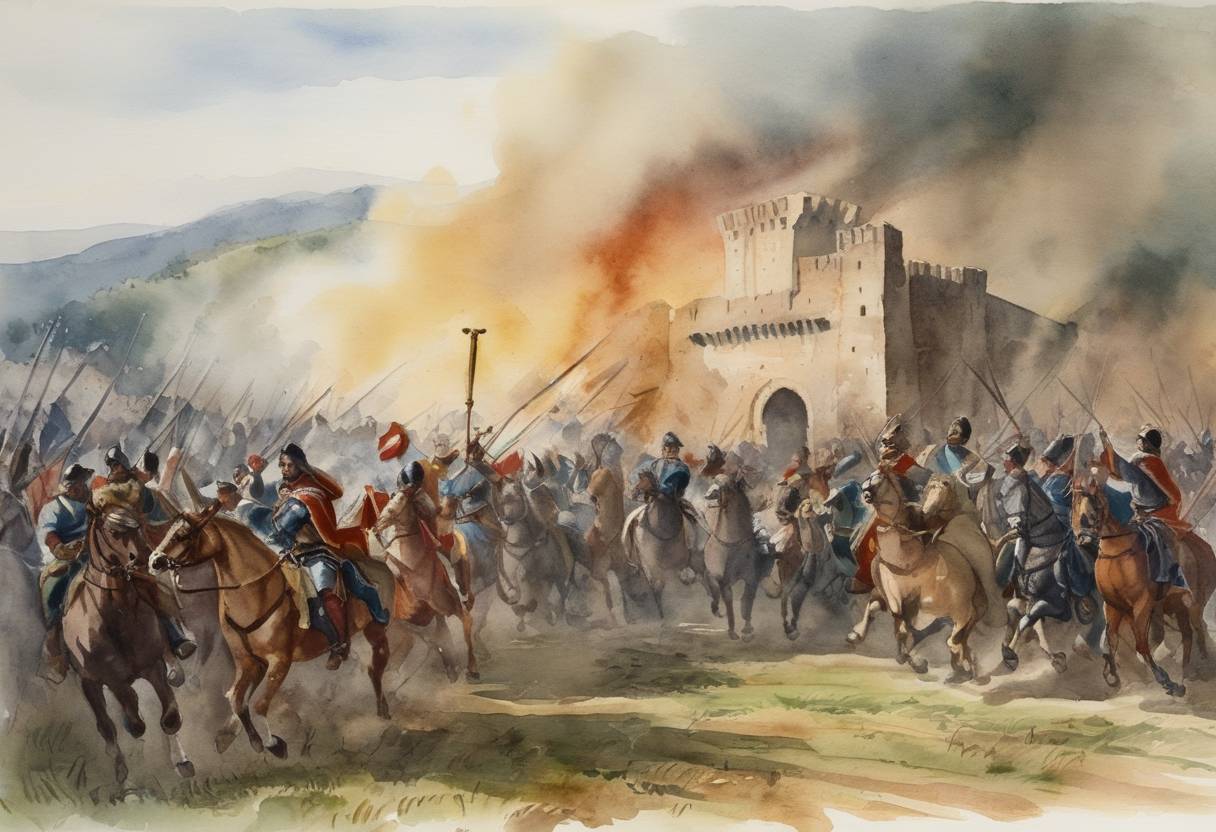
Battle of Montecatini - August 11, 1315
The Battle of Montecatini, fought on August 11, 1315, was a significant military engagement between the forces of the Republic of Pisa and the Republic of Florence, two powerful city-states during the Italian medieval period. This battle was part of the larger geopolitical conflicts that characterized the Italian peninsula during the Middle Ages, as various city-states vied for regional dominance.
Background
During this period, the Republic of Florence was a rising power, expanding its territory and influence throughout Tuscany. To counteract Florentine ambitions and preserve its own influence, Pisa allied with the Republic of Lucca and the influential condottiero (mercenary leader) Uguccione della Faggiuola. Tensions escalated as Florence sought to diminish Pisan power, culminating in open conflict.
The Battle
The battle took place near the town of Montecatini, located in what is now the Tuscany region of Italy. The Pisan forces, commanded by Uguccione della Faggiuola, were composed of a coalition including Pisans and cavalry from Lucca. The Florentines, on the other hand, were supported by their allies, which included soldiers from the Kingdom of Naples.
On the day of the battle, the Pisan army achieved a decisive victory over the Florentines. The engagement was marked by strategic maneuvering and the effective use of the cavalry by Uguccione’s forces. The Florentine troops, despite being well-equipped and numerically superior, could not withstand the onslaught and organization of their adversaries.
Aftermath
The victory at Montecatini allowed Pisa to temporarily halt Florentine expansion and secured its position in Tuscany for a time. However, the conflict did not settle the regional rivalry, as hostilities continued intermittently in the following years. Uguccione della Faggiuola gained prestige for his tactical leadership, although his triumphs would eventually lead to internal conflicts within Pisa and his own eventual downfall.
The Battle of Montecatini is remembered as an example of the competitive and often violent nature of Italian city-state politics during the Middle Ages. It highlights how alliances and military prowess were pivotal in shaping the balance of power within the region, influencing Italian history in the subsequent centuries.