The Battle of Neville's Cross: October 17, 1346
1346 · Durham, England
The Battle of Neville's Cross took place, where English forces defeated the Scots, capturing King David II of Scotland.
August 5, 1388
The Battle of Otterburn was fought between the Kingdoms of Scotland and England. This was one of the border skirmishes associated with the Wars of Scottish Independence. The Scottish army, led by James, Earl of Douglas, secured a victory against the English forces.
Otterburn, England | Kingdom of Scotland
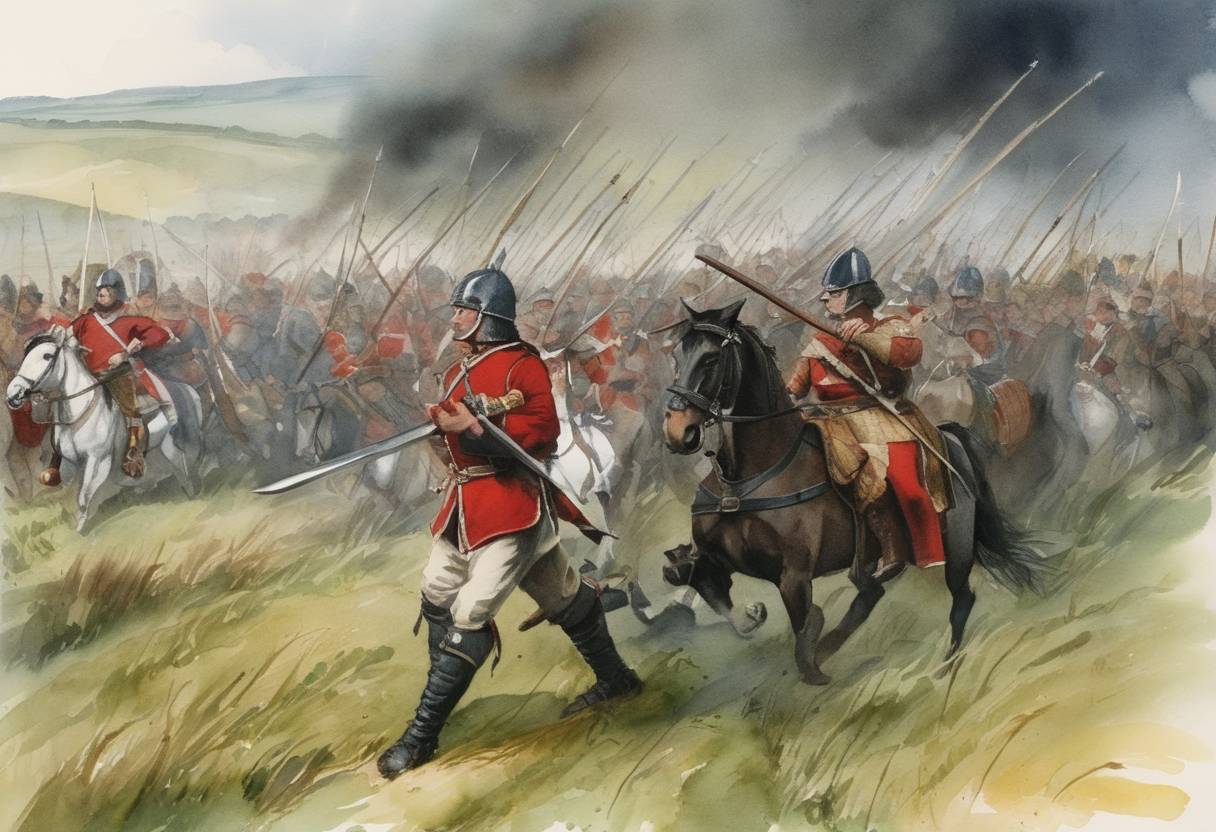
The Battle of Otterburn occurred as part of the ongoing hostilities of the Wars of Scottish Independence. It was a notable confrontation between the Kingdoms of Scotland and England, reflecting the persistent border conflicts of the era.
The late 14th century was a period marked by territorial disputes and power struggles between England and Scotland. Following the end of the formal War of Scottish Independence, intermittent skirmishes and raids continued to occur, primarily along the Anglo-Scottish border. The Scottish leadership often mounted these incursions into English territory to exert pressure and claim plunder, fuelling ongoing tensions between the two kingdoms.
In the summer of 1388, the Scots planned a large-scale raid into Northern England, intending to draw English forces away from supporting exploits elsewhere. The Scottish army, divided into two groups, sought to conduct raids in different English regions. The division led by James, Earl of Douglas, advanced towards the town of Newcastle, with Otterburn becoming their focal point en route back to Scotland.
Taking place on the night of August 5, 1388, the Battle of Otterburn unfolded with the Scottish force strategically engaging the English troops led by Henry Percy, known as “Hotspur,” and his brother Ralph Percy. The smaller Scottish contingent utilized night attack tactics, exploiting the element of surprise and the challenging terrain, which limited the ability of the English cavalry to maneuver effectively.
Despite being heavily outnumbered, James Douglas’s forces achieved a decisive victory. The battle resulted in the capture of Hotspur and significant English casualties. James, Earl of Douglas, was mortally wounded during the conflict, adding a layer of poignancy to the Scottish triumph.
The outcome of the Battle of Otterburn bolstered Scottish morale and demonstrated their ability to challenge English military might despite numerical inferiority. It further contributed to the legend and legacy of figures like the Douglas family and Henry Percy in the cultural and historical narratives of the region.
The victory did not substantially alter the territorial status quo, yet it reinforced the capacity of the Scots to conduct successful military campaigns deep within English territory. This battle remains an illustrative example of medieval warfare and the contested and volatile nature of the Anglo-Scottish borderlands during the period.
Source: en.wikipedia.org